
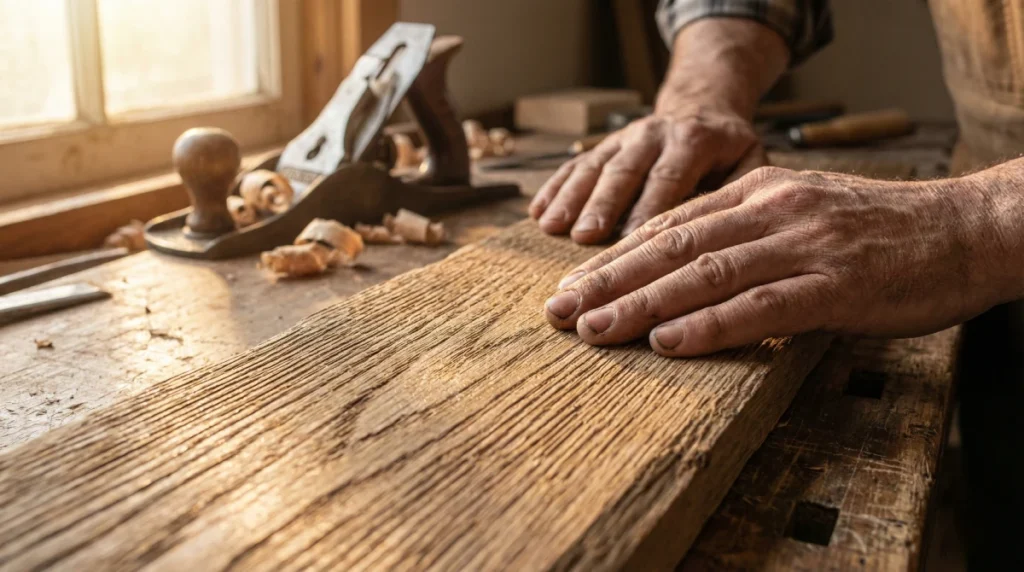
If there is one thing I’ve learned after twenty years of covering my shop floor in sawdust, it’s that woodworking is a sensory trade. Sure, we obsess over how a piece looks-the joinery, the lines, the color. But the first thing a client does when they walk up to a custom dining table or a new set of cabinets? They reach out and touch it.
That split second-where their hand meets the surface-is where wood texture makes or breaks the project.
To a novice, wood is just “smooth” or “rough.” But to us, texture is a language. It’s the difference between the glass-like surface of a French-polished mahogany and the rugged, tactile grip of a wire-brushed oak floor. Understanding wood texture isn’t just about sanding; it’s about knowing the biology of the tree, choosing the right species, and knowing how to manipulate that surface to tell a story.
In this guide, I’m going to break down everything you need to know about wood texture, from the biological structure of grain to the techniques I use on the jobsite to enhance it.
The Biology of Texture: Open Grain vs. Closed Grain
Before we pick up a sander, we have to understand what we are cutting into. Wood texture is dictated primarily by the size and distribution of the wood’s pores (vessels). In the trade, we categorize this into three main buckets: Coarse (Open Grain), Fine (Closed Grain), and Medium.
1. Coarse Texture (Open Grain)
Think of Red Oak, Ash, or Walnut. If you look closely at a board of Red Oak, you can actually see the pores with your naked eye. They look like tiny pinholes or dashed lines running with the grain.
- The Feel: Even after sanding to 220 grit, you can feel the topography. The summer growth rings are hard, and the spring growth rings are porous.
- The Pro Take: I love open-grain woods for flooring and rustic furniture. They take stain incredibly well because those pores soak up the pigment, creating a high-contrast look. However, if you want a mirror finish on open-grain wood, you have to work for it. You’ll need a grain filler (paste wood filler) to level out those valleys before you topcoat.
2. Fine Texture (Closed Grain)
This is your Maple, Cherry, and Birch. The pores are so small you practically need a microscope to see them.
- The Feel: These woods sand to a marble-like smoothness. They feel dense and uniform.
- The Pro Take: I use closed-grain woods for cutting boards, kitchen utensils, and painted cabinetry. Because there are no deep pores to trap bacteria or paint, they finish out incredibly smooth. However, be careful with staining-since there are no deep pores to hold the pigment, blotchiness is a common headache if you don’t use a pre-stain conditioner.
3. Medium Texture
Woods like Poplar or Soft Maple fall somewhere in the middle. They are generally easy to work with and provide a balanced surface that isn’t too thirsty for finish but doesn’t require a ton of prep to get smooth.
Natural Textures: Figuring and Chatoyancy
Sometimes, texture is purely visual-a trick of the light caused by the way the tree grew. We call this figuring. While the wood might feel smooth to the touch, it looks like it has deep ripples or waves.
Curly and Tiger Grain
This happens when the fibers of the tree grow in a wavy pattern rather than straight up and down. When you plane this wood, you’re cutting through the waves, exposing end grain and face grain in alternating strips.
- The Challenge: This is a nightmare to hand plane. If you run a standard bench plane over curly maple, you’ll likely get “tear-out” (where the wood fibers rip rather than shave).
- The Fix: I keep a low-angle jack plane with a freshly sharpened blade specifically for figured wood. The lower angle slices the fibers cleanly without lifting them.
Chatoyancy ( The “Cat’s Eye” Effect)
This is the holy grail of wood finishing. It’s that 3D shimmering effect you see in high-end Walnut or Koa. It’s technically a visual texture, but it gives the wood depth. You achieve this not by carving, but by sanding to a very high grit (up to 400 or 600) and using penetrating oils like Tung Oil or Boiled Linseed Oil, which soak into the fibers and reflect light from within.
Manipulating Texture: Techniques for the Shop
Now, let’s talk about changing the actual feel of the wood. As modern woodworkers, we often want to add character to new lumber to make it feel established or to hide wear and tear in high-traffic areas. Here are the techniques I use most often.
1. Wire Brushing
Wire brushing is massive in the flooring and cabinetry industry right now. The concept is simple: you use a stiff wire brush to rip out the soft “spring wood” fibers, leaving the hard “summer wood” ridges behind.
- Tools: You can use a hand wire brush (for small drift wood projects), but for furniture, I use a Restorer tool or a wire wheel on an angle grinder.
- Best Woods: This only works well on ring-porous (open grain) woods like Oak, Ash, or Chestnut. If you try to wire brush Maple, you’ll just scratch it.
- Why do it? It creates a durable surface. By removing the soft wood, you leave the hardest parts of the timber exposed. It also hides scratches famously well.
2. Hand Scraped / Hewn
Before sandpaper existed, woodworkers smoothed timber with scrapers. This left subtle undulations and ripples in the surface. Today, we recreate this intentionally to give furniture an “antique” feel.
- Technique: I use a card scraper or a dedicated scraper plane. Instead of trying to get the board perfectly flat, I vary my pressure to create slight dips.
- The Result: When light hits a hand-scraped table, it doesn’t reflect flat like a mirror; it dances over the ridges. It begs to be touched.
3. Band Saw Marks (Rough Sawn)
“Rough sawn” is a texture that mimics the look of timber straight off the mill. We usually see this in rustic beams or farmhouse tables.
- How to Fake It: If I have clean lumber but want that rough look, I’ll run the board through my bandsaw and intentionally push it through a bit fast or wiggle it slightly. The blade leaves perpendicular scratch marks across the grain. Lightly sand these with 120 grit to remove splinters, but leave the deep scratches for character.
4. Shou Sugi Ban (Yakisugi)
This is an ancient Japanese technique of preserving wood by charring it with fire.
- The Process: I use a propane weed torch to burn the surface of Cedar or Cypress until it’s black and “alligator-skinned.”
- Refining the Texture: After burning, you can leave it widely cracked and charred (very rough), or wire brush the char away. Brushing off the soot leaves a raised grain texture that is incredibly pronounced and distinctively beautiful.
Refining the Feel: Sanding and “Water Popping”
Sanding is usually about removing texture, but how you sand determines the final tactile experience.
The Grit Progression
- 80-100 Grit: Levels the wood. Leaves visible scratches.
- 120-150 Grit: Removes leveling scratches. This is usually where I stop for flooring or decks where I need traction/grip.
- 180-220 Grit: The standard for furniture. It feels smooth to the hand but leaves the pores open enough to accept stain.
- 320+ Grit: This is for polishing. Be careful here-if you sand too fine on a wood you plan to stain, you can “burnish” the wood (seal the pores), preventing the stain from penetrating.
Water Popping (Grain Raising)
Have you ever sanded a piece perfectly smooth, applied a water-based finish, and then felt it dry rough like sandpaper? That’s “grain raising.” The wood fibers, which you pressed down during sanding, swell up when they get wet.
- Using it to your advantage: On projects where I want a deep, rich stain color, I intentionally “water pop” the grain. I wipe the sanded wood with a damp rag, let the fibers stand up, and let it dry. This opens the texture of the wood back up, allowing it to soak up twice as much stain.
Finish Selection: How Topcoats Affect Texture
You can have the most beautifully textured wood, but if you bury it under a thick layer of epoxy or polyurethane, you lose that connection. Your choice of finish changes the haptics (the feel) of the piece.
Film Finishes (Polyurethane, Varnish, Lacquer)
These sit on top of the wood.
- High Gloss/Thick Build: These fill in the texture. A thick pour of epoxy on a slab table removes all wood texture, replacing it with a plastic feel. This is great for protection, but cold to the touch.
- Satin/Matte: These reflect less light, making the wood look more natural, but they still create a barrier between your hand and the timber.
Penetrating Finishes (Oils and Waxes)
These are my personal favorites for texture.
- Tung Oil / Linseed Oil / Hardwax Oils: These soak into the wood fibers and harden. They do not form a plastic film on top.
- The Result: When you touch an oil-finished table, you are touching the actual wood. You can feel the grain. It feels warmer and more organic. For a piece meant to be touched (like a handrail or chair arm), a hardwax oil is unbeatable.
Matching Texture to Function
As a builder, my job is to match the texture to the application. Here are my rules of thumb:
- Dining Tables: Smooth is generally better. Crumbs get stuck in deep wire-brushed grain. If I do use Oak, I fill the grain or keep the texture very subtle.
- Flooring: Texture is king. A smooth, high-gloss floor shows every dog scratch and dent. A wire-brushed, matte-finished floor hides twenty years of abuse.
- Outdoor Furniture: Avoid rough textures where water can pool. Smooth (but not slippery) surfaces shed water better and rot slower.
- Tool Handles: Never varnish a hammer handle. I sand my handles to 150 and apply boiled linseed oil. Varnish causes blisters; oiled wood provides grip and absorbs sweat.
FAQ: Frequently Asked Questions About Wood Texture
1. Why does my wood feel rough after I apply the first coat of finish?
This is called “grain raising.” When water-based finishes (or even some stains) touch the wood, the cut fibers swell and stand up. To fix this, lightly sand the surface with high-grit sandpaper (320 or 400 grit) or a synthetic finishing pad between coats to knock down the fuzzy fibers.
2. Can I wire brush pine or softwoods?
You can, but proceed with caution. Because pine is so soft, a wire brush can quickly gouge it out aggressively, leading to a shredded look rather than a textured grain. If you want to texture softwoods, use a nylon abrasive wheel brush instead of a metal wire brush for a softer, more controlled erosion.
3. How do I get a smooth finish on open-grain wood like Oak?
If you want a glass-smooth finish on Oak or Ash, you need to use a grain filler (also called pore filler). After your initial sanding (and staining, if applicable), apply the paste filler across the grain to pack the pores. Scrape off the excess, let it dry, and then sand it back. This levels the “valleys” of the pores with the “peaks” of the surface.
4. What is the best finish to keep the natural feel of the wood?
Hardwax oils (like Rubio Monocoat or Osmo) are the industry leaders for this. They bond molecularly with the wood fibers rather than forming a plastic film on top. This leaves the wood feeling like wood, not plastic, while still offering excellent water and stain resistance.
5. Does sanding to a higher grit always make the wood look better?
Not always. If you are staining the wood, sanding too high (above 220 grit) can polish the surface so much that the stain cannot penetrate, leading to a light or washed-out color. If you are applying a clear oil finish, however, sanding higher (up to 400 or 600) can enhance the chatoyancy and sheen.
Conclusion
Wood texture is the soul of the project. It turns a sterile object into something organic and inviting. Whether you are aiming for the rustic, time-worn look of a barn beam or the impossible smoothness of a shaker cabinet, the key is intentionality.
Don’t let the texture happen to you-make it happen. Choose your species wisely, sand with a plan, and pick a finish that honors the tactile nature of the material. Next time you are in the shop, close your eyes and run your hand over your work. If it feels as good as it looks, you’re done.
Would you like me to help you troubleshoot a specific finishing issue you are having with a current project?