
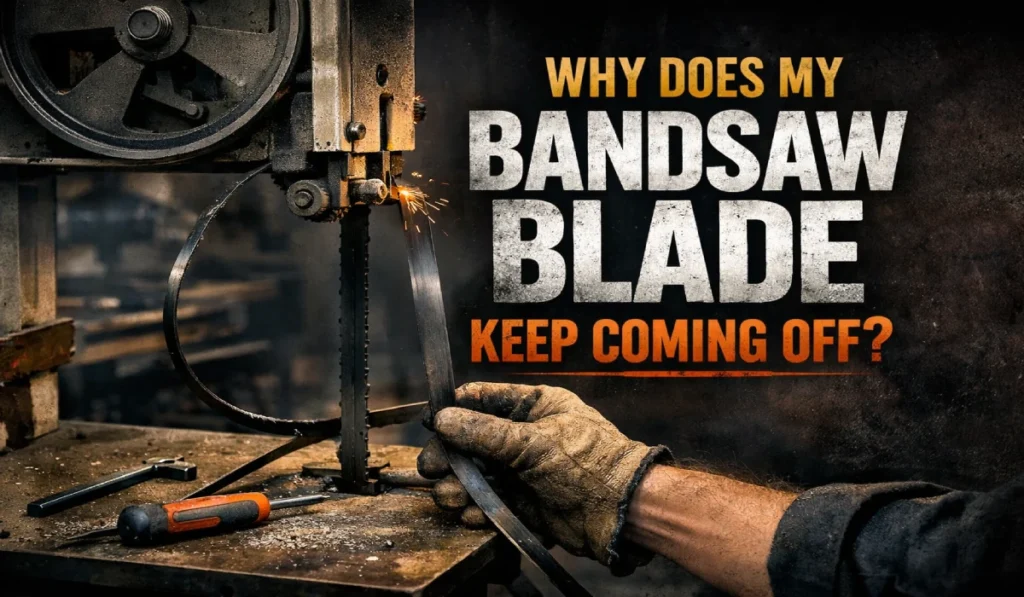
There isn’t a sound in the shop more terrifying than the BANG-whoosh-clatter of a bandsaw blade jumping off the wheels in the middle of a cut. It stops your heart, ruins your workpiece, and can damage your machine (or worse, your fingers).
If you are reading this, you are probably standing in front of your saw, staring at a tangled blade, wondering, “Why does this keep happening?”
I’ve been there. Whether I was resawing 10-inch walnut veneers or just cutting curves for a template, I’ve dealt with every tracking issue in the book. The good news is that a blade throwing itself off the tire is rarely a sign of a broken saw. It’s almost always a setup issue.
In this guide, we are going to walk through exactly why your bandsaw blade keeps coming off, starting with the simple fixes and moving to the more complex alignments. Let’s get that saw tuned up so you can get back to making sawdust.
The Anatomy of a Slip: How Tracking Works
Before we start turning knobs, you need to understand why the blade stays on in the first place. Your bandsaw wheels (usually) have a slight hump in the middle of the rubber tire, known as the crown.
Physics does something interesting here: a flat belt (your blade) on a crowned pulley (your wheel) naturally wants to climb to the highest point. That means if everything is aligned, the blade self-centers on the crown. When the blade pops off, it means some force-either lack of tension, bad alignment, or physical obstruction-overpowered that natural tendency to center itself.
Here are the primary culprits.
Reason 1: Insufficient Blade Tension (The #1 Cause)
In my experience, 80% of the time a blade jumps off, it is because it’s too loose. When a blade doesn’t have enough tension, it becomes “floppy” under the load of the cut. As you push wood into it, the blade deflects backward and twists. Once it twists enough, it catches the edge of the tire and-pop-it’s gone.
The Problem with Built-in Gauges
Most bandsaws come with a tension scale on the back of the upper wheel housing. It usually has markings for 1/4″, 1/2″, 3/4″, etc.
Ignore it.
Those springs wear out over time. A “1/2-inch” setting on a 10-year-old saw might barely be enough tension for a 1/4-inch blade. If you rely solely on that gauge, you are likely undertensioning your blade.
How to Set Tension Correctly
You don’t need an expensive tension gauge. Use your hand and your eyes.
- The Deflection Method: Raise the upper guide post all the way up. Push sideways on the blade with your index finger using moderate pressure (don’t break your finger, just a firm poke). The blade should not deflect more than 1/4 inch to 3/8 inch. If it moves an inch, it’s way too loose.
- The Flutter Test (My Favorite):
- Turn the saw on (safely, with guides backed off).
- Slowly lower the tension until the blade starts to vibrate or “flutter” visually side-to-side.
- Slowly increase tension until the flutter stops and the blade runs true.
- Give the tension wheel another quarter to half-turn for good measure.
Pro Tip: Wider blades (like a 3/4″ resaw blade) need significantly more tension than a 1/8″ scrolling blade. Don’t be afraid to crank it down, provided your saw frame can handle it.
Reason 2: Improper Tracking Adjustment
If tension is the muscle, tracking is the steering wheel. The tracking knob on the back of your upper wheel housing tilts the upper wheel forward or backward.
If the wheel tilts too far forward, the blade runs off the front. Too far back, it runs off the rear.
Where Should the Blade Ride?
This is a subject of debate among woodworkers, but here is the jobsite reality:
- For Crowned Tires (Most 14″ Saws): The blade should be centered on the tire. The deepest part of the gullet (the valley between teeth) should be near the center of the tire crown.
- For Flat Tires (Large European Saws): The teeth usually need to hang slightly off the front edge of the tire so they don’t chew up the rubber.
The “Spin Test” Procedure
Never adjust tracking with the saw running unless you are extremely experienced.
- Unplug the saw.
- Open the wheel covers.
- Spin the upper wheel by hand.
- Watch the blade. If it drifts forward, adjust the tracking knob to tilt the wheel back.
- Lock the tracking knob once the blade stays steady in the center of the tire after several rotations.
Reason 3: Worn or Dirty Tires
The rubber or urethane tires on your wheels are the only thing gripping the blade. If they are in bad shape, the blade has nothing to hold onto.
The “Crusty” Tire
If you cut a lot of pine or pitchy woods, sawdust and resin get compressed onto the tires. This creates bumps. A bump on the tire acts like a ramp, launching your blade off the wheel every time it rotates.
- The Fix: Take a stiff brush or a plastic scraper (not metal!) and clean the tires while spinning the wheel by hand.
The “Flat” Tire
Over years of tension, the crown on the tire can flatten out. Without that crown, the blade loses its self-centering physics.
- The Fix: If the tire looks flat or has deep grooves cut into it from previous blade slips, replace them. Urethane tires are a great upgrade over standard rubber-they don’t need glue and last longer.
Reason 4: Blade Guide Interference
Your blade guides (thrust bearings and side guides) are there to support the blade during the cut, not to direct the blade while it’s idling.
If your guides are set too tight or are misaligned, they can force the blade out of its natural track.
Diagnosing Guide Issues
- Back off everything. When setting up a bandsaw, I always retract the thrust bearings and side guides completely away from the blade.
- Track the blade first. Get the blade running true on the wheels with proper tension.
- Set the guides last.
- Thrust Bearing: Should sit about 1/16″ behind the blade when idling. It should only touch when you push wood into the saw.
- Side Guides: Should be close but not touching. A good trick is to wrap a piece of paper around the blade, push the guides against the paper, tighten them, and remove the paper. This leaves a perfect clearance gap.
If your side guides are pushing the blade to the left, but the tracking wants the blade to go right, the blade will eventually snap violently off the wheels.
Reason 5: Coplanarity (Wheel Alignment)
This sounds technical, but it’s simple: Are your top and bottom wheels in the same plane? If the bottom wheel is to the left and the top wheel is to the right, the blade is running diagonally. Eventually, it will pop off.
How to Check Coplanarity
You need a long straightedge (a 4-foot level works well).
- Remove the table (or work around it if you can).
- Place the straightedge vertically across the wheels.
- Ideally, the straightedge should touch four points: the top and bottom of the upper wheel, and the top and bottom of the lower wheel.
Note: On many modern saws, wheels are not perfectly coplanar by design (especially if the tracking relies on tilting the top wheel). However, if they are wildly off-by more than 1/8 inch-you may need to adjust the lower wheel hub with shims to bring it in line with the top wheel.
Reason 6: Damaged or Poorly Welded Blades
Sometimes, it’s not the saw. It’s the blade.
The Bad Weld
Run the saw and watch the blade from the side (safely). Does it “tick” or jump forward every time the weld passes? If the weld is misaligned (kinked), it acts like a speed bump. Every time that kink hits the guides or the tire, it destabilizes the blade.
The Dull Blade
A dull blade requires you to push harder to make the cut. Pushing harder increases backward deflection. Increased deflection makes the blade unstable. If you are having to heave your body weight into a piece of oak to get it to cut, stop. You are stressing the mechanics of the saw, and the blade will eventually surrender and jump off.
Reason 7: Feed Rate and User Error
We have to talk about how you are using the tool. Bandsaws are not bulldozers. They cut by removing material with thousands of tiny teeth.
If you force the wood into the blade faster than the teeth can clear the sawdust, the gullets pack full. A packed blade cannot cut. It will wander, twist, and eventually jump off the wheels to escape the pressure.
The Golden Rule: Listen to the saw. If the motor creates a low bogging groaning sound, you are pushing too hard. Ease up. Let the tool do the work.
Step-by-Step Troubleshooting Checklist
If your blade just popped off, don’t just put it back on and hope for the best. Follow this order of operations to ensure it stays on:
- Inspect the Blade: Is it kinked? Is the weld smooth? If it’s bent, trash it.
- Clean the Tires: Remove any sawdust buildup.
- Release Tension: Mount the blade loosely.
- Reset Guides: Back all guides away from the blade.
- Tension Up: Apply tension using the flutter method or deflection test.
- Hand Track: Spin the wheel by hand and adjust the tracking knob until centered.
- Lock Tracking: Tighten the lock nut on the tracking knob.
- Set Guides: Bring your thrust bearings and side guides back into position.
- Test Run: Turn the saw on for 5 seconds, then off. Check tracking again.
Conclusion: It’s All About the Setup
A bandsaw is one of the most versatile tools in the shop, but it’s also the most finicky regarding setup. If your bandsaw blade keeps coming off, take a deep breath. It’s almost never a catastrophic failure. It is simply the machine telling you that the relationship between tension, tracking, and alignment is out of balance.
Take the time to go through the steps above. Once you get that sweet spot-where the blade hums quietly in the center of the tire-you’ll find that your cuts are straighter, your surfaces are smoother, and your shop is a whole lot quieter.
Now, go tune that saw and make something great.
Frequently Asked Questions (FAQ)
1. How tight should a bandsaw blade really be?
A bandsaw blade needs to be tighter than most beginners think. For a standard 14-inch saw with a 1/2-inch blade, you want the blade to deflect no more than 1/4 inch when you press firmly on the side of the blade. If you use the “flutter test,” tighten the blade until the vibration stops, then add one more quarter-turn of tension.
2. Can a dull blade cause it to slip off the wheels?
Yes, absolutely. A dull blade forces you to push the wood harder against it. This pressure pushes the blade backward against the thrust bearing and can cause the blade to twist sideways. Once the blade twists, it loses its grip on the tire crown and will jump off.
3. Why does my blade come off only when I back out of a cut?
Backing out of a cut is a prime time for blade slippage. If the wood pinches the blade or if you pull slightly sideways, you can pull the blade off the wheels. Always pull the wood straight back, or better yet, turn the saw off and wedge the kerf open before removing the blade.
4. Should the blade teeth ride on the tire or off the edge?
This depends on your tires. If your tires have a “crown” (a hump in the middle, common on 14″ saws), the blade should be centered, meaning the teeth will touch the tire. If you have flat tires (common on larger industrial saws), the teeth should hang slightly off the front edge to prevent them from damaging the rubber.
5. How often should I replace my bandsaw tires?
There is no set time, but you should inspect them every time you change a blade. Look for dried-out cracks, missing chunks of rubber, or flat spots where the crown used to be. If the tires feel hard and brittle like plastic rather than grippy like rubber, it’s time to upgrade to urethane tires.