
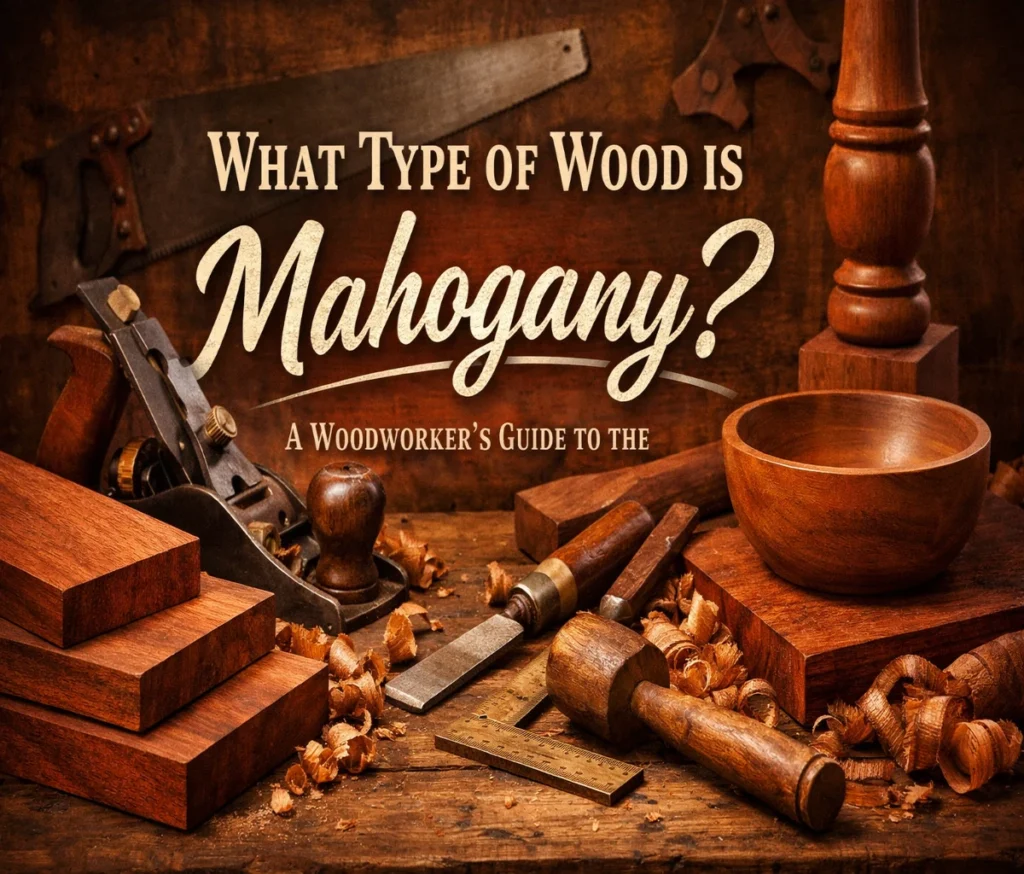
If you have spent any time in a lumber yard or pushing stock through a table saw, you know that the word “Mahogany” carries a certain weight. It is the gold standard. It is the wood that defined centuries of fine furniture, from Chippendale to the sleek mid-century modern pieces we still replicate today.
But walk into a big box store or even a specialty hardwood dealer, and things get murky. You’ll see labels like “Philippine Mahogany,” “African Mahogany,” “Santos Mahogany,” and “Genuine Mahogany.” They all look reddish-brown, but they are absolutely not the same thing.
As a woodworker who has built everything from exterior doors to heirloom cabinets, I’ve had my hands on all of them. I’ve smelled the distinct pepper-spice scent of the real stuff and fought the tear-out on the imposters.
In this deep dive, we are going to answer the question: What type of wood is mahogany? We will cut through the marketing fluff, look at the botany, discuss workability, and explain why this wood remains the king of the shop.
The Big Confusion: Genuine vs. The Imposters
To understand what mahogany is, you first have to understand what it isn’t. The term “Mahogany” has become a catch-all marketing term for almost any imported wood that is reddish-brown and reasonably hard.
However, in the strict botanical sense, true mahogany comes from the genus Swietenia. If it isn’t Swietenia, it isn’t “Genuine Mahogany.”
1. Genuine Mahogany (Swietenia macrophylla)
This is the real deal. In the U.S. trade, we usually call this Honduran Mahogany, Big Leaf Mahogany, or American Mahogany. It grows in Central and South America.
- The Look: It starts as a pinkish-brown color when freshly cut and oxidizes over time to a deep, rich, rusty red-brown. It has a golden luster that is hard to fake.
- The Status: This is the wood by which all others are measured. It is incredibly stable, rot-resistant, and works like butter (more on that later).
- Availability: Due to overharvesting, it is CITES regulated. You can still buy it in the States, but it is expensive and should always be sourced from certified plantations.
2. Cuban Mahogany (Swietenia mahagoni)
This is the “original” mahogany. If you see an 18th-century antique, it’s likely made of this. It is harder, darker, and heavier than Honduran Mahogany.
- The Status: Commercially, it is extinct. You cannot go to the lumber yard and buy boards of Cuban Mahogany. It is currently illegal to export from its native ranges. The only way we get it now is through reclaiming old furniture or very rare, small-batch salvage operations in Florida (from storm-downed trees).
3. African Mahogany (Khaya species)
This is what you will mostly find in lumber yards today labeled as “Mahogany.” It is not a Swietenia, but it is a distant cousin in the Meliaceae family.
- The Difference: It looks very similar to genuine mahogany, perhaps a bit more pink or purple in hue. It is generally cheaper than Honduran.
- The Catch: While it looks the part, it is harder to work with. The grain is often interlocked (growing in alternating directions), which causes fuzzy surfaces and tear-out when you run it over a jointer.
4. “Philippine Mahogany” (Luan/Meranti)
Let’s be clear: This is not mahogany. It is not even related. It is a mix of various Shorea species from Southeast Asia.
- The Reality: It is cheap, soft, stringy, and has no rot resistance. If you buy a cheap door skin or thin plywood underlayment, this is what you are getting. It has the color, but none of the properties that make mahogany great.
Characteristics: Why We Love It (and Hate It)
When we ask “what type of wood is mahogany,” we are really asking about its physical properties. Why do we pay $10 to $15 (or more) per board foot for this stuff?
1. Stability is King
The number one reason woodworkers and joiners worship Genuine Mahogany is stability. Wood moves; it expands in summer humidity and shrinks in winter dryness. Mahogany, however, moves very little. Once you mill a piece of Honduran Mahogany flat and square, it tends to stay that way. This makes it the premier wood for rail-and-stile doors, window sashes, and intricate joinery where a warped board means a failed project.
2. The Janka Hardness
Mahogany is a hardwood, but it isn’t “rock hard” like Hard Maple or Hickory.
- Genuine Mahogany: roughly 900 lbf on the Janka scale. This is the “sweet spot.” It is hard enough to resist dents but soft enough to cut easily.
- African Mahogany: roughly 1,070 lbf. Slightly harder, but also more brittle.
- Santos Mahogany: roughly 2,200 lbf. This is flooring material. It is incredibly hard and will dull your blades instantly.
3. Chatoyancy (The Shimmer)
This is a fancy word for “cat’s eye” effect. When you plane or sand a piece of quarter-sawn mahogany, the grain has a natural luster that looks like it is moving under the light. It reflects light from deep within the wood fibers. This depth is why mahogany furniture never looks “flat” or painted; it looks three-dimensional.
Workability: The Shop Experience
I want to talk about what it feels like to actually build with this wood. If you are used to working with Red Oak or Pine, switching to Mahogany is a revelation.
Machining and Cutting
Genuine Honduran Mahogany is arguably the best working wood on the planet. I don’t say that lightly. When you rip it on the table saw, it smells spicy and earthy. It doesn’t burn easily (like Cherry or Maple). You can cut crisp joinery—dovetails, tenons, box joints—and the edges hold perfectly without crumbling.
The African Mahogany Warning: If you are working with the African variety (Khaya), you need to be careful at the jointer and planer. Because the grain interlocks (spirals up the tree), one pass usually tears out chunks of grain.
- Pro Tip: If you are planing African Mahogany, take very light passes. If possible, use a drum sander for the final thicknessing rather than a planer, or wet the wood slightly before the final pass to soften the fibers.
Sanding and Finishing
Mahogany is an open-pored wood. If you look closely, you can see tiny little holes (pores) running along the grain.
- Grain Filling: If you want that glass-smooth, grand piano look, you have to use a grain filler (usually a dark paste) to plug those pores before applying your topcoat.
- Staining: Mahogany takes stain beautifully, but frankly, it’s a crime to stain high-quality Genuine Mahogany. It naturally oxidizes to a stunning color. A simple oil finish or shellac will make the grain pop immediately.
Common Uses for Mahogany
Because of its unique combination of rot resistance and beauty, mahogany is a versatile beast.
Fine Furniture
From dining tables to high-end dressers, mahogany is the standard for formal furniture. It carves exceptionally well. If you see intricate ball-and-claw feet on a chair, it’s likely mahogany because the wood holds detail without chipping.
Boat Building
This is where the rot resistance shines. Mahogany has been used for centuries in shipbuilding. It resists marine borers and water decay better than almost any other commercially available hardwood (except perhaps Teak). If you see a classic wooden runabout boat (like a Chris-Craft), that deep red hull is mahogany.
Musical Instruments (Tonewood)
Pick up a Gibson Les Paul or a high-end Martin acoustic guitar. The neck and often the body are made of mahogany. Why? Because it is warm, resonant, and sustains sound well. It is stable enough to hold the immense tension of guitar strings without warping the neck over time.
Exterior Joinery
I often recommend mahogany for front entry doors. It stands up to the weather, and because it doesn’t warp much, the door will actually open and close properly in both January and July.
Sustainability: The Elephant in the Room
We cannot talk about mahogany without addressing the environmental cost.
Historically, we ravaged the mahogany forests of the Caribbean and South America. This is why Cuban Mahogany is commercially extinct. Genuine Honduran Mahogany is currently listed on CITES Appendix II. This means trade is strictly controlled to ensure survival.
How to Buy Responsibly:
- Look for FSC Certified: The Forest Stewardship Council certifies lumber that is harvested sustainably.
- Ask the Source: A good lumber dealer knows exactly where their wood came from. If they can’t tell you, don’t buy it.
- Consider Alternatives: If you are painting the project, do not use mahogany. Use Poplar or Sapele. Save the Genuine Mahogany for projects where the wood’s natural beauty is the star.
Comparison: Mahogany vs. The Competition
Sometimes you need to know if mahogany is the right choice compared to other domestic heavyweights.
Mahogany vs. Walnut
- Color: Walnut is a cool, dark chocolate brown. Mahogany is a warm, reddish-orange brown.
- Hardness: They are very similar in hardness and workability.
- Cost: Both are premium, expensive woods.
- Vibe: Walnut feels modern or rustic; Mahogany feels traditional and formal.
Mahogany vs. Cherry
- Color: Cherry starts light pink and turns rusty red. It is the closest domestic look-alike to mahogany.
- Workability: Cherry burns easily on the table saw; Mahogany does not.
- Grain: Cherry has a subtle grain; Mahogany has deep, open pores.
Mahogany vs. Sapele
- Relation: Sapele is an African wood that is extremely popular as a mahogany substitute.
- Look: It is darker, redder, and has a very distinct “ribbon stripe” figure.
- Hardness: Sapele is much harder and heavier than Genuine Mahogany. It is great for flooring but harder to work with hand tools.
Frequently Asked Questions (FAQ)
1. Is mahogany a hard or soft wood? Mahogany is technically a hardwood (coming from a deciduous tree). On the Janka hardness scale, Genuine Mahogany ranks around 800-900 lbf. This makes it harder than pine or poplar, but softer than oak or maple. It is considered the perfect density for furniture making because it is durable yet easy to cut.
2. Can mahogany be used outdoors? Yes, absolutely. Genuine Mahogany is one of the best woods for outdoor projects due to its natural resistance to rot, decay, and moisture. It is frequently used for boat building, decking, and exterior doors. However, you must seal it properly to maintain its reddish color, otherwise, it will weather to a silvery gray over time.
3. Why is mahogany so expensive? Mahogany is expensive due to supply and demand, as well as strict import regulations. Genuine Mahogany (Swietenia macrophylla) takes decades to mature and grows in tropical regions where logging is heavily regulated (CITES) to prevent extinction. The cost reflects the difficulty of sustainable harvesting and transportation.
4. Is African Mahogany the same as regular Mahogany? No. African Mahogany (Khaya) is a different species. While it looks similar and is often used as a cheaper substitute, it is slightly harder and has interlocked grain, making it more difficult to work with (prone to tear-out) compared to the smoother-working Genuine Honduran Mahogany.
5. Does mahogany darken with age? Yes. Like Cherry, Mahogany reacts to UV light and oxidation. Freshly cut mahogany can look pinkish or salmon-colored, but over months and years, it will darken into the deep, rich reddish-brown or “rusty” color that makes it famous.
Final Thoughts from the Bench
So, what type of wood is mahogany? It is a tropical hardwood that offers a perfect storm of beauty, stability, and workability. It is the wood you use when you want a project to last 100 years.
While it comes with a high price tag and requires ethical purchasing, the experience of applying that first coat of oil to a piece of Honduran Mahogany and watching the grain catch fire is something every woodworker should experience at least once.
Treat it with respect, measure twice, and let the wood speak for itself.