
If you spend enough time in lumber yards or dusty workshops, you’ll eventually hear someone refer to Black Walnut as the “King of American Hardwoods.” And honestly? They aren’t wrong.
I’ve been building furniture and turning bowls for decades, and while I have a soft spot for the durability of White Oak or the affordability of Poplar, nothing quite beats the experience of milling up a rough-sawn board of Walnut. That moment when the planer reveals that deep, chocolate-brown heartwood is arguably the best feeling in the trade.
But what is walnut, really? Why does it command such a high price tag compared to Maple or Cherry? And, most importantly for us builder types, how does it behave under a saw blade or a chisel?
In this guide, I’m going to break down everything you need to know about Walnut wood—from identifying the different species to the specific tricks I use in my shop to get a glass-smooth finish.
The Basics: Defining Walnut Wood
When we talk about “Walnut” in the United States woodworking scene, 99% of the time we are talking about American Black Walnut (Juglans nigra).
It grows extensively throughout the Eastern United States and parts of Canada. Unlike many other trees that are harvested purely for volume, Walnut is prized for its aesthetic. It is one of the only domestic hardwoods that is naturally dark. While we have plenty of light woods (Maple, Ash, Pine) and reddish woods (Cherry, Red Oak), Walnut stands alone with its rich, dark brown tones.
Is All Walnut the Same?
No. While Black Walnut is the industry standard for furniture, there are a few other players you might run into:
- English Walnut (Juglans regia): This is actually the tree that gives us the edible walnuts we eat. The wood is lighter in color than Black Walnut, often with streaks of red or orange. It’s grown mostly in the Western U.S. and Europe. You’ll see this often in high-end gunstocks because of its incredible figuring.
- Claro Walnut (Juglans hindsii): Grown in California/Oregon. This stuff is often incredibly figured and multicolored, making it a favorite for live-edge slabs and veneers. It is distinct from the standard Black Walnut you find in the lumber rack at the hardware store.
- Peruvian Walnut (Juglans neotropica): A darker, sometimes purplish wood from Central/South America. It’s softer and lacks the complex grain patterns of American Black Walnut.
For the rest of this article, I’m focusing on American Black Walnut, as that is the workhorse of our domestic lumber industry.
Identification: How to Spot Real Walnut
You might think identifying Walnut is easy—”it’s the dark wood, right?”—but it’s a bit more nuanced than that.
1. The Color Contrast (Heartwood vs. Sapwood)
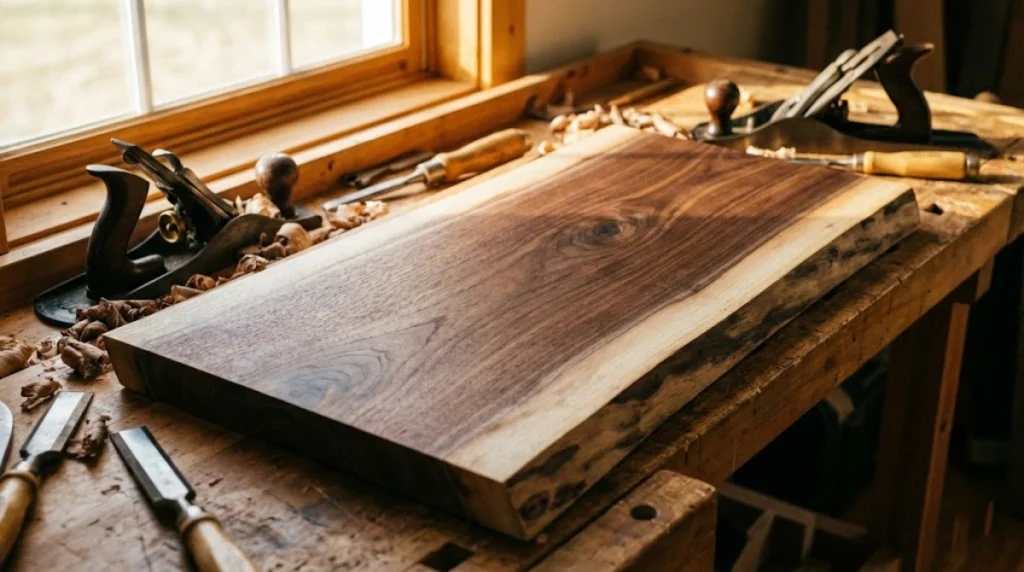
This is the biggest shock for new woodworkers. The “heartwood” (the center of the tree) is that famous coffee-colored brown. But the “sapwood” (the outer rings of the tree) is creamy white, sometimes bordering on yellow.
In lower-grade lumber, you will get boards that have a stark line where the chocolate brown turns to bright white. As furniture makers, we usually cut the sapwood off, which increases the waste factor (and the cost). However, some modern styles embrace this contrast, using the sapwood as a design element.
2. Grain and Texture
Walnut generally has a straight grain, though it’s famous for having “movement.” You’ll often find waves, curls, and crotch figures (where branches meet the trunk) that create stunning visual effects.
The texture is medium-coarse. It’s not as open-pored as Red Oak (where you can literally blow bubbles through the end grain), but it’s not as tight as Maple. It has a natural luster that develops a patina over time.
3. The Smell
I can blindfold myself in my shop and tell you if Walnut is being cut. It has a distinct, earthy, slightly acrid smell when machined. Some people love it; some find it a bit strong. To me, it smells like money and fine furniture.
The “Steaming” Controversy
Here is a detail that separates the pros from the hobbyists: Steamed vs. Unsteamed Walnut.
When Walnut logs are processed at commercial sawmills, they are often placed in a steamer before drying. Why? To darken the sapwood. The steam causes the dark pigments in the heartwood to bleed out into the white sapwood.
- The Pro: It makes the lumber look more uniform, so there is less “waste” for the seller.
- The Con: It kills the color. Steamed walnut often looks flat, greyish, or muddy compared to the vibrant deep chocolate and violet hues of air-dried or unsteamed walnut.
If you ever see a piece of vintage walnut furniture that looks unbelievably rich compared to the boards you just bought, the difference is likely that the vintage piece was made from unsteamed, air-dried lumber. If you can find a local sawyer who sells unsteamed slabs, buy them. The colors are unmatched.
Working Properties: Why Woodworkers Love It
There is a reason Walnut is expensive, and it isn’t just because it’s pretty. It is an absolute dream to work with.
Machining and Cutting
Walnut falls into the “Goldilocks” zone. It isn’t rock-hard like Hickory or White Oak, which can burn your saw blades and wear out your router bits. But it isn’t soft like Pine or Cedar, which dent if you look at them wrong.
It cuts cleanly. When I run Walnut through the jointer or planer, the surface usually comes out polished and smooth with very minimal tearout. It holds a crisp edge, making it excellent for detail work, chamfers, and intricate joinery like dovetails.
Bending and Gluing
Walnut is excellent for steam bending. If you are making Windsor chairs or curved architectural work, Walnut responds very well to heat and moisture manipulation.
Glue adhesion is also top-tier. Titebond or hide glue grabs onto Walnut fibers aggressively, making for joints that will last hundreds of years if designed correctly.
Sanding
Because the grain is somewhat open, Walnut sands easily. You don’t have to fight it. However, you do need to be careful with dust. Walnut dust is fine and can be an irritant to the lungs and skin. I always wear a respirator when sanding walnut, more so than with other domestic species.
Hardness and Durability
Let’s talk numbers for a second. In the woodworking world, we use the Janka Hardness Scale to determine how resistant a wood is to denting and wear.
- Hard Maple: 1,450 lbf
- Red Oak: 1,290 lbf
- Black Walnut: 1,010 lbf
- Cherry: 995 lbf
As you can see, Walnut is actually softer than Oak and Maple. This is important to know if you are planning to use it for flooring.
Is Walnut Good for Flooring?
Yes, but with a caveat. Because it is softer (1,010 Janka), it will show scratches and dog claw marks faster than a White Oak floor would. However, because Walnut is dark and has a complex grain, it hides dirt well. It makes for a stunning floor, but in a high-traffic house with three Golden Retrievers, it’s going to develop a “lived-in” look pretty quickly.
Rot Resistance
Walnut heartwood is rated as very durable regarding decay resistance. It is remarkably resistant to rot. However, we rarely use it for outdoor furniture simply because the sun bleaches the color out (more on that later) and because it’s too expensive to let sit in the rain.
Common Uses for Walnut
Because of its cost and beauty, Walnut is reserved for projects where aesthetics matter. You won’t find Walnut framing studs behind drywall.
- Fine Furniture: Tables, chairs, cabinets, and bed frames. This is its primary use.
- Veneer: Highly figured walnut logs are often sliced paper-thin and glued onto cheaper substrates (like plywood/MDF) to create panels that look like solid wood but are more stable and affordable.
- Gun Stocks: Walnut is the traditional wood for rifles and shotguns. It absorbs recoil well and doesn’t warp easily with humidity changes, which is crucial for accuracy.
- Musical Instruments: You’ll find Walnut in guitar bodies and acoustic sets. It offers a warm, bright tone.
- Turnings: Bowls, pens, and decorative items. The contrast between heartwood and sapwood looks incredible on a spinning lathe.
The Cost: Why is Walnut So Expensive?
If you go to a big box store, you probably won’t find Walnut. If you go to a hardwood dealer, prepare your wallet. Walnut is typically priced 2x to 3x higher than Red Oak or Poplar.
Why?
- Supply: Walnut trees don’t grow in dense forests like Pines. They grow individually or in small clusters. It takes a lot of land to harvest a decent amount of Walnut.
- Growth Rate: They grow reasonably fast, but they have a lot of branches. This means the tree produces a lot of knots. Finding “FAS” (First and Seconds) grade lumber—which means clear boards with no knots—is difficult. The yield from a Walnut log is lower than the yield from an Oak log.
- Demand: It is fashionable. Mid-Century Modern design relies heavily on Walnut, and that style has been booming for years.
Finishing Walnut: Best Practices
Finishing Walnut is where the magic happens. However, there is one major misconception you need to know about.
The Sun is the Enemy
Most woods, like Cherry or Maple, get darker as they age and absorb UV light. Walnut gets lighter.
If you put a Walnut table in a sunroom, in five years it will look like a golden-honey color, almost like Oak. To combat this, you need a finish with UV inhibitors, or you can use a slight stain to lock in the color (though I hate staining Walnut unless absolutely necessary).
My Favorite Finishes for Walnut
- Danish Oil / Tung Oil:
This is my go-to. An oil finish penetrates the wood and makes the grain “pop.” It adds a level of chatoyance (that 3D shimmering effect) that you just don’t get with surface finishes. It feels like natural wood to the touch. The downside is it offers less protection against water rings.
- Shellac:
Orange or Garnet shellac looks stunning on Walnut. It adds a warm amber tone that deepens the brown. It dries fast and is easy to repair.
- Polyurethane / Varnish:
If I’m building a dining table that will see hot coffee mugs and spaghetti spills, I use a wiping varnish or polyurethane. However, I usually put a coat of oil-free shellac or linseed oil down first to pop the grain, and then topcoat with the poly for protection. Polyurethane alone can sometimes look a bit “plastic” and cold on Walnut.
Grain Filling
Walnut has open pores. If you want that glass-smooth, piano-finish look, you have to fill the pores. You can use a commercial grain filler (dyed dark brown) before applying your topcoat. This is common for formal dining tables, but for rustic or modern furniture, I usually leave the pores open for texture.
Sustainability
Is Walnut endangered? No. American Black Walnut is not on the CITES Appendices or the IUCN Red List of Threatened Species. It is managed relatively well in the United States.
However, because the trees are valuable, “Walnut poaching” is a real thing. Unscrupulous people sometimes trespass to cut down massive burl trees. Always ensure you are buying your lumber from reputable sawyers who source ethically.
Comparison: Walnut vs. The Competition
To help you decide if Walnut is right for your next project, here is a quick showdown:
- Walnut vs. Oak: Walnut is softer, darker, and more expensive. Oak is harder, heavy-grained, lighter in color, and more affordable. Oak screams “traditional/country,” while Walnut screams “modern/elegant.”
- Walnut vs. Mahogany: Both are premium dark woods. Mahogany tends to be more reddish/orange and has a more consistent, straight grain. Walnut has more swirls and color variation. Mahogany is harder to source sustainably (depending on the species).
- Walnut vs. Stained Pine: Please don’t do this. I see people staining Pine dark to look like Walnut. It never works. The grain of Pine reverses the stain (making the light parts dark and the dark parts light), resulting in a muddy, zebra-stripe look. If you want the Walnut look but can’t afford Walnut, look into roasted/thermally modified Poplar or Ash.
Frequently Asked Questions (FAQ)
1. Does Walnut wood change color over time?
Yes, and this surprises many people. Unlike Cherry (which darkens), Black Walnut lightens over time when exposed to UV light (sunlight). Over several years, that deep chocolate brown will mellow into a golden honey color. You can slow this down by using finishes with UV blockers or keeping the piece out of direct sunlight.
2. Why is some Walnut wood purple or grey?
This is natural variation! Air-dried walnut often retains beautiful subtle hues of purple, red, and grey. However, if the wood looks uniformly grey/muddy and flat, it has likely been “steamed” at the sawmill to blend the sapwood and heartwood. Air-dried walnut is generally more vibrant than kiln-dried, steamed walnut.
3. Is Walnut toxic to work with?
Walnut trees produce a chemical called juglone, which is toxic to some other plants (like tomatoes). For woodworkers, the main concern is the dust. Walnut dust is a sensitizer; prolonged exposure can cause skin irritation and respiratory issues. It’s not “poisonous,” but you should always wear a good dust mask or respirator when sanding it.
4. Can I stain other woods to look like Walnut?
You can try, but it’s difficult to mimic the depth. The best substitute is arguably roasted (thermally modified) Ash or Poplar, which turns a dark chocolate brown all the way through due to the heat treatment. Staining Pine or Maple often looks blotchy and artificial compared to the real thing.
5. What is the best finish for Walnut?
For a natural look that highlights the grain, use a penetrating oil like Tung Oil or Boiled Linseed Oil. For high-protection surfaces (like a dining table), use a wiping varnish or oil-based polyurethane. Avoid water-based polyurethanes if possible, as they can sometimes leave a milky cast that obscures the dark richness of the wood.
Final Thoughts from the Shop
To me, Walnut is the tuxedo of woodworking materials. It is classy, timeless, and commands respect.
Yes, the sawdust is bitter. Yes, the price per board foot will make you wince at the checkout counter. But when you apply that final coat of oil and watch the wood transform from a dull gray board into a deep, glowing masterpiece of chocolate and amber, you realize it’s worth every penny.
If you are a beginner, don’t be afraid to use it. It’s forgiving to work with and hides joinery mistakes better than Maple. Just measure twice, cut once, and save those scraps—walnut offcuts make great cutting boards!