
If you have walked through a furniture store in the last ten years, or browsed Wayfair or Pottery Barn, you have seen it. You check the tag on a dining table or a nightstand, expecting to see “Oak,” “Maple,” or “Pine,” and instead, you see this: Rubberwood.
In my years running a shop and managing job sites, this is easily one of the most misunderstood materials I come across. Clients ask me all the time: “Is it flexible? Is it made of actual rubber? Is it cheap particle board?”
Here is the short answer: Yes, it is real wood. No, it does not bounce if you drop it.
As a carpenter who has cut, sanded, stained, and fixed plenty of this stuff, I’m going to pull back the curtain on Rubberwood. We are going to look at where it comes from, how it behaves under a saw blade, and whether you should actually spend your money on it.
The Origin Story: From Latex to Lumber
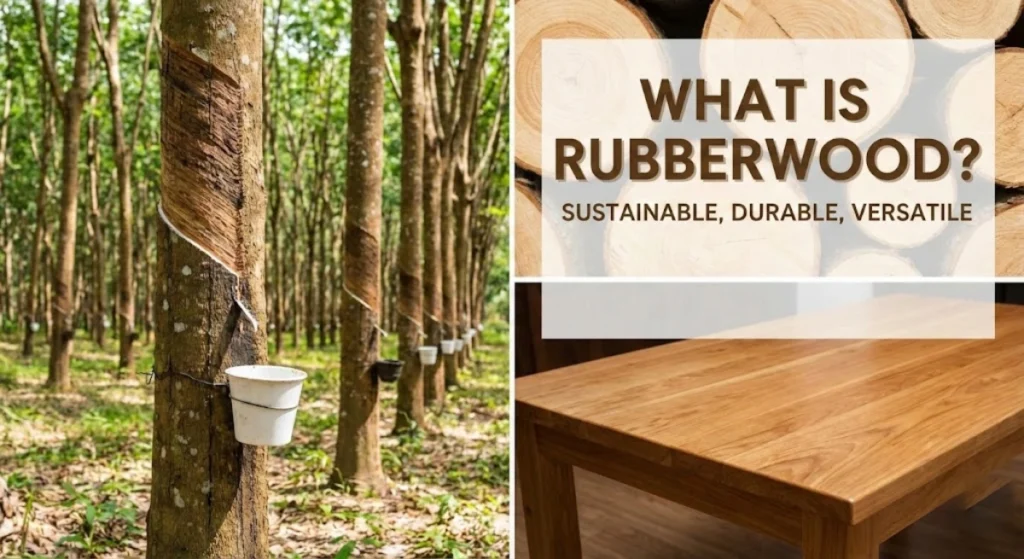
To understand the wood, you have to understand the tree. Rubberwood comes from the Pará rubber tree (Hevea brasiliensis). Historically, these trees weren’t grown for their timber; they were grown for latex.
For about 25 to 30 years, these trees are tapped for latex-the white sap used to make tires, gloves, and rubber bands. Eventually, the latex yield dries up.
Decades ago, once the tree stopped producing sap, plantation owners would just burn them down to clear space for new crops. It was massive waste. Then, the industry realized that Hevea actually produces a fairly dense, medium-hard lumber. Now, instead of burning it, they harvest it for furniture.
Pro Note: Because it is a byproduct of the latex industry, Rubberwood is considered one of the most eco-friendly and sustainable woods on the market. We aren’t cutting down virgin rainforests to get it; we are using a tree that has already served a purpose.
Is Rubberwood a Hardwood or Softwood?
This trips people up. In the U.S., we usually associate “softwood” with construction lumber like Pine or Fir, and “hardwood” with expensive furniture wood like Walnut or Oak.
Botanically, Rubberwood is a hardwood. It comes from a deciduous tree (one that loses its leaves).
However, just because it is a “hardwood” doesn’t mean it’s as hard as a rock. In the wood shop, we use the Janka Hardness Scale to determine how resistant wood is to denting and wear.
Here is how Rubberwood stacks up against common American species:
| Wood Species | Janka Hardness Rating (lbf) |
| White Pine | 420 (Very Soft) |
| Rubberwood | ~960 – 980 (Moderate) |
| Black Walnut | 1,010 |
| Red Oak | 1,290 |
| Hard Maple | 1,450 (Very Hard) |
The Takeaway: Rubberwood sits right in that “Goldilocks” zone. It is significantly harder than Pine (so it won’t dent if you look at it wrong), but it’s softer than Red Oak. It’s remarkably similar in density to Black Walnut or Teak.
Visual Characteristics: What Does It Look Like?
If you are trying to spot Rubberwood in the wild, look for the finger joints.
Because rubber trees are relatively small in diameter compared to massive Oaks or Maples, we rarely get wide, long slabs of Rubberwood. To make a tabletop or a dresser side, manufacturers take smaller strips of the wood and bond them together using finger joints (interlocking jagged cuts glued together).
Grain and Color
- Raw Color: When I plane it down, raw Rubberwood is a pale, creamy straw color. It’s sometimes called “Malaysian Oak” because of this light color, though that is purely a marketing term.
- Grain: The grain is generally straight and somewhat open, causing a coarse texture. It doesn’t have the beautiful, swirling cathedral grain patterns you see in Ash or Oak. It’s very uniform.
- Knots: You will rarely see knots in Rubberwood furniture because the lower grade lumber with defects is usually culled out or used for internal framing.
The “Pro” Experience: Working with Rubberwood
I have built custom built-ins and modified plenty of store-bought Rubberwood furniture. Here is my hands-on assessment of how it behaves in the shop.
1. Machining and Cutting
It cuts surprisingly well. Because it’s moderately dense, it doesn’t tear out as easily as soft Pine. If I run it through a table saw with a high-quality carbide blade, I get a clean edge. However, it does have a high starch content (more on that later), which can sometimes gum up blades if the wood wasn’t dried perfectly.
2. Sanding
It sands like a dream. Because the grain is consistent, you don’t get wild density changes that create uneven spots. I can usually take a piece of Rubberwood from 120 grit up to 220 grit very quickly, resulting in a surface that feels like glass.
3. Taking Stain
This is Rubberwood’s superpower. The wood is naturally very light and porous. It drinks up stain evenly.
- Want it to look like Walnut? A dark gel stain works wonders.
- Want a modern whitewash? It handles that too.
- Warning: Because it is so absorbent, if you don’t use a pre-stain wood conditioner, it can occasionally get blotchy. But generally, it’s a finisher’s friend.
4. The Smell
I have to mention this. If you cut into fresh, raw Rubberwood that hasn’t been sealed yet, it has a distinct odor. Some guys in the shop call it “sour,” others say it smells a bit like old cheese. The good news? Once the finish (polyurethane, lacquer, or varnish) is on, the smell is completely sealed in and you’ll never notice it in your home.
The Achilles Heel: Why Chemical Treatment is Mandatory
If Rubberwood is so great, why isn’t it the most expensive wood in the world?
Here is the catch: It is highly perishable.
The high starch content in the wood makes it a buffet for fungi and insects. If you chopped down a rubber tree and left the log on the ground, it would rot and be eaten by bugs within weeks.
To make it usable for furniture, the lumber must go through a pressure-treatment process, usually involving boron preservatives, and then be kiln-dried immediately.
Buyer’s Tip: If you are buying Rubberwood furniture, make sure it’s from a reputable manufacturer. If the wood wasn’t treated properly at the mill in Thailand, Vietnam, or Malaysia, it can warp or develop mildew spots later. In the U.S. market, almost everything you buy has been properly treated, but it’s worth knowing.
Rubberwood vs. The World: How It Compares
To help you decide if this wood is right for your next project or furniture purchase, let’s compare it to the usual suspects.
1. Rubberwood vs. Pine
- Durability: Rubberwood wins, hands down. Pine dents easily with a fingernail. Rubberwood can take a beating from kids and pets.
- Look: Pine has a rustic, knotty look. Rubberwood is cleaner and more modern.
- Verdict: For a dining table, choose Rubberwood. For a rustic farmhouse shelf, choose Pine.
2. Rubberwood vs. Oak
- Durability: Oak is harder and more scratch-resistant.
- Grain: Oak has that classic, deep grain texture. Rubberwood is smoother and blander.
- Price: Rubberwood is significantly cheaper.
- Verdict: If you are on a budget but want a solid hardwood feel, Rubberwood is the best alternative to Oak.
3. Rubberwood vs. MDF/Particle Board
- Quality: There is no comparison. Rubberwood is solid lumber. MDF is glue and sawdust.
- Longevity: MDF swells and crumbles if it gets wet. Rubberwood, being real wood, can be sanded and refinished if it gets damaged.
- Verdict: Always choose Rubberwood over MDF if you can afford the slight price jump.
The Pros and Cons: A Quick Summary
After handling thousands of board feet of different species, here is my honest scorecard for Rubberwood.
The Pros
- Cost-Effective: It is cheaper than almost any other hardwood because it’s a byproduct.
- Eco-Friendly: It utilizes “waste” wood from existing plantations.
- Stable: Because it is kiln-dried and composed of smaller glued staves (finger joints), it is surprisingly dimensionally stable. It doesn’t warp as aggressively as big slabs of solid Pine.
- Great for Finishes: It paints and stains beautifully.
The Cons
- Indoor Use Only: Do not-I repeat, do not-use Rubberwood for outdoor furniture. It absorbs moisture like a sponge and will rot, even if treated. It is strictly for climate-controlled interiors.
- The “Butcher Block” Look: Because it’s usually made of small strips glued together, you will see many seams. Some people love the mosaic look; others think it looks cheap.
- Denting: While harder than Pine, it is still softer than Maple. High heels or dropped cast-iron pans will leave a mark.
Maintenance: Keeping Your Hevea Happy
If you have a Rubberwood dining table or desk, taking care of it is straightforward. Since almost all Rubberwood furniture comes pre-finished (usually with a lacquer or polyurethane), you are maintaining the finish, not the raw wood.
- Heat is the Enemy: Rubberwood is sensitive to heat. Always use trivets or coasters. A hot pizza box placed directly on a Rubberwood table can leave a white, cloudy mark in the finish (called “blushing”).
- Humidity Control: Like all solid wood, it expands and contracts with the seasons. Keep your home’s humidity levels relatively consistent to prevent cracking at the glue joints.
- Cleaning: Skip the harsh chemical sprays. A damp cloth with a little mild dish soap is all you need. Dry it immediately.
Frequently Asked Questions (FAQ)
1. Is Rubberwood waterproof?
No. While Rubberwood is moderately dense, it is naturally very absorbent. While the finish (varnish or lacquer) offers protection, if water penetrates the wood, it can warp or rot quickly. Never leave standing water on rubberwood furniture and never use it outdoors.
2. Can I sand and refinish Rubberwood furniture?
Yes, absolutely. Since it is solid wood (not a veneer over particle board), you can sand down scratches or change the color. Just be aware that sanding too deep might reveal the finger joints more clearly, and you must re-seal it immediately to prevent moisture absorption.
3. Why is Rubberwood sometimes called “Malaysian Oak”?
This is a marketing tactic. Rubberwood is not related to the Oak family (Quercus). Furniture retailers use the term to highlight that Rubberwood shares similar density and durability characteristics with Oak, and to avoid the confusion that the furniture is made of “rubber.”
4. Is Rubberwood safe/non-toxic?
Yes. While the wood is treated with preservatives (like boron) to prevent bug infestation during the drying process, these compounds are generally considered safe for household use once the wood is finished and sealed. It is standard practice in the industry.
5. Does Rubberwood contain latex that causes allergies?
Generally, no. The latex is harvested from the bark, while the lumber comes from the trunk’s core. Furthermore, the kiln-drying and seasoning process removes the vast majority of natural fluids. However, if you have a severe, life-threatening latex allergy, consult a medical professional before bringing it into your home, just to be safe.
Final Verdict: Is Rubberwood “Good” Wood?
In the woodworking community, we can be a bit snobby about lumber. We love our Walnut, Cherry, and White Oak. But honestly? Rubberwood deserves more respect than it gets.
It bridges the gap between disposable, cheap particle board furniture and high-end, heirloom hardwood pieces. It gives you the feel, weight, and repairability of solid wood at a fraction of the price.
If you are looking for a dining table that needs to survive toddlers, or a desk that looks high-end without the $2,000 price tag, Rubberwood is a solid choice. It holds screws well, it doesn’t wobble, and it looks great with a stain.