
If you have been furniture shopping lately-whether you are looking at unfinished pieces to stain yourself or browsing the aisles of a big-box store-you have likely seen the term “Parawood.”
It sounds exotic, doesn’t it? Maybe a little mysterious. In my years running a shop and building custom cabinetry, I’ve had countless clients ask me about this material. Is it real wood? Is it cheap junk? Why is it suddenly everywhere?
Here is the short answer: Parawood is Rubberwood. It is the lumber harvested from the Pará rubber tree (Hevea brasiliensis).
But there is a lot more to the story. In the woodworking community, we have a love-hate relationship with this stuff. It is affordable and sustainable, but it has quirks that can drive a craftsman crazy if they don’t know how to handle it.
In this guide, I’m going to take off the sales hat and put on my shop apron. We are going to dig into what Parawood actually is, how it behaves under a saw blade, and whether you should trust it in your home.
The Origin Story: Where Does Parawood Come From?
To understand the wood, you have to understand the tree. Parawood comes from the rubber tree, which is native to Brazil (hence the name Pará, a state in Brazil) but is now primarily grown on massive plantations in Southeast Asia-Thailand, Malaysia, and Indonesia.
This is where the “Environmentally Friendly” tag comes from, and honestly, it’s a claim that holds water.
For decades, these trees were grown strictly for latex. Workers would tap the trees, collect the sap (latex) to make rubber, and repeat the process. After about 25 to 30 years, the tree stops producing enough latex to be commercially viable.
Back in the day, the plantation owners would just burn these “useless” trees right there in the field to clear the land for new saplings. It was a massive waste.
Eventually, someone realized that if you treat the wood properly, it’s actually a pretty decent medium-density hardwood. Now, instead of burning them, they harvest the lumber. Because it is a byproduct of an existing industry, Parawood is arguably one of the most eco-friendly lumbers on the market. We aren’t cutting down virgin rainforests to get it; we are using what was essentially agricultural waste.
The Technical Specs: Is Parawood a Hardwood?
Yes, Parawood is technically a hardwood. But as any carpenter will tell you, “hardwood” just means the tree is an angiosperm (has broad leaves and seeds), not that the wood is physically rock-hard. Balsa wood is technically a hardwood, and you can crush it with your thumb.
However, Parawood actually is physically hard.
The Janka Hardness Test
In the shop, we measure wood hardness using the Janka Hardness Scale, which measures the force required to embed a steel ball halfway into the wood.
- Parawood (Rubberwood): ~960 to 995 lbf
- Black Cherry: ~950 lbf
- Black Walnut: ~1,010 lbf
- Red Oak: ~1,290 lbf
- Hard Maple: ~1,450 lbf
As you can see, Parawood sits right in that “sweet spot” alongside Black Cherry and Walnut. It is significantly harder than Pine or Poplar (softwoods), which makes it a legitimate contender for furniture making. It resists dents and scratches fairly well, certainly better than the cheap pine furniture you might find in budget aisles.
Appearance and Grain: The “Malaysian Oak”
Marketing teams love to call Parawood “Malaysian Oak.” I tend to roll my eyes at that term because, biologically, it has absolutely nothing to do with the Oak family (Quercus).
However, visually? I can see why they say it.
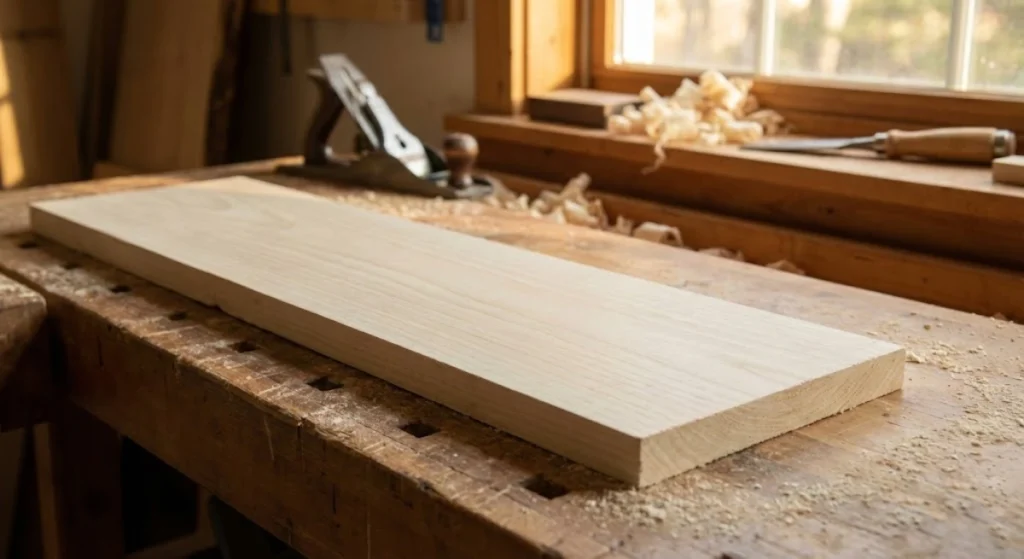
When I run a piece of Parawood through the planer, it reveals a pale, creamy blonde color—very similar to white pine or maple sapwood. The grain is generally straight, but it has a somewhat coarse, open texture that does remind you of Oak.
Key Visual Characteristics:
- Color: Light blonde to cream. It has very little natural variation, which is great if you want a uniform look but boring if you like character.
- Texture: Moderately coarse. It has large pores.
- Grain: Usually straight, sometimes interlocked.
Because the color is so light and neutral, it is basically a blank canvas. This is why furniture manufacturers love it. They can stain it dark to look like Mahogany, reddish to look like Cherry, or golden to look like Oak.
The Workability: A Woodworker’s Perspective
So, what is it like to actually build with? If you are a DIYer planning to buy some unfinished Parawood furniture to finish yourself, or if you sourced some boards for a project, here is what you need to know.
1. Cutting and Machining
It cuts relatively easily. It doesn’t have the high silica content that dulls blades instantly like Teak does. However, because of the latex content in the wood, I have noticed it can sometimes gum up saw blades or sandpaper a bit faster than domestic hardwoods. It saws cleanly, but you need to keep your feed rate steady to avoid burning.
2. Sanding
It sands beautifully. Because the grain is straight, you don’t get a lot of “tear-out” (where the wood fibers rip up) when you are sanding. It feels very smooth to the touch after a pass with 220-grit paper.
3. The Staining Challenge
This is the big one. While manufacturers say it “takes stain well,” my experience is a bit more nuanced.
Parawood is thirsty. It’s essentially a sponge. If you just slap a dark oil-based stain on it, it will absorb it unevenly. You will end up with a blotchy, muddy mess where some spots are pitch black and others are light brown.
Pro Tip: If you are finishing Parawood, always use a pre-stain wood conditioner. This helps seal the pores slightly so the stain absorbs evenly. Gel stains also work wonders on Parawood because they sit on top of the surface rather than soaking in deep.
4. The Smell
I have to mention this because it catches people off guard. When you cut or sand fresh Parawood, it has a distinct… let’s call it “sour” or “sweet” smell. Some people say it smells like yogurt or old cheese. The smell disappears once the wood is finished and sealed, but in the shop, it’s definitely noticeable.
The Critical Weakness: Why Parawood Needs Treatment
If Parawood is so great-hard, cheap, sustainable—why isn’t it the most expensive wood in the world?
It has an Achilles’ heel: It is perishable.
Freshly cut Rubberwood has a high starch and sugar content. In the humid climates of Southeast Asia where it grows, this makes it a buffet for fungi, mold, and insects. If you leave a raw Rubberwood log on the ground, it will rot in no time.
To combat this, almost all Parawood lumber is pressure-treated immediately after processing. It is usually dipped in a borate solution and then kiln-dried to remove moisture and kill any pests.
What does this mean for you?
It means Parawood is strictly for indoor use only. Even with the treatment, you cannot put this wood outside. If you build a Parawood deck chair or a garden bench, it will warp, rot, and fall apart within a season or two. Keep it in the living room, kitchen, or bedroom.
Parawood vs. The Competition
Let’s stack Parawood up against the usual suspects you’ll find in American homes.
Parawood vs. Pine
- Durability: Parawood wins hands down. Pine is a softwood; if you write on a piece of paper on a pine table, the pen might leave an indent in the wood. Parawood is much harder.
- Cost: Pine is generally cheaper, but not by much.
- Look: Pine has a rustic look with lots of knots. Parawood is cleaner and more modern looking, with very few knots.
Parawood vs. Oak
- Durability: Oak is harder and much more durable. An Oak table is an heirloom piece that will last 100 years. Parawood is durable, but not “heirloom” tough.
- Cost: Parawood is significantly cheaper than Red or White Oak.
- Grain: Oak has those distinctive “cathedral” grain patterns that are stunning. Parawood is more uniform and generic.
Parawood vs. MDF/Particle Board
- Durability: Parawood obliterates particle board. It is solid wood. It holds screws better, it doesn’t swell up like a balloon if it gets wet, and it can be repaired.
- Value: Parawood furniture is a massive step up from IKEA-style particle board. If you are on a budget but want solid wood, Parawood is the bridge between disposable furniture and high-end custom work.
Common Uses for Parawood
Because of its stability (once kiln-dried) and low cost, you will find Parawood in:
- Kitchen Cabinetry: It paints very well because it lacks deep grain texture, making for a smooth finish.
- Bar Stools and Chairs: Its resistance to warping makes it great for chair legs.
- Butcher Block Countertops: You will see a lot of budget-friendly butcher blocks made of Hevea (Parawood). They look great, but remember-keep them sealed!
- Children’s Toys: It’s non-toxic (once finished) and durable enough to take a beating from a toddler.
The Latex Allergy Question
I get asked this often: “I have a latex allergy. Can I use Parawood furniture?”
The general consensus from medical experts and industry studies is yes, it is safe.
The latex that causes allergies comes from the sap (the liquid). The wood itself, especially after being kiln-dried at high temperatures and sealed with finish, does not retain the allergenic proteins on the surface. I have never heard of a reaction from finished furniture, but if you have a severe, life-threatening allergy, it is always best to consult your doctor or order a small sample first.
Maintenance and Care
Taking care of Parawood is just like taking care of any other solid wood furniture.
- Control the Humidity: Like any wood, Parawood moves. It expands in summer and shrinks in winter. Keep your home’s humidity levels relatively stable (around 40-50%) to prevent cracking or checking.
- Clean Gently: Use a damp cloth with mild soap. Avoid harsh chemical cleaners that can strip the finish.
- Watch the Heat: Don’t put hot pans directly on a Parawood table. It can cause white heat rings in the finish (though this is more about the finish than the wood itself).
Frequently Asked Questions (FAQ)
1. Is Parawood considered real wood?
Yes, Parawood is 100% real, solid wood. It is not engineered wood, MDF, or particle board. It is lumber harvested from the Pará rubber tree.
2. Can I use Parawood for outdoor furniture?
No. Parawood is susceptible to rot, mold, and fungus when exposed to moisture. Even if you seal it, it does not have the natural weather resistance of woods like Cedar, Teak, or White Oak. Keep it indoors.
3. Is Parawood easy to stain?
Parawood absorbs stain very quickly, which can lead to blotchiness. For the best results, sand it to at least 220 grit and apply a pre-stain wood conditioner before applying your stain. This will help achieve an even, professional color.
4. How strong is Parawood compared to Oak?
Parawood is strong, with a Janka hardness rating of around 960 lbf, making it similar to Black Cherry or Soft Maple. However, Red Oak is harder (around 1290 lbf). While Oak is tougher, Parawood is more than strong enough for dining tables, chairs, and cabinetry.
5. Why is Parawood so cheap?
Parawood is a byproduct of the latex industry. The trees have already paid for themselves through rubber production. When the tree is cut down, the lumber is considered a secondary product, which keeps the cost much lower than trees grown exclusively for timber.
Final Verdict: Is Parawood Good Wood?
Here is my honest take from the workbench. If you are looking for high-end, investment-grade lumber with stunning figure and rich natural color (like Walnut or Mahogany), Parawood is not it. It is a utility wood. It is functional, not fancy.
However, if you are looking for solid, reliable, eco-friendly furniture that fits a budget, Parawood is fantastic. It is lightyears ahead of particle board and plywood. It paints well, stains decently if you know what you’re doing, and holds up to daily family life.
For the modern homeowner who wants sustainability without sacrificing durability, Parawood is one of the smartest buys on the market.