
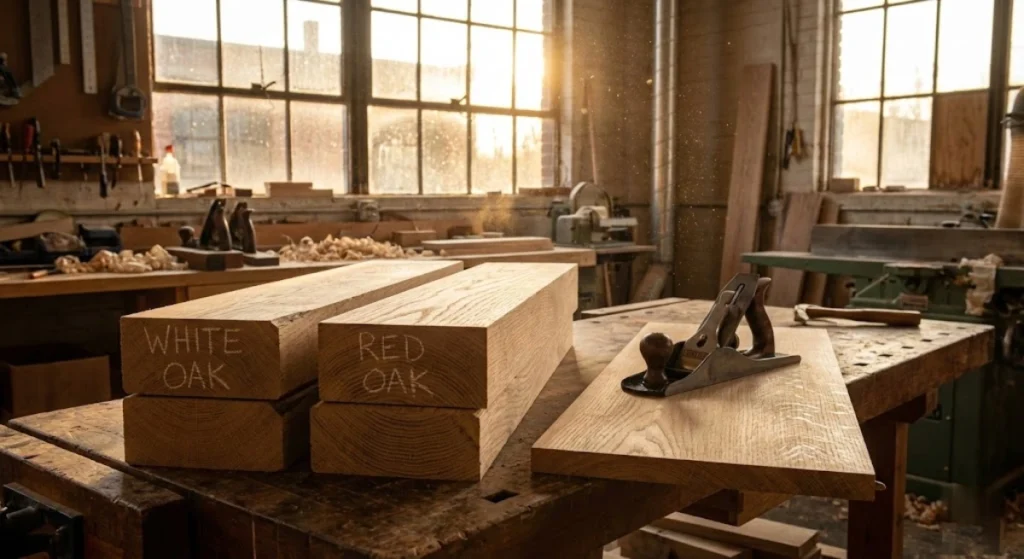
If you walk into any lumber yard in America, from the big box stores to the specialized hardwood dealers, you are going to find Oak. And if you walk into my shop, you’re going to smell it. It is the backbone of American carpentry, the standard against which we measure almost every other domestic hardwood.
But “Oak” isn’t just one thing. When a client asks me for an “oak table,” my first question is always, “Red or White?”
In this guide, I’m going to break down exactly what oak wood is, why it has been the go-to material for carpenters for centuries, and how you should be handling it in your next build. We aren’t just talking botany here; we are talking about how this wood behaves under a saw blade and chisel.
The Basics: What Exactly is Oak?
Botanically speaking, oak comes from the genus Quercus. There are hundreds of species worldwide, but here in the United States, we generally group them into two main commercial categories: Red Oak and White Oak.
Oak is a hardwood. Now, remember, “hardwood” doesn’t necessarily mean the wood is physically hard (though oak is); it means the tree is an angiosperm (a flowering plant) and is deciduous (loses its leaves in the fall).
What makes oak stand out to us woodworkers is its structure. It is a ring-porous wood. If you look at the end grain of a board, you will see distinct rings of large pores formed early in the growing season, followed by denser, darker bands of latewood. This gives oak that aggressive, coarse texture that screams “wood.” It doesn’t look like plastic; it has character.
The Big Showdown: Red Oak vs. White Oak
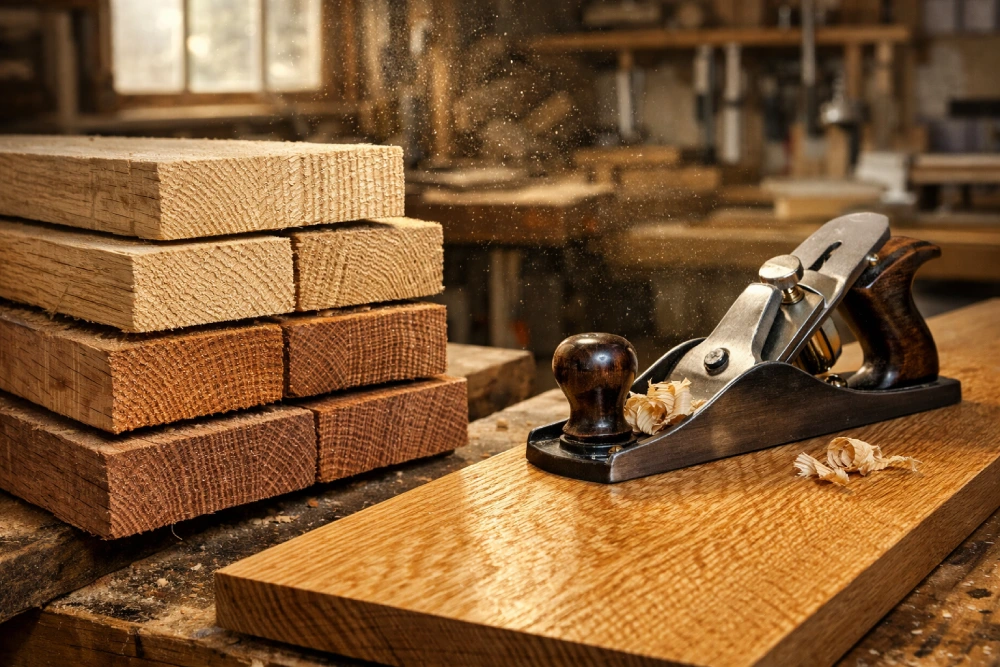
Understanding the difference between these two is critical. I have seen guys ruin projects because they used Red Oak for an outdoor gate, only to watch it rot out in three years.
1. Red Oak (Quercus rubra)
This is the most abundant hardwood in North American forests. If you have hardwood floors in a house built after 1950, they are likely Red Oak.
- Color: Despite the name, the wood isn’t bright red. It’s a light brown with a reddish or pinkish cast.
- Grain: The grain is wilder and more open.
- The Structure: Red Oak is extremely porous. The pores in the heartwood are open pipes running up the tree.
- The Straw Test: You can literally cut a distinct piece of Red Oak, stick one end in a cup of water, and blow bubbles through the other end like a straw. This means moisture wicks right into it. Never use Red Oak for untreated outdoor projects.
2. White Oak (Quercus alba)
White oak is the premium sibling. It is harder, heavier, and more expensive.
- Color: It ranges from a light tan to a pale yellow-brown, sometimes with an olive cast.
- The Structure: The pores in White Oak are plugged with organic crystal-like growths called tyloses. These tyloses block the pipes, making the wood watertight.
- Uses: Because it is waterproof, White Oak is used for boat building, outdoor furniture, and whiskey barrels. You can’t make a wine barrel out of Red Oak—it would leak everywhere.
Characteristics and Working Properties
When you are milling oak, you know it. It’s heavy, and it commands respect from your tools.
Hardness and Durability
We measure wood hardness using the Janka Hardness Scale, which measures how much force it takes to embed a steel ball halfway into the wood.
- Red Oak: ~1,290 lbf
- White Oak: ~1,360 lbf
For context, Hard Maple is around 1,450, and Pine is way down around 380-660. Oak sits in the sweet spot. It is hard enough to resist dents from dropping your keys or dragging a chair, but not so rock-hard (like Hickory or Ipe) that it destroys your saw blades instantly.
Workability and Tooling
- Blades: You need carbide-tipped blades. High-Speed Steel (HSS) will dull too fast. Because oak is dense, it generates heat. If you pause while ripping a board on the table saw, you will get burn marks. Keep the feed rate consistent.
- Splintering: Oak has strong grain lines. When you route an edge or crosscut, it loves to blow out or splinter on the back edge. Always use a backer board when cutting across the grain.
- Gluing: Both oaks glue up well, but be careful with “squeeze-out.” Because the pores are so deep, glue can get down in there and interfere with your stain later if you don’t clean it up thoroughly.
Steam Bending
If you are into chair making (think Windsor chairs), White Oak is legendary for steam bending. It becomes incredibly pliable when hot and holds its shape perfectly once cooled.
The Look: Grain Patterns and Rays
This is where the artistry comes in. How the log is cut changes the look of the oak entirely.
- Plain Sawn (Flat Sawn): This is the most common and cheapest cut. The log is sliced straight through. This gives you the classic “cathedral” grain—those big arches in the middle of the board. It looks rustic and traditional.
- Quarter Sawn: The log is cut radially (like pizza slices) before being milled into boards. This is crucial for White Oak. When you quarter-saw White Oak, you reveal the medullary rays. These appear as tiger stripes or silver flecks shimmering across the board. This is the hallmark of Arts and Crafts or Mission Style furniture (think Gustav Stickley).
- Rift Sawn: This produces the straightest grain with no cathedrals and no ray flecks. It is the most stable cut (expands and contracts the least) and is often used for table legs or modern furniture where you want a clean, linear look.
Finishing Oak: The Good and The Bad
Finishing oak is a polarizing topic in the woodworking world.
Staining
Oak is the easiest wood to stain. Because those pores are so large, they soak up pigment like a sponge. If you want a deep, rich color, oak delivers. However, because the earlywood pores absorb more stain than the dense latewood, staining oak essentially highlights the grain contrast. If you hate high-contrast grain, do not stain oak.
The “Open Grain” Issue
If you want a glass-smooth finish (like a piano), oak is a nightmare. You can apply ten coats of polyurethane, and you will still see the texture of the grain pores.
- Pro Tip: If you want a smooth surface, you must use a grain filler (paste wood filler) before your topcoat. This fills the pores to level the surface.
The Ammonia Trick (Fuming)
One of the coolest things about White Oak is its high tannin content. Instead of staining it, you can expose it to ammonia fumes. The ammonia reacts with the tannins to turn the wood a deep, rich, grayish-brown. This penetrates deep into the wood and won’t fade like a stain.
Iron Staining
Warning: Because of those tannins, if you get water and iron filings (from steel wool or a table saw top) on raw oak, it will turn jet black instantly. Never use steel wool to sand oak—use synthetic abrasive pads instead.
Common Uses for Oak Wood
1. Flooring
This is the number one use. It wears like iron and can be refinished multiple times over a hundred years. Red Oak is the industry standard for strip flooring.
2. Cabinetry
Oak cabinets had a bad reputation in the 80s and 90s (the “Honey Oak” era), but they are making a massive comeback. White Oak, finished with a matte, natural finish, is currently the hottest trend in high-end kitchen design.
3. Furniture
From dining tables to dressers. It provides significant structural integrity for joinery like mortise and tenon.
4. Cooperage (Barrels)
As mentioned, White Oak is the only wood used for whiskey and wine barrels. It imparts flavors of vanilla, caramel, and coconut to the spirits.
Availability and Cost
One of the best things about being a woodworker in the US is that Oak is domestic. We don’t have to import it from the rainforests. It grows in our backyards, from the Appalachians to the Midwest.
- Sustainability: Oak is highly sustainable. U.S. forestry management has ensured that oak growth exceeds harvest.
- Cost:
- Red Oak: Usually the cheapest domestic hardwood available. It is the budget-friendly workhorse.
- White Oak: The price has jumped significantly in recent years due to high demand for exports and flooring, making it about 20-40% more expensive than Red Oak depending on your region.
Frequently Asked Questions (FAQ)
1. Is Oak wood good for outdoor furniture?
Yes, but only White Oak. White Oak has closed pores (tyloses) that make it rot-resistant and waterproof. Red Oak has open pores that wick up moisture, causing it to rot quickly if left exposed to the elements.
2. Why does my Oak wood turn black when wet?
Oak has a very high tannin content. When tannins react with water and trace amounts of iron (from a steel can, a nail, or even steel wool particles), a chemical reaction occurs that stains the wood black. You can remove these stains using oxalic acid.
3. Is Oak harder than Maple or Walnut?
Oak is harder than Walnut but generally softer than Hard Maple. On the Janka scale, Red Oak is 1290 and White Oak is 1360. Black Walnut is around 1010 (softer), while Hard Maple is around 1450 (harder).
4. Can I paint Oak cabinets?
You can, but it requires prep work. Because Oak has such deep grain texture, simply painting it will result in a pitted look where the paint sinks into the pores. For a smooth, professional finish, you need to use a grain filler and a high-build primer before applying your topcoat.
5. How can I tell if I have Red or White Oak?
Look at the end grain. If the pores are large and open (you can see into them), it is Red Oak. If the pores look clogged with a crystalline substance, it is White Oak. Also, fresh-cut Red Oak smells slightly unpleasant (like vinegar), while White Oak smells mild and earthy.
Conclusion: Why I Choose Oak
There is a reason Oak has stuck around while other wood trends have faded. It is honest wood. It doesn’t hide what it is. It has texture, weight, and a smell that reminds you of the forest.
Whether you are framing a timber-frame house, laying a floor that will outlast your grandchildren, or building a dining table for family gatherings, Oak is usually the right answer. Just make sure you grab the right species for the job keep the Red Oak inside, put the White Oak outside, and keep your tools sharp.