
If you walk into my shop on any given Tuesday, odds are high you’ll find Maple sawdust on the floor. It’s the workhorse of American woodworking. Whether I’m building a bomb-proof workbench, a high-end dining table, or just a simple cutting board for a neighbor, Maple is the timber I reach for more than any other.
But if you’re new to buying lumber, Maple can be tricky. You’ll hear terms like “Hard,” “Soft,” “Sugar,” “Red,” and “Bird’s Eye” thrown around at the lumberyard. It can get confusing fast.
In this guide, I’m going to strip away the botany textbook jargon and talk to you like we’re standing at the table saw. We’re going to cover exactly what Maple is, the critical difference between the two main varieties, and how to work it without burning your blades or blotching your finish.
The Basics: What Exactly is Maple?
Maple is a domestic hardwood found primarily in North America. It comes from the genus Acer. While there are over 100 species of maple trees worldwide, as woodworkers in the U.S., we really only care about a handful of them.
Unlike trees like Walnut or Cherry, where we prize the dark heartwood (the center of the log), Maple is unique because we usually prize the sapwood (the outer rings). The sapwood is that creamy, off-white color that gives Maple its clean, modern aesthetic. The heartwood is darker, usually a reddish-brown, and while it’s structural sound, it’s often considered “paint grade” or used in places where looks don’t matter as much.
But here is the most important thing you need to know before you buy a single board foot: Not all Maple is created equal.
The Big Divide: Hard Maple vs. Soft Maple
If you take nothing else away from this article, remember this: “Maple” is a generic term. In the trade, we split it into two distinct categories. If you buy the wrong one, your project might fail, or you might end up sweating a lot more than necessary.
1. Hard Maple (Sugar Maple)
- Scientific Name: Acer saccharum
- Janka Hardness: ~1,450 lbf
- Common Names: Rock Maple, Sugar Maple.
This is the big daddy. It is the state tree of New York, Vermont, Wisconsin, and West Virginia. It’s the same tree that gives us maple syrup.
Hard Maple is dense, heavy, and incredibly strong. On the Janka hardness scale (the standard for measuring wood hardness), it sits around 1,450. To put that in perspective, Red Oak is around 1,290. Hard Maple will dull your tools faster, but it is virtually indestructible.
Best Use Cases:
- Flooring: Gymnasiums and bowling alleys use Hard Maple because it can take a beating.
- Workbenches: My main bench top is laminated Hard Maple. It’s heavy enough to stop the bench from racking and hard enough to take a hammer blow.
- Cutting Boards: Its tight grain structure creates a closed surface that resists bacteria and knife cuts.
- Baseball Bats: If you see a bat shattering in the MLB, it’s likely Ash. If it cracks but holds, it might be Maple.
2. Soft Maple
- Scientific Names: Acer rubrum (Red Maple), Acer saccharinum (Silver Maple)
- Janka Hardness: ~950 lbf (Red Maple)
- Common Names: Red Maple, Silver Maple, Bigleaf Maple.
Don’t let the name fool you. “Soft” Maple is still a hardwood. In fact, it’s about as hard as Cherry or Walnut. It’s only “soft” in comparison to its rock-hard cousin.
Soft Maple is lighter, easier to mill, and generally cheaper. It looks very similar to Hard Maple, though it can sometimes have a slightly greyer or more reddish cast.
Best Use Cases:
- Painted Furniture: Because it’s cheaper and has a tight grain, it paints beautifully.
- Drawer Boxes: It’s lighter than Hard Maple, making your drawers slide easier.
- Carving: If you’re into whittling or CNC work, Soft Maple tears out less and cuts easier.
- General Furniture: For tables or shelving where you don’t need “bowling alley” durability, Soft Maple saves you money and saves your saw blades.
Visual Characteristics: Why We Love the Look
One reason Maple has stayed in style for centuries is its versatility. It fits in a colonial farmhouse, and it fits in a modern minimalist apartment.
Color and Grain
The sapwood is a creamy white, sometimes with a slight yellow or reddish hue. The grain is generally straight, fine, and even. This “plain” look allows it to act as a neutral backdrop in interior design. It doesn’t scream for attention like a highly figured Walnut slab might.
Figured Maple: The Showstopper
While standard Maple is straight-grained, the maple tree is prone to “freaks of nature” that produce some of the most stunning wood grain on the planet. You pay a premium for these, but they are worth it for special projects.
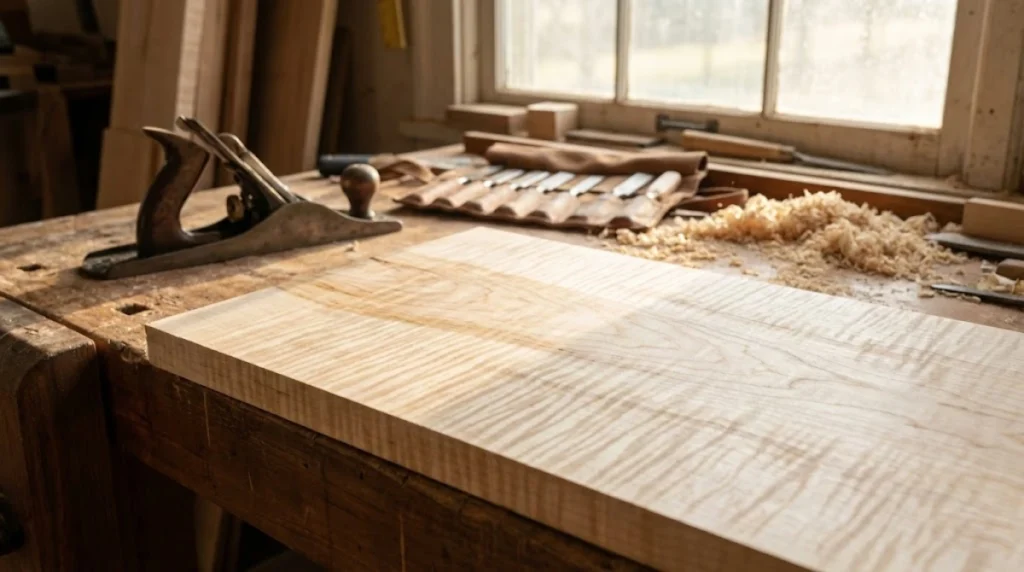
- Curly Maple (Tiger Maple): This looks like 3D waves running perpendicular to the grain. When you put a finish on it, the stripes seem to move as you walk around the piece (a phenomenon we call chatoyance).
- Bird’s Eye Maple: This figure looks like tiny swirling eyes scattered across the board. It’s rare and was huge in Art Deco furniture.
- Quilted Maple: Usually found in Bigleaf Maple (Soft), this looks like a puffy blanket or water rippling. It’s highly prized by electric guitar makers for “drop tops.”
- Spalted Maple: This is technically decaying wood. Fungi create black distinct lines through the wood. It looks like ink drawings. You have to stabilize it sometimes, but it makes for incredible turned bowls.
Workability: The Real Shop Talk
Okay, let’s get to the nitty-gritty. How does it behave when you put a blade to it?
Cutting and Milling
Hard Maple is unforgiving. If your table saw blade is dull, Maple will let you know immediately by smoking. The high sugar content in the wood actually caramelizes (burns) very easily.
- Tip: When ripping Hard Maple on a table saw, use a dedicated rip blade (24 tooth) and keep your feed rate consistent. If you stop pushing mid-cut, you will get a black burn mark that is a pain to sand out later.
Soft Maple mills like a dream. It cuts cleanly, routers nicely, and generally behaves itself.
Gluing and Fastening
Maple glues up very well. Because the pores are tight, you don’t get a “starved joint” where the glue soaks in too deep.
- Tip: Pre-drill everything. I mean it. If you try to drive a screw into Hard Maple without a pilot hole, you will snap the screw head off. I guarantee it.
Finishing (The Tricky Part)
This is where beginners get into trouble. Maple is notorious for blotching when stained.
Because the density of the wood fibers varies slightly across the board, dark liquid stains absorb unevenly. You might think you’re applying a nice “Dark Walnut” stain, and ten minutes later, your table looks like a muddy, splotchy mess.
My Recommendation:
- Leave it natural: A clear oil finish (like boiled linseed oil or Tung oil) or a water-based polyurethane looks best on Maple. It highlights that creamy color.
- Use Dye, not Stain: Aniline dyes sit on top rather than soaking in unevenly.
- Gel Stain: If you must stain it dark, use a Gel Stain. It’s thick like pudding and doesn’t penetrate as deep, giving you a more even color.
Sustainability and Cost
One of the reasons I advocate for using Maple is that it is a responsible choice.
Is it Eco-Friendly?
Yes. Maple grows relatively fast and is abundant across the Eastern United States and Canada. It is not an endangered rainforest species. The domestic hardwood market in the U.S. is heavily regulated, and for the most part, we are growing more Maple than we are harvesting. Choosing Maple reduces carbon footprint compared to importing exotics like Teak or Mahogany.
The Price Tag
Maple is a mid-range hardwood.
- Least Expensive: Poplar, Pine.
- Mid-Range: Soft Maple, Red Oak, Ash.
- Upper-Mid: Hard Maple, Cherry.
- Expensive: Walnut, White Oak.
Currently, Hard Maple runs a bit more than Red Oak but significantly less than Walnut. Soft Maple is often one of the best bargains in the lumberyard for the quality of wood you get.
Comparison: Maple vs. The Rivals
Sometimes the best way to understand a wood is to compare it to the other guys on the rack.
Maple vs. Oak
- Grain: Oak has a very open, porous grain (you can feel the texture). Maple is closed-grain and smooth to the touch.
- Look: Oak looks traditional and rustic. Maple looks cleaner and more contemporary.
- Workability: Oak is easier to stain but splinters more. Maple is harder to stain but holds sharper edges.
Maple vs. Walnut
- Hardness: Hard Maple is significantly harder than Walnut. If you are building a dining table for a family with kids who bang forks on the table, go Maple. Walnut dents easier.
- Color: Walnut is prized for its dark chocolate color; Maple for its white creaminess.
- Cost: Walnut is almost always 30-50% more expensive than Maple.
Common Problems to Watch Out For
I want you to be prepared, so here are the two biggest headaches you’ll face with Maple.
- Movement: Maple moves. All wood expands and contracts with humidity, but Maple can be particularly active. If you are building a wide tabletop, you must use proper breadboard ends or Z-clips to attach it to the base. If you glue a Maple top down solid to a frame, it will crack when the seasons change.
- Yellowing: Over time, clear-coated Maple will shift from white to a pale yellow/amber. This is caused by UV light reacting with the wood and the finish (especially oil-based poly). If you want it to stay white-white, use a water-based finish and keep it out of direct sunlight.
Frequently Asked Questions (FAQ)
1. Is Maple wood good for outdoor furniture?
Generally, no. Maple is not naturally rot-resistant like White Oak wood, Cedar, or Teak. It is susceptible to insect attack and decay if left exposed to the elements. If you must use it outdoors, it requires a heavy-duty marine-grade varnish or epoxy seal, and even then, it requires regular maintenance.
2. How can I tell if I have Hard or Soft Maple?
The fingernail test is the quickest shop trick. Press your fingernail firmly into a non-visible area of the board. If you can leave a dent, it’s likely Soft Maple. If it feels like you are pressing against a rock and leave no mark, it’s Hard Maple. Also, look at the end grain: Hard Maple growth rings are usually tighter and harder to see.
3. Is Maple wood safe for cutting boards and food contact?
Yes, Hard Maple is the industry standard for butcher blocks and cutting boards. It is non-toxic, and its tight, closed-grain structure prevents bacteria, moisture, and food particles from getting trapped deep in the wood fibers. Just finish it with food-safe mineral oil or beeswax.
4. Why did my Maple turn blotchy when I stained it?
Maple has varying density in its pore structure. When you apply a liquid pigment stain, the softer parts of the wood soak up way more color than the hard parts, leading to dark splotches. To prevent this, always use a “Pre-Stain Wood Conditioner” before applying the stain, or switch to a Gel Stain which sits on the surface.
5. Does Maple wood darken over time?
Yes, but not in the way Cherry does (which gets significantly darker/redder). Maple tends to “amber” or yellow slightly as it ages, largely due to UV exposure and the oxidation of oil-based finishes. To minimize this, use a water-based polyurethane which stays clear and doesn’t yellow.
Final Verdict: Why It Belongs in Your Shop
I’ve built everything from kitchen cabinets to baby cribs out of Maple. It is the definition of reliability.
If you want a wood that is going to last 100 years, takes a glassy-smooth finish, and offers a bright, clean aesthetic, you cannot beat Hard Maple. If you want those same looks but want to save a few bucks and save your saw blades, Soft Maple is the hidden gem of the lumber world.
Next time you are at the lumber yard, pull a board of Maple off the rack. Feel the weight of it. Look at that tight grain. That is the feeling of American quality.