
If you spend enough time in the shop-whether you’re a weekend warrior in a garage or a seasoned carpenter on a jobsite-you develop a certain relationship with your PPE (Personal Protective Equipment). We love our safety glasses, we tolerate our dust masks, and we depend on our hearing protection. But when it comes to gloves, things get complicated.
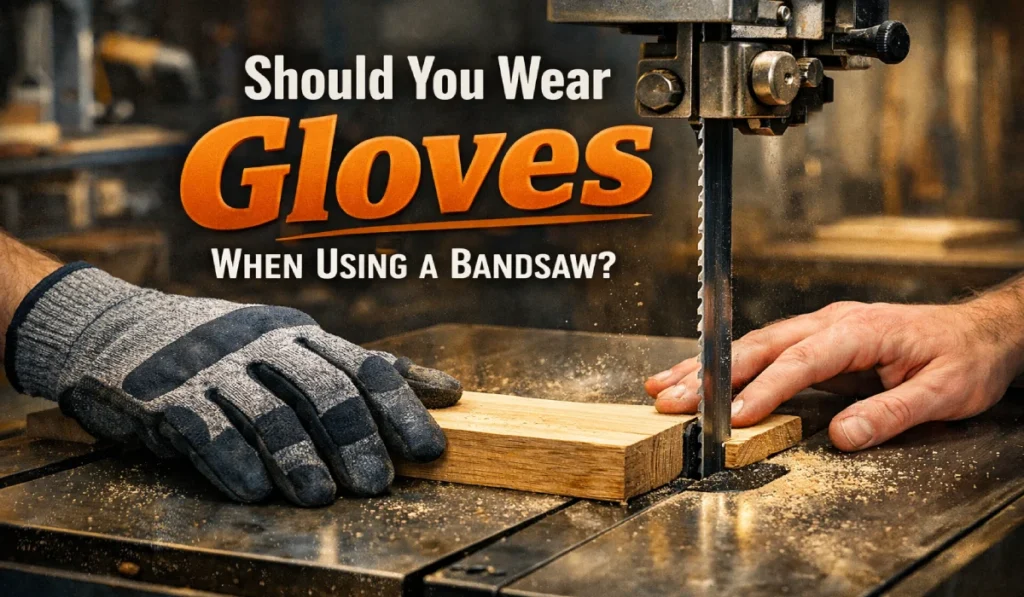
I’ve had apprentices ask me this constantly, usually on those bitter cold mornings when the shop isn’t fully heated yet: “Should I wear gloves when using the bandsaw?”
The short, hard, non-negotiable answer is no.
Actually, let me correct that. It’s a HELL NO.
While it might feel counterintuitive to expose your bare skin to a serrated steel ribbon moving at 3,000 feet per minute, wearing gloves while operating a bandsaw is statistically one of the most dangerous things you can do. In this guide, I’m going to break down exactly why that is, the gruesome mechanics of “degloving” injuries (sorry, but we have to talk about it), and the very few, specific exceptions where gloves are allowed near the machine.
The Golden Rule of Rotating Machinery
To understand why gloves are banned at the bandsaw, you have to understand the physics of rotating machinery. This rule applies to jointers, drill presses, lathes, and table saws, but it is particularly critical with the bandsaw.
The bandsaw blade is a continuous loop of toothed steel driving downwards toward the table. It relies on friction and the bite of the teeth to remove wood.
The Grip vs. The Slip
When you touch a spinning blade with your bare skin (an accident we all strive to avoid), the injury is usually a cut or a laceration. It’s painful, it bleeds, and it requires stitches. However, your skin has a natural tendency to tear away or pull back from the sharpness.
Fabric works differently. Leather, cotton, mechanics’ synthetic blends, and dipped nitrile gloves are designed to provide grip. When a fast-moving bandsaw tooth catches the fabric of a glove, it doesn’t just cut the fabric. It snags it.
Because the glove is wrapped tightly around your hand, that snag translates instantly into a pull. The machine has more torque than your wrist has strength. In a fraction of a second, the blade grabs the glove and pulls your hand into the cut zone.
The “False Security” of Gloves
I’ve seen guys on the jobsite argue that they are wearing “tight-fitting” mechanic gloves, so the risk is lower. They are wrong.
The bandsaw doesn’t care if the glove is baggy or tight. In fact, some tough materials (like Kevlar or thick leather) are actually worse in this scenario because they don’t tear easily. If the glove doesn’t rip immediately, the kinetic energy of the blade is transferred directly to your hand and arm, pulling you down into the table throat.
The Nightmare Scenario: What is “Degloving”?
I hate to get graphic, but sometimes fear is the best teacher. In the medical world and the woodworking safety community, the injury associated with gloves and rotating machinery is often called degloving or avulsion.
If your bare finger hits the blade, you might lose the tip of your finger. It’s a tragedy, but it’s often a clean amputation or a deep cut.
If a gloved finger hits the blade, the fabric gets entangled. The blade pulls the glove material down with immense force. Since the glove is attached to the skin of your hand, the machine can strip the skin, muscles, and tendons right off the bone structure of the hand, much like taking a glove off.
In my years in the trade, I’ve heard plenty of horror stories. The common thread in the worst machinery accidents is almost always loose clothing or gloves. A cut heals; a crushed and mangled hand pulled into a machine by a glove often does not.
Exceptions: When Should You Wear Gloves?
Now that I’ve scared you straight, let’s dial it back. I am not anti-glove. I have a pair of leather riggers and a pair of anti-vibration gloves in my apron at all times. There are two very specific times when gloves are not only allowed near a bandsaw but recommended.
1. Changing the Blade
This is the number one exception. Bandsaw blades are sharp, oily, and awkward. Even a dull blade has enough bite to slice your hand open if it coils unexpectedly.
When the machine is unplugged and powered down, you should absolutely wear leather gloves to change the blade.
- Coiling/Uncoiling: If you’ve ever tried to uncoil a 105-inch blade, you know it acts like a spring-loaded snake. It can snap open with force. Leather gloves protect your palms and wrists from these sudden movements.
- Tracking Setup: While mounting the blade, you are often handling the teeth directly to center them on the tire. Gloves prevent those jagged little nicks.
Crucial Step: Once the blade is on, tensioned, and the doors are closed, the gloves come off before you plug the machine back in.
2. Handling Rough Lumber (Away from the Cut)
If you are milling rough-sawn lumber, live-edge slabs, or reclaimed wood, splinters are a real issue. I’ve handled rough oak that looked like a cactus.
It is perfectly fine to wear gloves while moving this stock around your shop, stacking it, or bringing it to the bandsaw. However, the moment you are ready to make the cut:
- Place the wood on the table.
- Remove your gloves and put them in your back pocket.
- Turn on the saw.
- Make the cut.
It’s a hassle to take them on and off, I know. But that extra 10 seconds is the price of keeping your fingers.
If Not Gloves, Then What?
If you can’t wear gloves, how do you protect your hands? The goal of bandsaw safety is to keep your fleshy parts as far away from the blade as possible while maintaining control of the workpiece.
The Mighty Push Stick
Your hands should rarely be within 3 inches of the blade. If you are cutting a small piece, you need a push stick. I make my own out of scrap plywood with a “bird’s mouth” notch. If the blade slips or the wood twists, the push stick takes the damage, not your thumb.
Friction is Your Friend
One reason people want to wear gloves is to get a better grip on slick wood. If you are struggling to hold a piece of wood steady, gloves aren’t the answer—technique is.
- Clean the Table: A rusty or resin-filled cast iron table creates drag. Wax your table so the wood glides smoothly. This reduces the force you need to push, which reduces the chance of your hand slipping.
- Sharp Blades: A dull blade requires you to shove the wood hard. Pushing hard is dangerous. A sharp blade should cut with minimal feeding pressure.
Managing Splinters Without Gloves
“But what about the splinters?” This is the most common rebuttal I hear. If the wood is so rough that you can’t hold it safely without gloves, you have two options:
- Sand the contact points: Hit the sides of the board with 80-grit paper or a block plane just to knock down the sharp hazards where your hands will be placed.
- Use a Push Block: A push block with a rubber bottom (like you’d use on a jointer) allows you to put downward pressure and forward pressure on rough wood without your skin actually touching the splintery surface.
The Psychology of Shop Safety
Why do we still see people wearing gloves on YouTube or in forums? It usually boils down to complacency or comfort.
The “Cold Shop” Factor
I work in the Northeast. In January, my uninsulated shop can drop to freezing. It is incredibly tempting to keep my mechanic gloves on just to keep my fingers from going numb. Numb fingers are clumsy, right?
True, numb fingers are dangerous. But gloves are more dangerous. The solution isn’t PPE; it’s environment. Get a space heater, or use hand warmers in your pockets between cuts. Do not let thermal comfort compromise mechanical safety.
The “Tear-Away” Myth
I’ve heard manufacturers claim that certain nitrile gloves will “tear away” before pulling your hand in. While technically possible in low-torque situations, a 3HP bandsaw with a resaw blade doesn’t care about marketing claims. The speed at which the accident happens is faster than the material’s failure point. Don’t risk it.
General Bandsaw Safety Checklist
Since we are talking about what not to wear, let’s quickly cover what you should be doing to stay safe at the bandsaw.
- Safety Glasses are Mandatory: Bandsaws don’t kick back like table saws, but they do spit dust and occasionally snap blades.
- Roll Up Sleeves: Just like gloves, long loose sleeves are a catch hazard. Roll them above the elbow.
- Remove Jewelry: No rings, no watches, no dangling bracelets. If it can catch, it must go.
- Secure Loose Hair: If you have long hair, tie it back. Leaning in to check a cut line with long hair dangling is a recipe for disaster.
- Blade Guard Height: Keep the upper blade guide assembly no more than 1/4 inch above the stock. This minimizes the amount of exposed blade, reducing the chance of accidental contact.
Frequently Asked Questions (FAQ)
1. Can I wear nitrile (surgical) gloves while using a bandsaw?
No, it is not recommended. While thin nitrile gloves tear easier than leather, they still offer a “catch point” for the blade teeth. Furthermore, if a glove tears, it can distract you or obscure your view of the cut line, leading to an accident. The safest policy is bare hands.
2. Is it safe to wear gloves when using a scroll saw?
Scroll saws are much lower power and move slower than bandsaws, leading some to believe gloves are safe. However, the general safety rule for all moving blades remains the same: no gloves. You need tactile feedback from the workpiece, and gloves reduce your sensitivity and dexterity.
3. What should I do if the wood is too rough to hold without gloves?
If the wood is too splintery or rough to handle with bare hands, use a push block with a rubber sole or a push stick. Alternatively, take a moment to quickly sand or plane the specific areas where you need to place your hands.
4. Why are gloves okay for changing the blade but not running the saw?
When changing the blade, the saw is unplugged and has zero potential to pull your hand in. The danger during a blade change is a static cut from sharp teeth or the blade coiling back on you. Gloves protect against these static hazards. When the saw is running, the hazard changes to entanglement, which gloves exacerbate.
5. Does the “no glove” rule apply to all power tools?
It applies to almost all tools with rotating or moving parts. This includes table saws, jointers, planers, drill presses, lathes, and sanders. Gloves are generally safe for handheld power tools that don’t have exposed rotating mechanisms near the grip (like an oscillating multi-tool), but for stationary machinery, gloves are a major violation of safety protocol.
Conclusion: Respect the Machine
The bandsaw is generally considered one of the safer machines in the shop because it doesn’t suffer from the violent kickback of a table saw. But that reputation can breed a false sense of security.
The bandsaw is a flesh-cutting machine. It doesn’t know the difference between white oak and your index finger. By wearing gloves, you are tethering yourself to the workpiece and increasing the “grab” surface area for the blade teeth.
So, here is the final verdict: Keep the gloves on your bench, not your hands.
Use gloves to move lumber. Use gloves to change blades. But when that motor hums to life and the blade starts tracking, show the machine some respect and bare your hands. It’s the only way to ensure that you walk out of the shop with the same number of fingers you walked in with.
Stay safe, make sawdust, and keep those edges sharp.