
In the world of professional carpentry, the term “solid wood” gets thrown around like a badge of honor, while “rubberwood” is often treated like the mysterious newcomer on the block. If you’ve been browsing for a new dining table or planning a cabinetry build, you’ve likely run into the debate: Rubberwood vs. Solid Wood.
As someone who has spent decades covered in sawdust, running everything from vintage hand planes to the latest brushless table saws, I’ve seen how these materials behave under pressure. There is a lot of marketing fluff out there, but when you’re standing in a workshop, the only thing that matters is how the wood cuts, how it finishes, and how long it’s going to last in a real home.
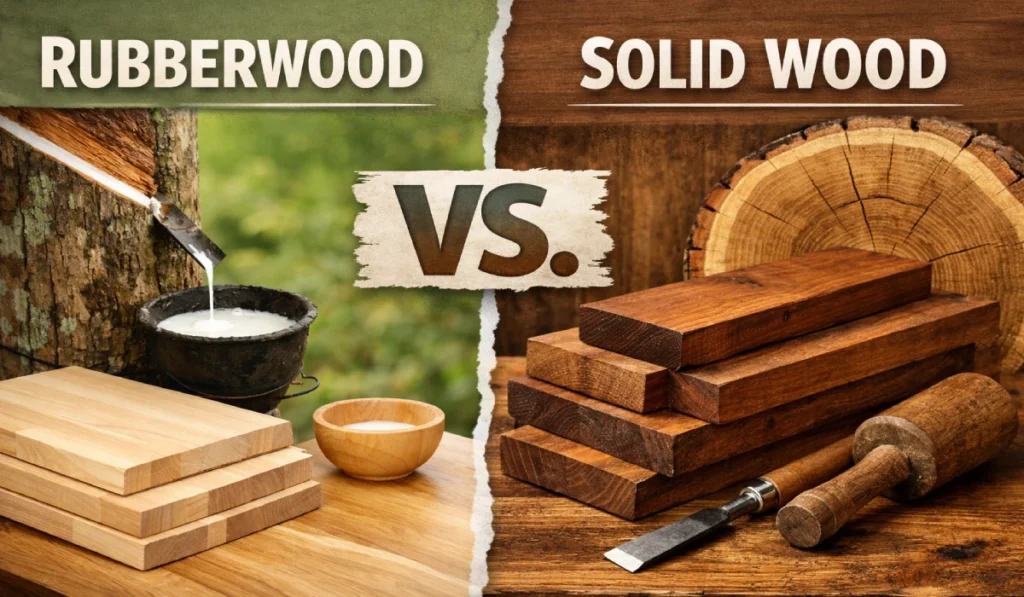
Let’s break down the “vs.” here. First, a quick correction: Rubberwood is solid wood. However, in the industry, “solid wood” usually refers to traditional hardwoods like Oak, Maple, or Walnut. Today, we’re going to look at how the eco-friendly underdog, Rubberwood, stacks up against the “heavy hitters” of the lumber yard.
What Exactly is Rubberwood? (Hint: It’s Not Made of Rubber)
One of the most common questions I get on the jobsite is, “Is rubberwood actually squishy?” The answer is a hard no.
Rubberwood comes from the Hevea brasiliensis tree-the same tree used to produce natural latex. For years, once these trees stopped producing latex (usually after about 25–30 years), they were simply cut down and burned to make room for new saplings.
In the last few decades, the industry got smart. Instead of wasting that timber, we started processing it into furniture-grade lumber. This makes rubberwood one of the most sustainable “solid woods” on the market today.
Durability and Hardness: The Janka Scale Reality
When pros talk about durability, we look at the Janka Hardness Scale. This measures the force required to embed a small steel ball halfway into the wood.
- Rubberwood: Sits at about 960 lbf.
- White Oak: Sits at about 1,360 lbf.
- Black Walnut: Sits at about 1,010 lbf.
As you can see, rubberwood is surprisingly close to Black Walnut in terms of hardness. It is a true hardwood. It isn’t as “bulletproof” as White Oak or Hickory, but it’s significantly tougher than softwoods like Pine or Cedar. In my experience, it handles the “toddler with a toy truck” test quite well, though it can be prone to scratching if you aren’t careful with your topcoats.
Working With the Grain: A Carpenter’s Perspective
From a woodworking standpoint, these materials offer very different experiences at the workbench.
1. Grain Pattern and Aesthetics
Traditional solid hardwoods like Oak are famous for their “cathedral” grain patterns and prominent rays. People pay a premium for that visual texture.
Rubberwood, on the other hand, has a relatively subtle, straight grain with a coarse texture. To the untrained eye, it looks a bit like Maple but with more open pores. It’s a “quiet” wood. This makes it fantastic for modern, minimalist furniture where you don’t want the wood grain to scream for attention.
2. Stability and Warping
This is where things get interesting. Rubberwood is known for having low kiln-dry shrinkage. In the shop, this means it is incredibly stable. When I’m building a large tabletop, I’m always worried about seasonal expansion and contraction-the movement that causes joints to crack or tops to cup.
Because rubberwood is processed after its “latex life,” and often finger-jointed into larger panels, it stays remarkably flat. Standard solid hardwoods like Cherry or Oak require much more “breathing room” in their joinery to account for humidity changes.
3. Taking a Finish
If you like the look of dark Walnut but don’t have the budget for it, rubberwood is a great “chameleon.” Because its natural color is a light cream to pale yellow, it takes stains very evenly.
Pro Tip: Since rubberwood has a somewhat open grain, I always recommend using a grain filler if you want a glass-smooth, high-gloss finish. If you’re going for a rustic or satin look, a simple wipe-on poly works wonders.
The Cost Factor: Why Your Wallet Might Prefer Rubberwood
Let’s talk brass tacks. In today’s market, the price of domestic hardwoods like Maple and Walnut has skyrocketed.
- Traditional Solid Wood: You are paying for the slow growth of the tree, the harvesting costs, and the prestige.
- Rubberwood: You are essentially buying a byproduct of the rubber industry.
Typically, rubberwood furniture or lumber can be 30% to 50% cheaper than Oak or Cherry. For a homeowner on a budget or a shop looking to keep overhead low, that’s a massive win. You’re getting the structural integrity of solid timber without the “luxury” price tag.
Sustainability: The Green Choice
If you care about where your lumber comes from, rubberwood wins by a landslide.
Most “solid wood” comes from forests that take 50 to 100 years to mature. While responsible forestry exists, it’s a slow process. Rubberwood is a renewable resource in the truest sense. Using it prevents the wood from being burned and puts a “waste” product to good use. For my eco-conscious clients, this is usually the deciding factor.
Common Use Cases: Which Should You Choose?
Choose Rubberwood If:
- You are building or buying furniture for a high-traffic area (like a breakfast nook) where you want durability without high costs.
- You plan on painting the piece. Rubberwood’s tight grain takes paint beautifully without the “bleed” issues you see in Red Oak.
- You want to be environmentally responsible.
Choose Traditional Hardwoods (Oak, Maple, Walnut) If:
- You want an heirloom-quality piece that will be passed down for generations.
- You love the natural, intricate beauty of wood grain and want it to be the centerpiece of the room.
- The project is for outdoor use. Rubberwood is NOT rot-resistant and should never be used for decks or outdoor furniture.
Maintenance: Keeping Your Wood Looking Sharp
Regardless of which side of the fence you land on, maintenance is key.
- Humidity Control: Both rubberwood and traditional hardwoods hate “dry” air. Keep your home between 35% and 55% humidity to prevent cracking.
- Cleaning: Never use harsh chemicals. A damp microfiber cloth is usually all you need.
- Refinishing: The beauty of both materials is that they can be sanded down and refinished. Unlike particle board or MDF, if you scratch your rubberwood table, you can grab a random orbital sander and some 120-grit paper and make it look new again.
Frequently Asked Questions (FAQ)
1. Does rubberwood smell like rubber? Not at all. Once it is seasoned and finished, it has a very faint, sweet woody scent, similar to most other hardwoods. The latex is removed during the processing stage.
2. Can I use rubberwood for outdoor projects? I wouldn’t recommend it. Rubberwood is susceptible to fungal decay and rot if it gets wet frequently. It’s strictly an indoor wood.
3. Is rubberwood prone to bugs? In its raw, untreated state, it can be. However, any rubberwood used for furniture is chemically treated and kiln-dried during manufacturing to prevent any infestation. It’s perfectly safe for your home.
4. How does rubberwood compare to MDF or Plywood? There is no comparison. Rubberwood is a natural, solid timber. It holds screws better, lasts longer, and can be repaired/sanded, unlike MDF or low-grade plywood.
5. Why is rubberwood often called “Parawood”? It’s the same thing! “Parawood” is just another name for Rubberwood, derived from the scientific name Hevea brasiliensis. Some retailers use it because it sounds a bit more “premium” than rubberwood.
The Verdict From the Shop Floor
Is rubberwood better than “solid wood”? No. Is it a “fake” or “cheap” substitute? Also no.
Rubberwood is a functional, reliable, and sustainable hardwood that fills a vital gap in the market. It offers the weight and feel of traditional timber at a fraction of the cost. However, it will never replace the soul and character of a century-old piece of White Oak or the deep, chocolatey hues of American Black Walnut.
When I’m building for a client who wants a “forever” table, I reach for the Oak. When I’m building a sturdy, beautiful kitchen island for a family that needs to stay on budget, I’ll recommend rubberwood every single time.