
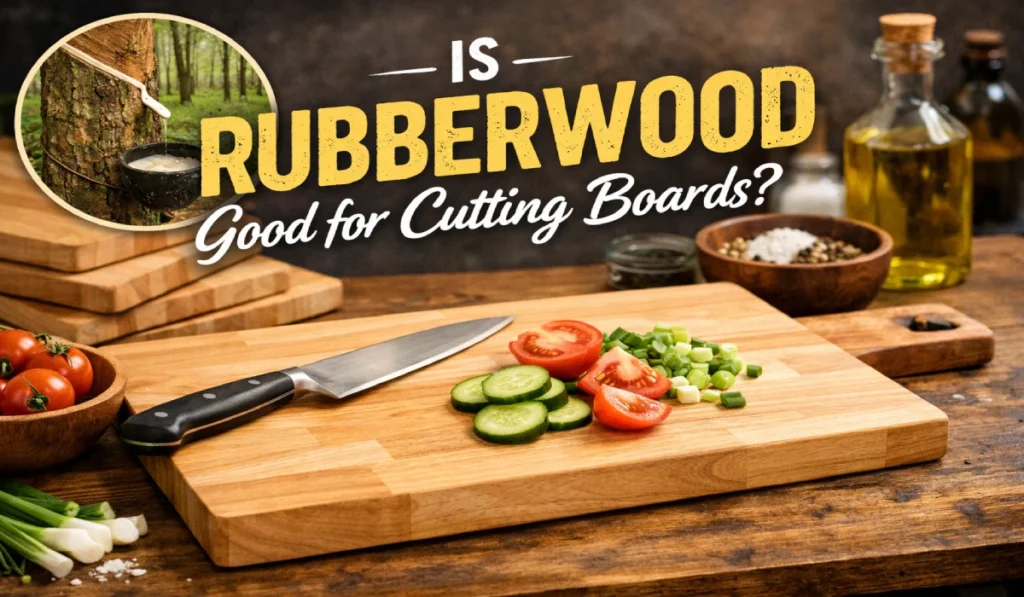
If you’ve spent any time browsing the kitchen aisles of a big-box store or scrolling through online home goods retailers lately, you’ve likely seen a surge in “Parawood” or rubberwood products. From dining tables to butcher blocks, this material is everywhere. But the big question for home cooks and hobbyist woodworkers alike is: Is rubberwood actually good for cutting boards?
As someone who has spent decades in the shop covered in sawdust and years on jobsites testing the limits of various timber species, I’ve seen how different woods react to moisture, sharp steel, and daily abuse. Rubberwood is a bit of a “dark horse” in the industry. It’s often marketed as an eco-friendly alternative to Maple or Walnut, but it comes with its own set of rules.
In this guide, we’re going to tear down the myths and look at the cold, hard facts about rubberwood to see if it deserves a spot on your kitchen counter.
What Exactly is Rubberwood?
Before we talk about knives and juices, let’s talk about the tree. Rubberwood (Hevea brasiliensis) is primarily grown in Southeast Asia. For about 25 to 30 years, these trees are tapped for their sap to produce natural rubber. Once the latex production dries up, the trees used to be burned.
In recent decades, the industry realized that this “waste” wood is actually a viable hardwood. This makes it incredibly sustainable—you aren’t cutting down old-growth forests; you’re using a byproduct of the rubber industry. In the trade, we often call it “Parawood” because it sounds a bit more high-end than “rubberwood,” but they are one and the same.
The Professional Breakdown: Durability and Hardness
When I evaluate a wood for a cutting board, the first thing I look at is the Janka Hardness Scale. This measures how much force is required to embed a small steel ball into the wood.
- Hard Maple (the gold standard): 1,450 lbf
- Black Walnut: 1,010 lbf
- Rubberwood: 960 to 995 lbf
As you can see, rubberwood sits just slightly below Black Walnut. In the woodworking world, this is a “sweet spot.” It is hard enough to withstand the pressure of a sharp chef’s knife without getting gouged instantly, yet it isn’t so hard that it will roll the edge of your expensive German or Japanese steel.
If a wood is too soft (like Pine or Cedar), your knife will create deep valleys where bacteria can hide. If it’s too hard (like Bamboo or Ipe), you’ll be sharpening your knives every single week. Rubberwood hits a very respectable middle ground.
Is Rubberwood Food Safe?
This is the number one concern I hear from clients. Since it comes from a tree that produces latex, people worry about chemicals or allergic reactions.
1. The Latex Factor
While the tree produces latex, the wood itself contains very little of it once it has been kiln-dried and processed. Most people with a latex allergy do not react to finished rubberwood products. However, if you have an extremely severe, life-threatening latex allergy, I always tell folks to play it safe and stick with North American Hard Maple.
2. The Treatment Process
Here is where you need to be careful. Because rubberwood is a tropical species with a high sugar content, it is susceptible to fungus and insects. To prevent this, the raw lumber is often treated with chemicals (like boron) immediately after being felled.
When buying a rubberwood cutting board, you must ensure it is labeled “Food Grade” or “Food Safe.” This means the manufacturer has properly sealed the wood and used FDA-approved glues. If you are buying raw rubberwood lumber to make your own board, make sure you know its origin and treatment history.
The Pros of Rubberwood Cutting Boards
1. Dimensional Stability
In my experience, rubberwood is surprisingly stable. It doesn’t shrink or swell as drastically as some of our domestic hardwoods when the humidity changes. In a kitchen environment—where the board goes from bone-dry to soaking wet—this stability prevents the board from warping or “cupping” on your counter.
2. Price Point
Let’s be real: clear-grade Walnut and Maple prices have skyrocketed. Rubberwood is significantly more affordable. You can often get a thick, end-grain rubberwood butcher block for a fraction of the price of a domestic equivalent. For a heavy-use kitchen tool, that value is hard to beat.
3. Eco-Friendly Credentials
If you’re looking to minimize your environmental footprint, rubberwood is a winner. It is essentially a recycled material from the plantation industry. You’re giving a second life to a tree that has already served a 30-year purpose.
4. Knife-Friendly Grain
The grain of rubberwood is relatively dense but has a slight “give.” When your knife strikes the board, the wood fibers absorb the impact rather than resisting it. This keeps your knives sharper for longer compared to plastic or glass (which you should never use!) boards.
The Cons of Rubberwood Cutting Boards
1. Moisture Sensitivity
Rubberwood is essentially a giant sponge if left untreated. It is a “thirsty” wood. If you leave it sitting in a puddle of water in the sink, it will absorb moisture faster than Maple. This can lead to rot or the breakdown of the glue joints.
2. Aesthetics
While it has a nice, light-blonde-to-straw color, the grain pattern is somewhat “fuzzy” or speckled. It lacks the elegant, swirling grain of Cherry or the deep, chocolatey tones of Walnut. It’s a utilitarian wood—it looks clean and modern, but it won’t be the centerpiece of a high-end kitchen remodel.
3. Odor Absorption
Because it is more porous than some hardwoods, rubberwood can sometimes hang onto smells like garlic or onion if it isn’t properly seasoned with mineral oil.
The Expert’s Guide to Maintenance
If you decide to go with a rubberwood board, you can’t just throw it in the dishwasher and forget about it. (In fact, if I catch you putting any wood board in the dishwasher, we’re going to have a serious talk!)
To keep a rubberwood board in top shape, follow this pro routine:
- Seasoning: When you first get the board, coat it in food-grade mineral oil. Let it soak in for 20 minutes and wipe off the excess. Repeat this until the wood stops “drinking” the oil.
- The “Bee” Secret: I always recommend a 3-to-1 mixture of mineral oil and beeswax. The wax creates a physical barrier on the surface that helps shed water, which is crucial for a porous wood like rubberwood.
- Cleaning: Wash with warm, soapy water. Never submerge it. Dry it immediately with a clean towel and stand it up on its edge so both sides can air dry evenly.
- Refacing: If the board gets heavily scarred after a year of use, don’t throw it out! Take some 80-grit sandpaper followed by 120 and 220-grit, sand it smooth, and re-oil it. It’ll look brand new.
End-Grain vs. Edge-Grain Rubberwood
When shopping, you’ll see two types of construction.
- Edge-Grain: The wood is laid flat. These are cheaper and easier to find. They are fine for light prep work, but they will show knife marks more quickly.
- End-Grain: The wood fibers stand vertically (like a brush). This is the “pro” choice. When the knife hits an end-grain board, it slides between the wood fibers rather than cutting through them. For rubberwood, I highly recommend end-grain because it compensates for the wood’s natural porosity by allowing the oil to penetrate deeper into the fibers.
How Does it Compare to Other Materials?
| Feature | Rubberwood | Hard Maple | Bamboo | Plastic |
| Durability | High | Very High | High | Low |
| Knife Friendliness | Excellent | Excellent | Poor (Dulls knives) | Good |
| Sustainability | Best | Good | Great | Poor |
| Price | Low/Mid | High | Low | Very Low |
| Maintenance | Moderate | Moderate | Moderate | Low |
Frequently Asked Questions (FAQ)
1. Does rubberwood smell like rubber?
No. Once the wood is processed and dried, it has a very neutral, slightly sweet woody scent. It does not smell like a car tire. Any “factory” smell you might notice on a new board is usually the shipping plastic or the initial mineral oil coating.
2. Is rubberwood better than Bamboo?
In my shop, rubberwood wins every time. Bamboo is technically a grass and is held together with a massive amount of glue. Bamboo is also very high in silica, which acts like sandpaper on your knife edges. Rubberwood is a true hardwood and is much kinder to your cutlery.
3. Can I use olive oil to season my rubberwood board?
Absolutely not. Never use vegetable oils (olive, canola, sunflower) to season any wood cutting board. These oils are organic and will go rancid over time, leaving your board smelling like spoiled food. Always use food-grade mineral oil or specialized “butcher block conditioner.”
4. How often should I oil a rubberwood cutting board?
Because rubberwood is more porous than Maple, I recommend oiling it once a month if you use it daily. A good rule of thumb: if the wood starts to look pale or feels “thirsty” and dry to the touch, it’s time for a coat of oil.
5. Can rubberwood handle raw meat?
Yes, as long as the board is properly seasoned with oil and wax. The oil fills the wood’s pores, preventing meat juices from soaking in. After cutting raw meat, sanitize the board with a mild bleach solution or white vinegar, wash with soap, dry immediately, and re-apply a light coat of oil
The Verdict: Should You Buy One?
In my professional opinion, yes, rubberwood is an excellent choice for a cutting board, provided you understand what you’re buying.
It is the perfect “workhorse” board. If you want a tool that performs almost as well as Hard Maple but costs 40% less, rubberwood is your best friend. It’s a fantastic choice for home cooks who prepare fresh meals daily and want a sustainable, knife-friendly surface.
However, if you are looking for a “heirloom” piece that you’ll pass down to your grandkids, or if you have a severe latex allergy, I’d suggest spending the extra money on a high-quality North American Rock Maple or Black Walnut board.
Rubberwood isn’t “cheap wood”-it’s smart wood. Treat it with a little oil and a lot of respect, and it will serve your kitchen for years.