

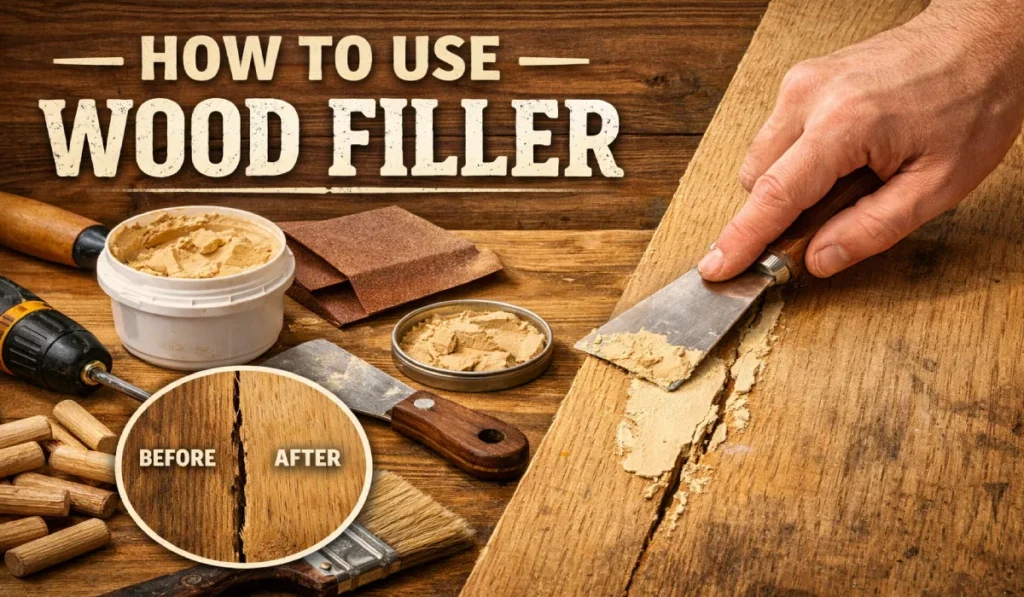
If you spend enough time in the shop or on a jobsite, you’re going to have gaps. It doesn’t matter if you’ve been woodworking for thirty years or thirty minutes-wood is a natural material that moves, warps, and sometimes just doesn’t cooperate. Maybe a knot popped out during planing, or your miter joint is just a hair open on the heel.
I’ve seen a lot of apprentices panic when they see a gap, thinking the piece is ruined. It’s not. Knowing how to use wood filler correctly is what separates a finished project from a scrap pile. It is one of the most essential skills in carpentry, yet it’s often done poorly.
In this guide, I’m going to break down everything I know about wood filler-from choosing the right type for your project to the specific techniques I use to make repairs vanish.
Wood Filler vs. Wood Putty: Know the Difference
Before we crack open a can, we need to clear up the biggest misconception in the finishing aisle. Wood filler and wood putty are not the same thing. I see DIYers mix these up constantly, and it ruins their finish.
Wood Filler
- When to use it: Before you apply a finish (stain, clear coat, paint).
- Properties: It hardens as it dries. It can be sanded, shaped, and drilled.
- Best for: Filling grain, repairing cracks, fixing nail holes in raw wood, and smoothing out tabletop imperfections.
- Base: Usually water-based or solvent-based.
Wood Putty
- When to use it: After you apply a finish.
- Properties: It stays somewhat soft and pliable. It cannot be sanded (it will gum up your paper).
- Best for: Filling tiny brad nail holes on pre-finished molding or flooring.
- Base: Usually oil-based.
The Golden Rule: If you are still building and sanding, use wood filler. If you are already done staining and sealing, use wood putty.
Choosing the Right Filler for the Job
Not all fillers are created equal. In my shop, I keep three specific types on hand. Here is how I decide which one to grab.
1. Water-Based Wood Filler (The Generalist)
This is my go-to for interior furniture and cabinetry. Brands like Timbermate or Elmer’s are common here.
- Pros: Dries fast, cleans up with water, very easy to sand, emits low fumes.
- Cons: Not structural; can crack in large holes.
Pro Tip: If it dries out in the tub, you can usually revive it with a few drops of warm water.
2. Solvent-Based Filler (The Heavy Lifter)
Use this for exterior work or larger gaps where durability matters. Famowood is a classic example.
- Pros: Bonds extremely well, sets rock hard, resists shrinking better than water-based.
- Cons: Smells strong (use ventilation), requires acetone or mineral spirits for cleanup, dries very fast while working.
3. Two-Part Wood Epoxy (The Rebuilder)
Think of this like Bondo for wood. If you are repairing a rotted window sill or a stripped screw hole, standard filler will fail. You need a two-part epoxy.
- Pros: Structural strength, waterproof, does not shrink.
- Cons: Expensive, harder to sand, must be mixed preciseley.
Step-by-Step: How to Apply Wood Filler Like a Pro
Now that you have the right product, let’s get to work. Most people just smear it on and hope for the best. That leads to sunken repairs and halo effects around the patch. Follow this process for a seamless repair.
Step 1: Prep the Surface
Wood filler needs a clean surface to bond to. If there is sawdust, grease, or loose wood fibers in the hole, the filler will pop out later.
- Clean it out: Use a stiff bristle brush or compressed air to blow out the defect.
- Remove loose fibers: If you are filling a gouge with splintered edges, take a utility knife or a chisel and pare away the loose fibers. You want a clean, solid edge for the filler to butt against.
- Sand lightly: Hit the area with 150-grit sandpaper to remove any surface oils.
Step 2: The Application (Overfill is Key)
Grab a putty knife. I prefer a flexible metal knife for flat surfaces and a plastic card or rubber spatula for curved profiles.
- Scoop a small amount: Don’t overload your knife. It’s easier to control a small bead.
- Press firmly: Drive the filler into the hole. You aren’t just covering the top; you want to displace the air inside the crack. If you don’t press hard, you’ll get air pockets.
- Leave it proud: This is the most important step. Wood filler shrinks. As the moisture or solvent evaporates, the volume decreases. If you swipe it perfectly flat while it’s wet, it will be a concave depression when it dries. Leave a mound of filler slightly higher than the surrounding wood surface.
Pro Tip: If you are filling a deep hole (deeper than 1/4 inch), don’t try to do it in one pass. It will take forever to dry and might crack. Fill it halfway, let it dry, and then do a second coat.
Step 3: The Waiting Game
Patience is a tool in woodworking. If you sand filler while it is still gummy in the center, you will tear it out and clog your sandpaper instantly.
- Water-based: usually ready in 15–30 minutes for shallow fills.
- Solvent-based: 10–20 minutes.
- Epoxy: Check the label, usually 1–24 hours.
How to tell if it’s dry: Touch it. If it feels cool to the touch, it is still holding moisture. It should feel dry and room temperature.
Step 4: Sanding Flush
Once fully cured, it’s time to level it out.
- Start with the surrounding grit: If you sanded the project to 120-grit before filling, start sanding the filler with 120-grit.
- Use a backing block: Never sand filler with just your fingers. Your fingertips are soft and will dig into the filler (which is often softer than the wood), creating a dip. Use a hard sanding block to ensure the filler ends up perfectly flush with the wood.
- Sand with the grain: Just like sanding wood, always move your abrasive in the direction of the grain fibers.
- Inspect by touch: Close your eyes and run your fingers over the repair. Your fingers can detect ridges and dips better than your eyes can.
The “Stainable” Myth: Troubleshooting Color
Every can of wood filler says “Stainable” on the label. As a professional, I’m telling you to take that with a grain of salt. Wood filler does not absorb stain the same way natural wood fibers do. It lacks the cellular structure of wood (pores and veins).
Often, when you stain over a patch, the filler turns out much darker or much lighter than the surrounding wood. Here is how I manage that.
1. Match the Filler to the Finished Color, Not the Raw Wood
If you are planning to stain your White Oak with a dark Walnut stain, don’t use a “White Oak” colored filler. It will stick out like a sore thumb. Use a filler that is closer to the final stain color. Or, better yet, mix a drop of your stain liquid directly into the wet wood filler before applying it.
2. The Sawdust Trick (The DIY Filler)
For the absolute best color match, I make my own filler.
- The Recipe: Take fine sanding dust from the actual project you are working on (from your orbital sander bag) and mix it with a high-quality wood glue (like Titebond II or III).
- The Consistency: Mix it until it looks like peanut butter.
- Why it works: Because it is made of the same wood species, it will react to the finish much more similarly than a store-bought paste.
- Note: This mixture is harder to sand than commercial filler, so be careful not to dish out the surrounding wood while sanding the patch.
3. Grain Simulation
If you have a large patch on a prominent surface, it will look like a flat blob of color. After staining, I sometimes take a fine-tip Sharpie or specialized graining pen and gently draw in grain lines to connect the natural wood grain across the patch. It sounds artistic, but it’s surprisingly easy and effective.
Common Mistakes to Avoid
I’ve made all these mistakes so you don’t have to.
Using Filler on Joints that Move
Wood filler has very little tensile strength. If you have a loose chair leg or a table apron that is wiggling, stuffing filler in the crack won’t fix it. The movement will crack the filler out in a week. Glue fixes joints; filler hides cosmetic gaps. Fix the structure first.
Sanding Too High of a Grit
If you sand your wood filler to 400-grit but the rest of the wood is at 180-grit, the stain will penetrate differently. The filler will look “polished” and won’t take the color. Keep the sanding grit consistent across the whole piece.
Ignoring the Cleanup
Solvent-based fillers dry fast. If you leave the lid off the can while you hunt for a putty knife, you’ll come back to a hockey puck. Always recap immediately. Also, clean your putty knife right away. Once that stuff hardens on your knife, you’ll need a chisel to get it off.
When NOT to Use Wood Filler
There are times when filler is the wrong tool.
- Large structural voids: If a screw stripped out of a door hinge, filler won’t hold the new screw. You need to drill it out and glue in a dowel plug.
- Decking gaps: If you are trying to fill the gaps between deck boards, stop. Those gaps are there for drainage and expansion. Filling them will cause rot.
- High-Movement Outdoor cracks: If you have a large check (crack) in a timber post outside, standard filler will eventually crack and fall out due to freeze/thaw cycles. Use a flexible caulk or epoxy specifically designed for exterior extremes.
Frequently Asked Questions (FAQ)
Can I drill a screw into wood filler?
Generally, no. Standard wood filler is brittle and will crumble under the torque of a screw. If you need to re-drill a hole, use a two-part wood epoxy or drill the hole out larger and glue in a solid wood dowel/plug.
How long does wood filler take to dry?
Shallow repairs with water-based filler can be sanded in 15 to 30 minutes. Deep repairs or solvent-based fillers may need 2 to 4 hours. Always err on the side of waiting longer; sanding wet filler ruins the repair.
Can I use wood filler on painted wood?
Absolutely. In fact, it’s easier to use on painted projects because you don’t have to worry about color matching. Just fill, sand flush, prime, and paint.
Does wood filler shrink?
Yes, almost all wood fillers shrink as the solvent or water evaporates. This is why it is critical to overfill the repair slightly so that when it shrinks, it settles level with the surface rather than below it.
Finish Like a Pro: Make Repairs Disappear
Using wood filler isn’t about covering up sloppy work; it’s about refining the final product. Wood is an organic material-it has knots, voids, and inconsistencies. Knowing how to manipulate filler to mask those imperfections is a hallmark of a skilled craftsman.
Remember: Prep the hole, overfill it, let it dry completely, and use a block to sand it flush. If you follow those steps, you’ll be the only one who knows the repair is there. Now, get out into the shop and make some sawdust.