
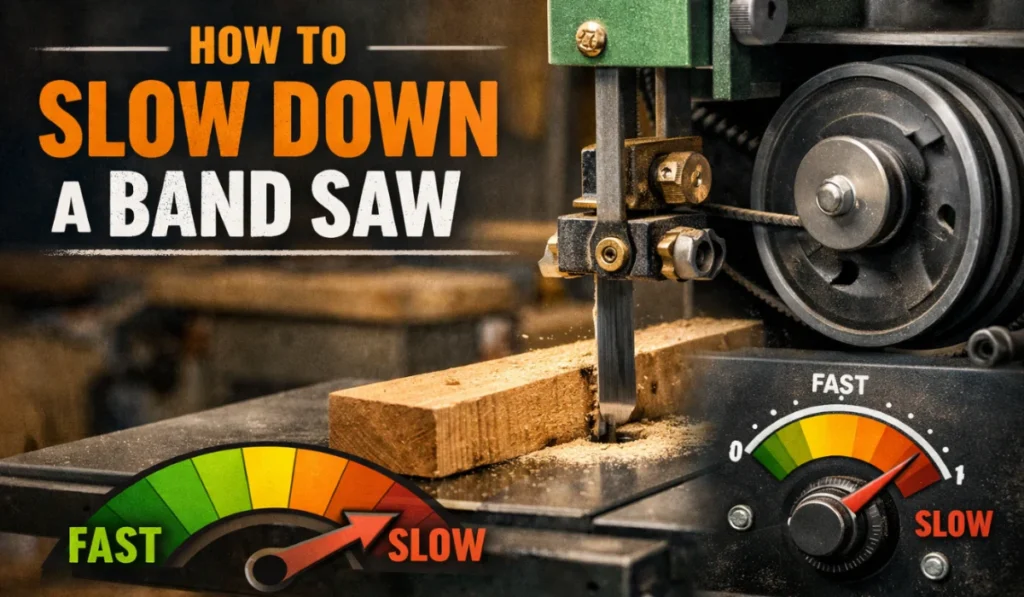
If you’ve spent enough time in the shop, you’ve probably hit that wall where your band saw just feels… too aggressive. Maybe you’re trying to cut a piece of thick acrylic and it’s melting back together behind the blade. Maybe you scored a piece of mild steel and thought, “I’ll just run this through the band saw,” only to watch the teeth strip off your blade in a shower of expensive sparks.
Most standard 14-inch and bigger wood band saws are set up for one thing: ripping and resawing lumber. They typically run at about 3,000 Surface Feet Per Minute (SFPM). That is perfect for pine, oak, and maple. It is terrible for steel, which needs to be cut closer to 100-300 SFPM, or thermoplastics that require a slower pace to prevent friction welding.
I’ve modified half a dozen saws over the years, from old Delta Rockwells to modern Rikons, to get them to run at the speeds I need. Whether you are looking to cut metal, stop burning exotic hardwoods, or work with delicate plastics, slowing down your machine is the answer.
In this guide, I’m going to walk you through exactly how to slow down a band saw, the mechanics behind it, and which method is right for your shop and budget.
Why Speed Matters: Understanding SFPM
Before we start turning wrenches, we have to talk about SFPM. Surface Feet Per Minute is the measurement of how many feet of blade pass a single point in sixty seconds.
Wood is fibrous and soft. It cuts best with high speed and aggressive feed rates to clear chips. If you run too slow in wood, you lose momentum, the blade bogs down, and you get a rough cut.
Metal and plastic are different.
- Steel/Iron: Requires high torque and very low speed (100–300 SFPM). If you run a wood blade at 3,000 SFPM into steel, the friction generates instantaneous heat that softens the blade teeth, dulling them immediately.
- Non-Ferrous Metals (Aluminum/Brass): Can handle medium speeds (1,000–2,000 SFPM) but often benefit from slower speeds than wood to prevent gumming up the gullets.
- Plastics: High speed creates friction heat. Since plastic doesn’t conduct heat away like metal, it melts. You need a slower speed to create a chip rather than a slurry.
If you are just burning cherry or maple during a rip cut, your problem likely isn’t speed—it’s a dull blade, poor tension, or a bad setup. But if you are changing materials, you need to change your speed. Here is how we do it.
Method 1: The Step Pulley Swap (The Free Fix)
Many older band saws, and even some modern “multi-speed” saws, come with step pulleys already installed. This is the first place you should look.
Open the lower cabinet door of your saw. Look at the pulley attached to the motor and the pulley attached to the lower wheel shaft.
- Single Pulley: You have one speed. Skip to Method 2.
- Step Pulley: These look like stacked pancakes of different sizes.
How to Adjust Step Pulleys
If you have step pulleys, changing speed is just like shifting gears on a bicycle, but you have to move the chain (belt) manually.
- Unplug the Saw: Never touch the drivetrain while the machine is hot.
- Relieve Tension: There is usually a tensioning bolt or a lever on the motor mount. Loosen it so the motor swings free and the belt goes slack.
- Move the Belt:
- To Slow Down: Move the belt to the smallest step on the Motor Pulley and the largest step on the Wheel Pulley.
- To Speed Up: Do the opposite.
- Re-tension: Pull the motor back to tightens the belt and lock it down. You want about 1/4″ to 1/2″ of deflection in the belt when you press it with your thumb.
The Limitation: Step pulleys usually only drop your speed by half. If your saw runs at 3,000 SFPM, the slow speed might be 1,500 SFPM. This is great for sawing aluminum or huge timbers, but it is still way too fast for steel.
Method 2: Changing Pulley Ratios (The Mechanical Fix)
If you don’t have step pulleys, or the stock ones don’t get you slow enough, you can swap the pulleys out entirely. This is a cheap, mechanical solution that I’ve used on dedicated shop saws many times.
The Physics of Pulleys
The math is simple: Smaller Motor Pulley + Larger Wheel Pulley = Slower Blade.
Let’s say you have a 1,725 RPM motor.
- Current Setup: 3″ pulley on motor, 6″ pulley on the wheel. This is a 1:2 ratio. The wheel turns at half the motor speed.
- New Setup: 2″ pulley on motor, 8″ pulley on the wheel. This is a 1:4 ratio. The wheel turns at quarter speed.
Practical Steps to Swap Pulleys
- Measure Your Shafts: You need to know the diameter of your motor shaft (usually 5/8″ or 1/2″) and the lower wheel shaft. You also need to know if they use a keyway (a square notch).
- Buy Cast Iron Pulleys: Do not buy cheap stamped steel or zinc die-cast pulleys for a band saw. They vibrate. Buy machined cast iron pulleys (BK style are common).
- Install the New Pulleys:
- Remove the old pulleys (you might need a gear puller if they are rusted on).
- Slide the new ones on, insert the key stock, and tighten the set screw.
- Crucial Step: You must align the pulleys. Use a straightedge ruler across the faces of both pulleys. If they aren’t perfectly inline, the belt will wear out in a week and your saw will vibrate like a washing machine with a brick in it.
- Check Belt Length: Changing pulley sizes usually changes the distance required. You will likely need to buy a shorter or longer V-belt (usually A-series or 4L belts for woodworking saws).
Pro Tip: There is a limit here. If the wheel pulley gets too big, it hits the cabinet door. If the motor pulley gets too small (under 2 inches), the belt slips because there isn’t enough surface area for grip.
Method 3: The Jackshaft System (For Cutting Steel)
If you want to cut steel on a wood band saw, simply swapping two pulleys won’t work. You can’t get the ratio low enough. You need a reduction of roughly 20:1.
To do this, we build a Jackshaft. This is an intermediate axle with two pulleys on it.
How a Jackshaft Works
Instead of the belt going from the Motor -> Wheel, it goes: Motor -> Large Pulley on Jackshaft -> Small Pulley on Jackshaft -> Large Pulley on Wheel.
It’s a double reduction.
- Motor (2″ pulley) drives the Jackshaft Input (10″ pulley). Speed is cut by 5.
- Jackshaft Output (2″ pulley) drives the Band Saw Wheel (10″ pulley). Speed is cut by 5 again.
- Total reduction is massive.
Building It
I’ve built these using pillow block bearings mounted to a piece of plywood bolted to the saw stand.
- Mount two pillow block bearings on a board.
- Run a steel shaft through them.
- Put a big pulley on one end and a small pulley on the other.
- Connect the motor to the big pulley.
- Connect the small pulley to the saw.
This turns a 3,000 SFPM wood saw into a 150 SFPM metal-eating machine. It requires fabrication skills, but it’s the only mechanical way to get true metal-cutting speeds on a wood saw.
Method 4: Variable Frequency Drive (The Modern Upgrade)
If you have a bit of budget and want the “Cadillac” solution, you want a Variable Frequency Drive (VFD). This is an electronic box that controls the frequency (Hz) of the electricity going to your motor, allowing you to dial the speed up or down with a knob.
The Catch: You Need a 3-Phase Motor
Standard residential wall outlets are Single Phase. VFDs generally work by taking Single Phase power and converting it to 3-Phase power, while varying the frequency.
- If your saw already has a 3-phase motor (common in industrial auctions): You are golden. Buy a VFD.
- If your saw has a standard 1-phase motor (most home shop saws): You cannot use a standard VFD. You would need to replace the motor with a 3-phase motor, then install the VFD.
Why I Love the VFD Setup
I converted my 18″ Rikon to a 3-phase motor with a VFD last year, and I’ll never go back.
- Infinite Control: I can run at 5% speed for steel or 100% speed for resawing wood.
- Soft Start: The blade doesn’t jerk to life; it ramps up slowly. This is easier on the tires and bearings.
- Electronic Braking: You can program the VFD to stop the blade in 3 seconds when you hit the switch, rather than waiting a minute for it to coast down.
Is it Worth the Cost?
A 2HP 3-phase motor costs around $200-$300. A decent VFD (like a Teco-Westinghouse or a generic Huanyang) costs $100-$200. For $400, you get a machine that can cut literally anything. If you are serious about mixed-media fabrication, this is the route to take.
Blade Selection: The Hidden Factor
Slowing the saw down is only half the equation. You must match the blade to the speed and material.
If you successfully slow your saw down to 200 SFPM for steel, but you leave your 3 TPI (Teeth Per Inch) timber-wolf resaw blade on there, you are going to have a bad day. The teeth will hook the metal and strip instantly.
The General Rules:
- Slow Speed (Metal): High tooth count. 14 TPI to 24 TPI. You want fine teeth that chip away at the hard material. Use Bi-Metal blades; standard carbon steel blades dull too fast on steel.
- Medium Speed (Plastics/Non-Ferrous): 6 TPI to 10 TPI. You need some gullet space to clear the plastic chips so they don’t reweld, but enough teeth to leave a clean edge.
- High Speed (Wood): 2 TPI to 4 TPI. Deep gullets to clear sawdust.
Troubleshooting: Issues When Slowing Down
When you modify a machine, you introduce new variables. Here is what to watch out for.
1. Loss of Torque
This is the biggest issue with Method 4 (VFDs). As you reduce the Hz to slow the motor, you also reduce the cooling fan speed and potentially the torque.
- The Fix: If using a VFD, buy a “Sensorless Vector” drive. These are smart enough to boost the voltage at low RPMs to maintain torque. Also, watch your motor temp. If running at 10% speed for an hour, the internal fan isn’t moving enough air. You might need an external fan blowing on the motor fins.
2. Vibration
This is common with Method 2 (Pulley Swap). If you use a single belt on a small pulley, it can develop a “set” or memory if it sits too long, causing a thump-thump-thump rhythm.
- The Fix: Use a “Link Belt” (those red segmented belts). They run smoother and reduce vibration significantly on modified setups.
3. Tracking Issues
When you change speed, sometimes the tracking on the tires changes slightly due to centrifugal force differences.
- The Fix: Always hand-spin the wheels after making speed adjustments to ensure the blade is still riding the center of the tire (or the crown, depending on your wheel type) before turning the power on.
Safety: The Danger of “Low Speed”
Do not be lulled into a false sense of security just because the blade is moving slowly. A band saw moving at 100 SFPM has immense torque. If it catches a piece of metal or a rag, it will not stall—it will pull.
- Clamp your work: When cutting metal, the blade grabs harder than it does with wood. Use a drill press vise or a specialized clamp to hold the metal. Never freehand cut round pipe; it will spin in your hands and pull your fingers into the blade.
- Lubrication: When cutting metal at slow speeds, friction is still high. Use a stick of cutting wax or a spray of cutting fluid to keep the blade cool.
Frequently Asked Questions (FAQ)
1. Can I use a dimmer switch to slow down my band saw motor?
Absolutely not. Dimmer switches (like for lights) or router speed controllers work on “Universal” motors (like in drills or routers) that have brushes. Band saws use “Induction” motors (with capacitors). Using a dimmer switch on an induction motor will cause it to overheat, hum loudly, and burn out the capacitors or the windings in minutes. Do not do this.
2. How slow does my band saw need to be to cut steel?
To cut mild steel, you generally need a blade speed between 100 and 300 SFPM. Most wood band saws run at 3,000 SFPM. This means you need to reduce the speed by a factor of 10 to 30. Simply changing one pulley usually isn’t enough; you typically need a jackshaft reduction or a 3-phase motor with a VFD.
3. Can I cut aluminum without slowing down my band saw?
Yes, usually. Aluminum is soft enough that you can cut it at wood speeds (3,000 SFPM), provided you use the right blade (8-14 TPI) and—this is critical—lubrication. Without wax or oil, aluminum will melt and “gum up” the blade teeth, ruining the blade. However, slowing the saw down to 1,000-1,500 SFPM makes the cut much more controllable and safer.
4. What is the formula to calculate SFPM on my band saw?
The formula is: (Motor RPM × Motor Pulley Diameter) ÷ Driven Pulley Diameter × 0.262 = SFPM
- Motor RPM: Usually 1725 or 3450 (check the plate on the motor).
- 0.262: This converts the wheel circumference (based on diameter) into feet. Alternatively, just mark the blade with a piece of white tape, spin the wheel by hand for one revolution, measure how far the tape moved in feet, and multiply by the RPM of the wheel.
5. Will slowing down the band saw affect the tension?
Indirectly, yes. Changes in drive belts (length or thickness) can alter the geometry of the motor mount. After any modification to speed, pulleys, or belts, you must re-check your blade tension. Furthermore, cutting harder materials like steel generally requires higher blade tension (and a beam strength blade) compared to cutting soft pine.
The Simple Upgrade That Transforms Your Workshop
Slowing down a band saw opens up a new world of fabrication. You stop being just a “woodworker” and become a “maker.” Suddenly, fabricating a custom steel bracket for a table leg or cutting intricate acrylic templates becomes something you can do right in your own shop.
For most people, checking for step pulleys is the first move. It’s free and easy. If you need to cut steel regularly, I highly recommend looking into the VFD conversion. It’s an investment, but having a dial-controlled variable speed band saw is one of the most satisfying upgrades I’ve ever made to my shop.
Take your time, watch your fingers, and make some sawdust (or metal chips).