

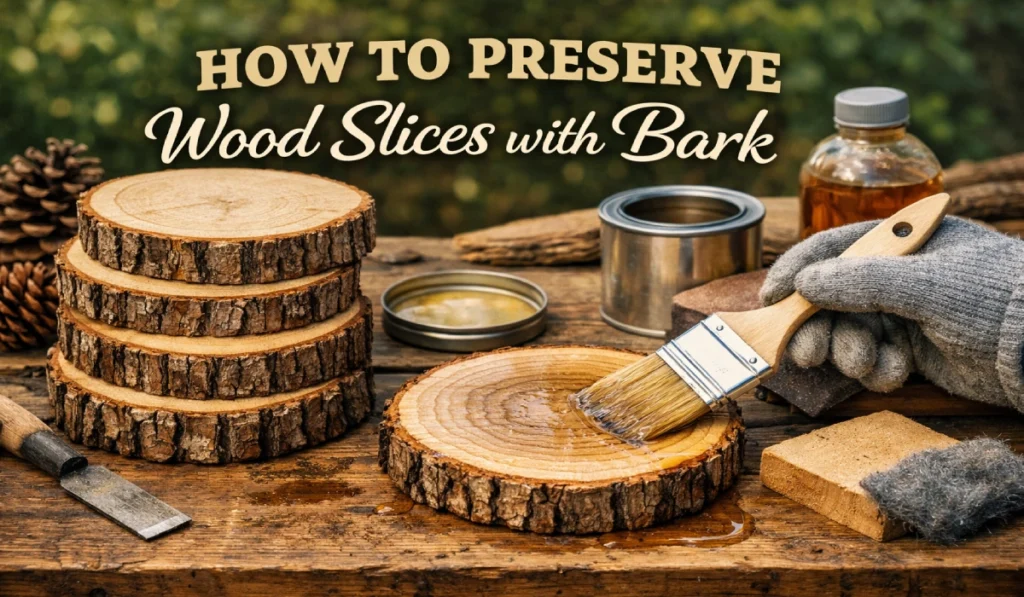
If you’ve spent any time in the shop or scrolling through Pinterest, you’ve seen them: rustic wood slices used for everything from wedding centerpieces and coasters to massive coffee tables. In the trade, we call these “cookies.” They look incredible, offering a raw, cross-section view of the tree’s life rings.
But here is the hard truth I’ve learned after ruining more than a few nice pieces of Walnut and Oak: wood cookies want to crack.
Unlike a standard board cut with the grain, a wood slice is 100% end grain. As it dries, it shrinks radially, and because the pith (the center) doesn’t shrink at the same rate as the outer rings, the wood literally tears itself apart. Often, the bark-the very thing that gives it that rustic character-falls right off.
I’m going to walk you through exactly how I process wood slices in my shop. We are going to cover cutting, the crucial drying process (including the chemical stabilizers I swear by), and how to finish them so they last a lifetime.
The Science: Why Wood Slices Crack (Checking)
Before we fire up the chainsaw, you need to understand the enemy. In woodworking, a crack in a log or board is often called a “check.”
Wood is like a bundle of straws held together. When you cut a board (long grain), you are looking at the side of the straws. When you cut a cookie (end grain), you are looking into the open ends of the straws. Moisture escapes from end grain about ten times faster than it does from side grain.
This rapid moisture loss causes the outer rings (sapwood) to shrink faster than the center (heartwood). The tension builds up until-pop-you get a massive V-shaped crack running from the bark to the center. To prevent this, we have to slow down the drying process or replace the water in the wood cells with a stabilizer.
Step 1: Selecting and Cutting Your Timber
Preservation starts the moment the tree hits the ground.
Timing Matters
If you are harvesting the wood yourself, try to cut in the winter. During winter, the sap content in the tree is lower. In the spring and summer, the layer between the wood and the bark (the cambium layer) is slippery and wet with sap, making the bark much more likely to peel off later.
Choosing the Right Wood
Not all species behave the same.
- The Good: Basswood, Pine, and Willow tend to move less and hold bark reasonably well.
- The Bad: Oak, Hickory, and Apple are notorious for moving, twisting, and checking violently as they dry.
- The Ugly: If you find a log that has been sitting on the ground rotting for a year, the bark is likely already separating. Cut fresh or cut standing deadwood that isn’t punky.
Cutting the Slices
I use a chainsaw for the initial bucking. If you want a 2-inch thick finished coaster or trivet, cut it at least 2.5 inches thick. You need extra material to account for warping. You will be flattening this later, and you’ll lose thickness during that process.
Pro Tip: If you have a bandsaw with a resaw fence, use it. A chainsaw leaves a rough surface that requires hours of sanding. A bandsaw leaves a cleaner cut that saves you time and elbow grease later.
Step 2: The Drying and Stabilization Process
This is where 90% of people fail. You cannot just cut a slice and leave it on your workbench. It will crack. You have three main options here, ranging from “free and slow” to “expensive and fast.”
Method A: The Slow Air Dry (The Traditional Way)
If you have patience and no budget, this is your route.
- Seal the Face: Immediately after cutting, coat both faces of the cookie with a green wood sealer (like Anchorseal) or even heavy latex paint. This forces moisture to leave slowly through the bark, rather than rushing out the end grain.
- Stack and Sticker: Place the slices on a shelf with “stickers” (small strips of wood) between them to allow airflow.
- Wait: The rule of thumb for lumber is one year per inch of thickness. For end-grain cookies, it can be even longer.
- Risk Level: High. Even with sealing, some species will still crack.
Method B: The Alcohol Displacement (Pentacryl) – My Recommendation
If you are serious about this, buy a product called Pentacryl. It is a liquid wood stabilizer (mostly polyethylene glycol) that displaces the water in the wood cells. It prevents the wood from shrinking as it dries.
How to use it:
- Green Wood: This works best on fresh, wet wood.
- Soak it: Get a plastic tub. Place your cookies inside. Pour the Pentacryl over them until they are submerged. If they float, weigh them down with a brick (wrap the brick in plastic so it doesn’t stain the wood).
- Time: Let them soak for 24 to 48 hours for small coasters, or several days for large table tops.
- Dry: Remove them and stack them on stickers (on their side) in a cool area away from direct heat.
- The Result: The drying time is cut down significantly, and the success rate is near 95%. The wood doesn’t shrink, so the bark stays put.
Method C: The Denatured Alcohol Bath
A cheaper alternative to Pentacryl is soaking the wood in Denatured Alcohol (DNA). The alcohol bonds with the water in the wood and evaporates quickly, pulling the moisture out.
- Soak for 24 hours.
- Remove and let dry.
- Warning: This dries the wood very fast. Sometimes too fast, which can actually cause cracks if you aren’t careful. It’s better for small items like jewelry or ornaments, not big slabs.
Step 3: Locking the Bark Down
Even with proper drying, the bark is mechanically fragile. It’s held on by a thin layer of cambium that becomes brittle when dry. We need to glue it back on.
The CA Glue Trick
For cookies where the bark feels slightly loose or has small gaps:
- Get thin-viscosity CA glue (Cyanoacrylate—essentially industrial Super Glue).
- Run a bead of thin CA glue right along the seam where the bark meets the wood. The thin glue will wick down into the crack via capillary action.
- Spray it with an activator (accelerator) to freeze it instantly.
- Repeat around the entire perimeter.
The Varnish Soak
If the bark is very craggy and fragile (like on a Live Oak or Cottonwood), I brush a diluted mixture of oil-based polyurethane or sanding sealer directly onto the bark. I let it soak in and harden. This turns the bark into a hard, composite-like material that won’t flake off when you touch it.
Step 4: Flattening the Slice
Once your wood is dry (measured with a moisture meter—you want it under 10-12%), it’s likely warped. A warped coaster wobbles; a warped table is useless.
Small Slices (Coasters/Centerpieces)
For anything under 12 inches wide, I use a belt sander clamped upside down in my vise, or a stationary disc sander.
- Start with 60 or 80 grit.
- Keep the wood moving to avoid heat buildup (which causes checking!).
- Sand until flat, then switch to a Random Orbit Sander (ROS) to go through the grits: 120, 150, 220.
Large Slices (Table Tops)
You cannot run a cookie through a thickness planer. It is end grain-the planer knives will catch the grain and explode the piece (and possibly destroy your planer).
You need a Router Sled.
- Build a simple U-shaped rail system that straddles your workbench.
- Mount your router in a sled that slides back and forth on the rails.
- Use a “slab flattening bit” (a wide, straight cutter).
- Make multiple light passes, shaving off 1/8th inch at a time until one side is flat. Flip it over and do the other side.
Critical Note: When flattening, be extremely careful near the bark edges. If your router bit catches the bark, it will rip a chunk off. I usually stop my router pass about 1/4 inch from the bark and sand that last bit by hand.
Step 5: Finishing for Durability
End grain sucks up finish like a sponge. If you just wipe on one coat of oil, it will disappear, and the wood will look dry again in an hour.
Option 1: The Natural Look (Oils)
If you want a matte, natural feel, use Tung Oil or Boiled Linseed Oil.
- Flood the surface. Let it sit for 15 minutes.
- Wipe off the excess.
- Repeat. You might need 5 or 6 coats because the end grain is so thirsty.
- Pros: Easy to apply, brings out the deep color of the grain.
- Cons: Not very protective against water rings (bad for coasters).
Option 2: The Armor Plating (Epoxy)
For coasters or coffee tables that will see heavy use, epoxy is king. It also helps hold the whole thing together structurally.
- Seal Coat: Paint on a thin layer of epoxy first to seal the air pockets. If you pour a thick layer immediately, the end grain will release bubbles and ruin your finish.
- Flood Coat: Once the seal coat is tacky, pour your flood coat.
- Bark Edge: You can brush epoxy onto the bark for a “wet look,” or tape off the bark if you want it to look natural.
- Pros: Waterproof, stabilizes cracks, glass-like finish.
- Cons: Can look like plastic if you aren’t careful.
Option 3: Polyurethane (The Middle Ground)
Oil-based polyurethane is my go-to for most projects. It ambers the wood slightly (giving it that warm, vintage look) and provides a hard shell.
- Thin your first coat with mineral spirits (50/50 mix). This allows it to penetrate deep into the fibers.
- Sand lightly with 320 grit between coats.
- Apply 3-4 full-strength coats.
Troubleshooting Common Issues
“I followed the steps, but a crack appeared anyway!”
It happens. Don’t panic. You can make the crack a feature.
- Bowties: Cut a “bowtie” or “butterfly” key out of a contrasting wood and inlay it across the crack. This physically prevents the crack from opening further and looks pro.
- Epoxy Fill: Mix epoxy with black pigment, turquoise powder, or copper dust. Fill the crack. It highlights the imperfection rather than hiding it.
“The bark fell off in one big ring.”
If the bark comes off in one clean loop, you are actually in luck.
- Finish the wood slice and the inside of the bark ring separately.
- Once finished, use 5-minute epoxy to glue the bark ring back onto the wood slice. Use strap clamps to hold it tight while the glue cures. It will look seamless.
“The wood slice is cupping (turning into a bowl).”
This means one side dried faster than the other.
- Fix: Flip the slice over so the wet side is facing up. Sometimes simply exposing the damp side to air will equal out the tension and flatten the board back out. If that fails, you have to return to the router sled.
Summary Checklist
- Cut thick (2.5″+) to allow for flattening.
- Soak in Pentacryl or seal ends immediately to prevent rapid water loss.
- Dry slowly on stickers.
- Stabilize loose bark with thin CA glue.
- Flatten with a router sled (never a planer).
- Seal the thirst end grain with multiple coats of finish.
Preserving wood slices with the bark on is a battle against nature. You are fighting the wood’s natural desire to shrink and separate. But with the right chemicals, patience, and techniques, you can create a piece of decor that brings the raw beauty of the forest right into your living room-without it falling apart a month later.
Now, get out to the shop and make some sawdust!
1. Why do wood slices crack in the first place?
Wood acts like a bundle of straws filled with water. As wood dries, the moisture evaporates, causing the fibers to shrink. The issue with wood slices (often called “cookies”) is that they contain the pith (the center), the heartwood, and the sapwood, all of which dry and shrink at different rates. This creates tension within the disc. When the tension becomes too great, the wood splits to relieve the stress, resulting in the dreaded “V-shaped” crack.
2. What is the best product to stop wood slices from cracking?
While simple sealers like polyurethane protect the surface, they don’t prevent the wood from shrinking. To actually prevent cracks, you need a wood stabilizer.
- Pentacryl is widely considered the gold standard. It displaces the water in the wood and lubricates the fibers, preventing them from shrinking as they dry.
- PEG (Polyethylene Glycol) is a traditional alternative, though it can sometimes make finishing difficult later.
- Denatured Alcohol is a popular DIY method to speed up water displacement, though it is generally less reliable than Pentacryl for larger slices.
3. How long does it take for a wood slice to dry properly?
Patience is key. If you are air-drying without a stabilizer, it requires roughly one year per inch of thickness. However, if you use a stabilizer like Pentacryl or a soaking method, you can significantly reduce this time.
- Soaking: Usually 2–4 days depending on size.
- Drying after soaking: 2–3 weeks in a cool, dry place away from direct sunlight or heat sources.
- Quick-drying methods: Methods like baking in an oven or microwaving are possible but risky; they often cause immediate cracking if not done perfectly.
4. How do I make sure the bark doesn’t fall off?
Bark adhesion is actually determined largely by when you cut the tree.
- Winter Cuts: Wood cut in the winter (when the sap is dormant) holds bark much tighter.
- Spring/Summer Cuts: Wood cut during the growing season has flowing sap, making the bark “slippery” and prone to falling off. If the bark feels loose, you can run a thin bead of thin CA glue (super glue) along the edge where the bark meets the wood to bond it back in place before sealing.
5. Can I save a wood slice that has already started to crack?
Yes, but you cannot “uncrack” it—you can only fill it. If a crack appears, you should stabilize the wood immediately to stop it from widening. Once dry, you can fill the crack using:
- Epoxy Resin: Mix with a colored pigment (like black or gold) to turn the crack into a feature.
- CA Glue and Sawdust: Pack the crack with sawdust and saturate it with super glue for an invisible repair.
- Wood Filler: Good for very small, hairline cracks, though it may not hold up to structural movement as well as epoxy.