
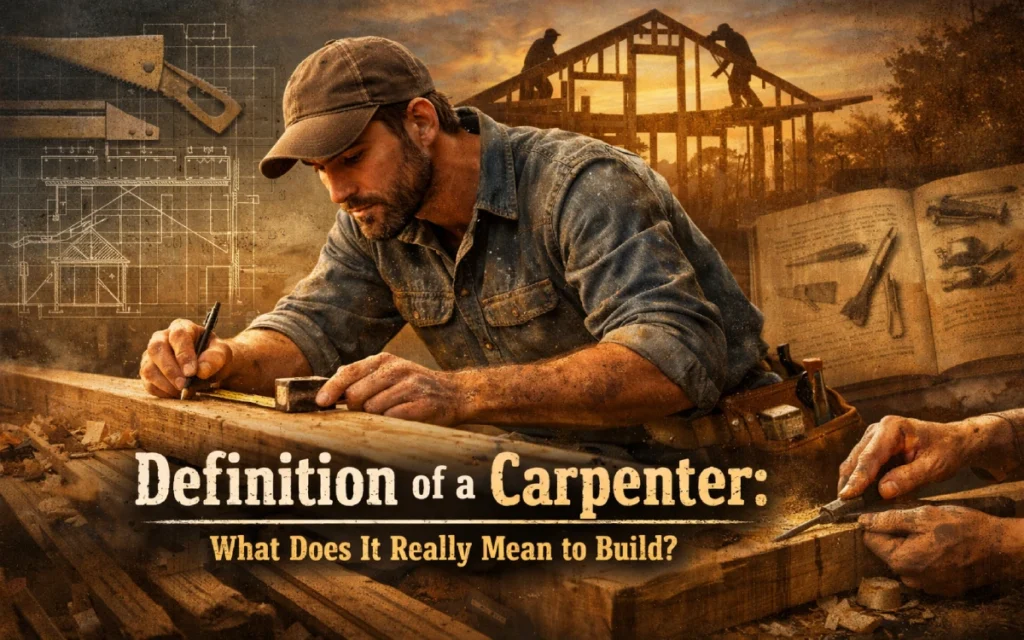
If you ask a dictionary for the definition of a carpenter, you’ll get something dry like, “a person who makes and repairs wooden objects and structures.”
Technically, sure. That’s true. But asking a carpenter what they do and getting that answer is like asking a chef if they “heat up food.” It misses the blood, the sweat, the math, and the sheer satisfaction of turning a pile of raw lumber into a house that will stand for a hundred years.
I’ve spent decades on jobsites across the U.S., from framing sub-developments in the scorching heat to installing crown molding in high-end colonials. I’ve seen the trade evolve from hammers and handsaws to cordless impact drivers and laser levels.
In this guide, we are going to tear down that dictionary definition and rebuild it. We’re going to look at what a carpenter actually is, the different breeds of carpenters out there, and why this trade remains the backbone of the construction industry.
The Core Definition: More Than Just Wood
At its heart, a carpenter is a skilled craftsperson who cuts, fits, and joins building materials. While wood is the traditional medium—and still the soul of the trade—modern carpenters work with everything from fiberglass and drywall to metal studs and composites.
A carpenter is a problem solver. We are the ones who take a two-dimensional set of blueprints and translate them into a three-dimensional reality. That requires a specific set of skills that goes beyond just swinging a hammer.
The Carpenter’s Mindset
To understand the definition of a carpenter, you have to understand how we think.
- Spatial Awareness: We have to visualize how a roof pitch intersects with a valley rafter before we even pick up a saw.
- The “Trifecta”: Every piece of material we touch has to be three things: Plumb (perfectly vertical), Level (perfectly horizontal), and Square (perfectly 90 degrees). If you miss one of these, the whole building fights you.
- Structural Physics: We might not call it physics, but when we frame a header over a window, we are calculating load distribution to ensure the roof doesn’t collapse.
The Two Main Worlds: Rough vs. Finish
If you want to sound like you know what you’re talking about on a jobsite, you need to understand the divide between Rough Carpentry and Finish Carpentry. While many of us can do both, they are two different disciplines requiring different tools and different mindsets.
1. Rough Carpentry (The Framers)
Rough carpenters are the muscle and the skeleton of the construction world. They build the structures that get covered up by drywall and brick, but without them, there is no building.
What they do:
- Framing: Erecting the skeletal structure of the building, including walls, floors, and roofs.
- Formwork: Building the temporary molds into which concrete is poured for foundations.
- Roofing: Cutting and installing rafters and trusses.
The Rough Carpenter’s Vibe: Speed and strength are king here. A rough carpenter works fast. They are swinging a 22oz framing hammer or a pneumatic framing gun. They are walking on narrow top plates 20 feet in the air. Their measurements need to be accurate, but generally, we are working within an 1/8th of an inch tolerance.
2. Finish Carpentry (The Trim Guys)
Once the rough guys leave and the drywall is up, the finish carpenters arrive. This is where the trade moves from “structure” to “furniture.”
What they do:
- Trim and Molding: Installing baseboards, crown molding, chair rails, and window casings.
- Door and Window Installation: Hanging doors so they swing perfectly and latch with a satisfying click.
- Cabinetry: Installing kitchen cabinets and vanities.
- Stairs: Building balusters, newel posts, and treads.
The Finish Carpenter’s Vibe: Patience and precision rule this world. A gap of 1/32 of an inch is a disaster in finish carpentry. These carpenters use coping saws, miter saws with high-tooth-count blades, and 18-gauge brad nailers. They aren’t trying to build the house; they are trying to make the house look beautiful.
Other Specialized Types of Carpenters
The definition of a carpenter expands even further when you look at niche specializations. The trade is massive, and you can spend a lifetime mastering just one corner of it.
The Cabinetmaker
Often considered the aristocrat of woodworking, the cabinetmaker works in a shop (joinery), not usually on a construction site. They build fine furniture and cabinetry. Their tolerances are incredibly tight. They deal with joinery techniques like dovetails and mortise-and-tenon. While a framer worries about rain, a cabinetmaker worries about humidity changes warping a drawer front by a millimeter.
The Shipwright
This is carpentry on “hard mode.” A shipwright builds and repairs boats. Why is this harder? Because on a boat, nothing is straight. There are no level floors or plumb walls. Everything is curved, tapered, and angled. They have to steam-bend wood and use complex geometry to fit planks against a curved hull.
The Scenic Carpenter
These are the folks working in Hollywood or on Broadway. They build sets for movies and plays. Their definition of a carpenter is unique because they build things that look real but are temporary and lightweight. They might build a “brick wall” out of styrofoam and plywood in a day.
The Joister
In commercial construction, you have carpenters who specialize solely in floor joists. In the UK and other parts of the world, distinctions like “Joiner” vs. “Carpenter” are more rigid (Joiners make the wood components in a shop; Carpenters install them on site). In the U.S., the lines are blurrier, but the specialization is just as real.
The Toolbox: How the Definition Has Changed
You can’t define a modern carpenter without talking about the tools. If you walked onto a jobsite in 1950, you’d hear the rhythmic thwack-thwack of hammers and the rasp of handsaws.
Today, the definition of a carpenter involves being a power tool expert.
The Battery Revolution
The biggest shift in the last 20 years is the cordless revolution. We are no longer tethered to the wall or a noisy generator.
- Impact Drivers: These have largely replaced hammers for driving fasteners.
- Cordless Circular Saws: We can cut rafter tails on a roof without dragging an extension cord through the mud.
- Oscillating Multi-Tools: We call this the “guy that gets you out of a jam” tool. It buzzes through wood, metal, and plastic in tight spaces.
Lasers and Tech
The modern carpenter uses laser levels that shoot a green line 360 degrees around a room. We use moisture meters to check lumber before installing it. We even use apps to calculate stair stringer layouts. The trade is becoming higher-tech, but the wood still cuts the same way.
Carpenter vs. Woodworker: Is There a Difference?
This is a common debate. Is a carpenter a woodworker? Yes. Is a woodworker a carpenter? Not necessarily.
Here is the distinction:
- Carpenters generally work on structures. They build houses, bridges, and commercial buildings. They usually travel to the work (the jobsite).
- Woodworkers generally create objects. They make bowls, tables, guitars, or boxes. They usually work in a fixed location (a shop).
A carpenter needs to know building codes, load paths, and how to flash a window to prevent water leaks. A woodworker needs to know how different grains absorb stain and how to sharpen a chisel to a razor edge. There is massive overlap, but the end goals are different.
The Physical Reality of the Trade
We need to include the physical toll in our definition of a carpenter. This is not a desk job. It is a contact sport.
Carpentry requires:
- Endurance: Lifting 80lb sheets of plywood and carrying 2x4s all day.
- Balance: Walking on 3-inch wide walls three stories up.
- Dexterity: Flipping a hammer, grabbing a nail, and striking it in one fluid motion.
- Resilience: Working in freezing snow, blistering sun, and pouring rain.
It builds a certain type of character. You learn to trust your hands. You learn that if you cut a board too short, you can’t stretch it (despite what we tell the apprentices about the “board stretcher”). You learn to own your mistakes and fix them.
How to Become a Carpenter
If this definition appeals to you, the path to entry is one of the few remaining meritocracies in the U.S. workforce. You don’t necessarily need a college degree.
- The Apprentice: You start at the bottom. You are the “gopher” (go for this, go for that). You haul lumber, you sweep sawdust, and you hold the dumb end of the tape measure. In exchange, you watch and learn.
- The Journeyman: After a few years (and usually a formal apprenticeship program through a union or trade school), you are trusted to work alone. You have your own tools, and you know the code.
- The Master Carpenter: This isn’t just a title; it’s a reputation. A master can run a crew, solve complex architectural problems, and teach the next generation.
The Future of Carpentry
Is the definition of a carpenter going to change again? Absolutely.
We are seeing the rise of pre-fabrication, where walls are built in factories by robots and trucked to the site. We are seeing Cross Laminated Timber (CLT) allow us to build skyscrapers out of wood.
But no matter how much technology advances, there will always be a need for a human being to walk onto a site, look at a problem, and cut a piece of wood to fit. Robots are bad at renovation. They can’t fix a sagging door in a 100-year-old house. They can’t interpret the eccentric requests of a homeowner.
The definition of a carpenter is resilient. It adapts.
Frequently Asked Questions (FAQ)
1. What is the difference between a carpenter and a joiner?
In the U.S., these terms are often used interchangeably, but historically and in places like the UK, the difference is location. A joiner usually works in a workshop creating components (doors, stairs, window frames) and “joining” wood. A carpenter works on-site installing those components and constructing the building’s structural elements.
2. Do carpenters need to be good at math?
Yes. You don’t need calculus, but you need rock-solid geometry and arithmetic. Carpenters constantly use the Pythagorean theorem (3-4-5 triangles) to ensure walls are square. We add and subtract fractions (inches) all day long. If you can’t read a tape measure instantly, you’ll struggle.
3. What is the average salary of a carpenter?
This varies wildly based on location, experience, and specialization. An apprentice might start near minimum wage, but a union journeyman in a major city can make $60,000 to $90,000+ annually, plus benefits. Specialized high-end finish carpenters or business owners can make significantly more.
4. Is carpentry hard on your body?
Yes. It is physically demanding work. It involves heavy lifting, repetitive motions, and working on knees or overhead. However, proper technique, using modern tools (like lifts and ergonomic hammers), and maintaining physical fitness can lead to a long, healthy career.
5. Can I become a carpenter later in life?
Absolutely. Many people switch to carpentry in their 30s or 40s because they are tired of office work and want to create something tangible. While the apprenticeship pay cut can be tough, the skills are learnable at any age if you have the drive and physical capability.
Summary
So, what is the definition of a carpenter?
A carpenter is the bridge between the dream of a building and the reality of it. We are the ones who understand the language of wood. We are mathematicians with mud on our boots. We are artists with power tools.
Whether we are framing a cathedral ceiling or coping a delicate piece of baseboard, the core remains the same: We build.