
You know that smell. That sweet, acrid scent of scorching Cherry or Maple that tells you something is wrong before your eyes even register the smoke. You’re pushing harder, the blade is wandering like a lost dog, and the cut quality looks like it was gnawed by a beaver.
It’s the age-old question every apprentice asks me eventually: “How long is this blade actually supposed to last?”
The frustrating answer is: It depends.
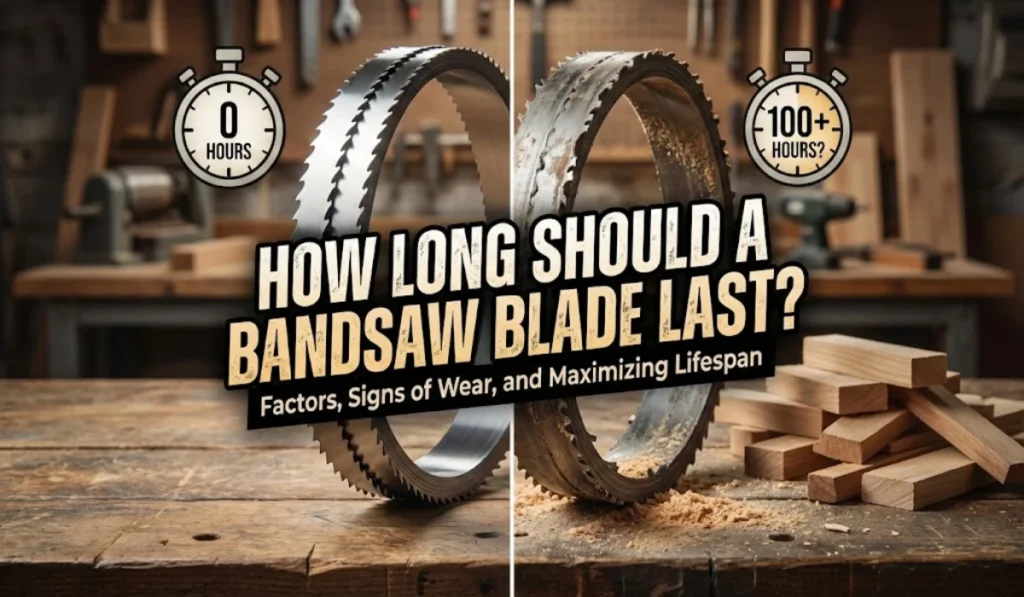
The helpful answer–the one I’m going to give you today–is that a bandsaw blade can last anywhere from two hours of cut time to several years, depending entirely on what you bought and how you treat it. A cheap carbon steel blade fighting White Oak will die before lunch. A carbide-tipped blade cutting Pine might outlive your current shop apron.
In this guide, we’re going to cut through the noise. I’ll break down the lifespan differences between blade types, the tell-tale signs your blade is toast, and the maintenance habits I use to keep my blades cutting true for as long as possible.
The “Rule of Thumb” for Blade Life
Before we get into the metallurgy, let’s set some expectations. In a professional shop environment where the saw is running daily, we measure blade life in cutting hours, not calendar days.
- Standard Carbon Steel Blades: Expect roughly 5 to 10 hours of actual cutting time if you are cutting hardwoods. If you are a hobbyist working weekends, this might last you six months.
- Bi-Metal Blades: These are the workhorses. You can expect roughly 20 to 40 hours of cut time. They cost a bit more, but they pay for themselves in longevity.
- Carbide-Tipped Blades: These are the Ferraris of resawing. They can last 100+ hours or significantly longer. I’ve had carbide blades on my 18-inch saw for three years that still slice veneer like butter.
However, these numbers are just benchmarks. Let’s look at the variables that actually determine if your blade survives the project.
The Big Three: Factors That Kill Your Blade
1. The Material You Are Cutting
This is the biggest variable. Wood density acts like sandpaper on your blade’s teeth.
- Abrasive Woods: Tropical hardwoods (like Teak or Ipe) contain silica. Silica is essentially sand inside the wood fibers. It will dull a standard steel blade almost instantly. Even domestic hardwoods like White Oak or Hickory generate significant heat and wear.
- Softwoods: Pine, Fir, and Cedar are gentle. A cheap blade will last a very long time if you stick to softwoods.
- Green Wood: Cutting wet logs (green wood) is actually easier on the teeth regarding friction, but the moisture can lead to rust and pitch buildup, which kills performance if you don’t clean it.
2. The Type of Blade (Metallurgy)
Not all steel is created equal. When you buy a blade, you are usually choosing between three categories.
Carbon Steel (The Disposable Option) These are the blades that likely came with your saw or the ones you pick up for $15 at the big box store. The teeth are hardened, but the back is soft to allow for flexing.
- Lifespan: Shortest.
- Best for: Scroll work, tight curves, and softwoods.
- Verdict: Treat them as disposable. When they dull, toss them.
Bi-Metal (The Pro Standard) These blades feature a strip of high-speed steel (HSS) welded to a carbon steel backer. HSS can withstand higher temperatures without losing its hardness.
- Lifespan: 5x to 10x longer than carbon.
- Best for: General ripping, contour cutting, and shops that cut a mix of hard and softwoods.
- Verdict: The best bang for your buck for general woodworking.
Carbide-Tipped (The Heavy Hitter) These blades have actual carbide blocks welded onto the teeth. They are expensive–often $150 to $200–but they are in a league of their own.
- Lifespan: 25x to 30x longer than carbon.
- Best for: Heavy resawing and abrasive exotics.
- Verdict: Essential for serious furniture makers, but overkill for cutting curves in pine.
3. Operator Technique (Heat is the Enemy)
I’ve seen guys ruin a brand new $50 blade in five minutes. How? Heat. When you force the wood into the blade faster than the gullets can clear the sawdust, friction builds up. That heat transfers to the teeth. If the teeth get hot enough, the metal tempers back (softens), and the edge is gone forever.
- Feed Rate: Listen to the saw. If the motor is bogging down, back off.
- Tension: Too little tension allows the blade to flutter, banging the teeth against the wood or the guides.
5 Signs It’s Time to Replace Your Blade
You don’t need a microscope to know when a blade is done. The wood will tell you. Here is the checklist I run through in my head whenever a cut feels “off.”
1. The “Push” Test
A sharp bandsaw blade should feed itself. Once you engage the wood, the downward force of the teeth should almost pull the workpiece out of your hands. If you find yourself having to lean your body weight into the wood to get it to move, your blade is dull. Stop pushing; you’re just generating dangerous heat.
2. Burning and Smoke
If you see burn marks on the cut surface, friction is winning. This usually means the set of the teeth (the amount the teeth bend left and right) has worn down. Without that clearance, the body of the blade rubs against the wood. If you smell smoke, stop immediately.
3. The Drunken Drift
When a blade dulls, it rarely dulls evenly. Usually, the teeth on one side will wear slightly faster than the other. This causes the blade to pull hard to the left or right. If you are trying to cut a straight line but have to angle your fence 10 degrees just to compensate, the blade is shot.
4. The Clicking Sound
If you hear a rhythmic tick… tick… tick… every time the blade makes a revolution, hit the emergency stop. That is the sound of a cracked blade passing through the guides. A cracked blade is a ticking time bomb. Do not try to save it. Cut it in half (so nobody else tries to use it) and trash it.
5. Fine Dust Instead of Chips
Look at the sawdust pile. A sharp blade cutting with the grain should produce nice, long shavings or coarse chips. If your saw is producing fine, flour-like dust, the teeth aren’t cutting–they are grinding. Grinding equals dullness.
Is It Dull or Just Dirty? (Don’t Throw Money Away!)
This is the biggest mistake I see rookie woodworkers make. They throw away perfectly good blades because they think they are dull.
When you cut resinous woods (Pine, Cherry, Fir), pitch and sap bake onto the blade. This pitch fills up the gullets and covers the teeth, effectively rounding over the sharp edge.
The Fingernail Test: Unplug the saw. Open the wheel covers. Scrape your fingernail lightly across the teeth (be careful!). If you feel a sticky, gummy residue, your blade isn’t dull–it’s dirty.
How to Clean It:
- Remove the blade.
- Coil it up and place it in a shallow pan (a kitty litter tray works great for this).
- Soak it in a resin remover. I use specialized blade cleaners, but honest-to-god oven cleaner or Simple Green works in a pinch.
- Let it sit for 10 minutes.
- Scrub it with a brass wire brush.
- Rinse, dry immediately, and protect it with a little spray lubricant.
I have “resurrected” blades that I thought were dead, simply by scrubbing off the burnt-on pitch.
How to Extend the Life of Your Bandsaw Blade
If you want to get every cent’s worth out of your investment, you need to adopt a few shop habits. These are the protocols I use in my shop.
De-Tension After Use
I know, it’s a pain. But leaving a blade under high tension when the saw isn’t running causes metal fatigue. It also flattens the rubber tires on your bandsaw wheels. Get in the habit of taking the tension off at the end of the day. It saves the blade and the machine.
Round the Back of the Blade
This is a pro trick. When you get a new blade, install it and turn the saw on. Take a fine sharpening stone (or a diamond paddle) and gently touch it to the back corners of the blade (not the teeth!). Hold it there for a few seconds. This rounds over the sharp 90-degree corners on the back of the band. This helps the blade make tighter turns without binding in the kerf, reducing friction and heat.
Adjust Your Guides Properly
Whether you have ceramic cool blocks or bearing guides, they should not be touching the blade when it’s spinning freely. There should be a dollar-bill thickness of space between the guides and the blade. If the guides are tight against the blade, you are work-hardening the metal, which leads to premature snapping.
Use the Right Blade for the Job
Don’t be lazy. I know changing blades takes time, but don’t try to resaw a 10-inch log with a 1/4-inch scroll blade. You will overheat the blade, stretch the metal, and ruin the set. Conversely, don’t use a huge 3/4-inch resaw blade to cut tight curves; you’ll twist the metal and crack the gullets.
When to Sharpen vs. When to Replace
In the old days, every craftsman knew how to file a bandsaw blade. Today, the economics have changed.
Carbon and Bi-Metal Blades: Generally, it is not worth your time to sharpen these. By the time you buy the files and spend two hours hunched over the blade, you’ve lost more in “shop rate” than the $20 cost of a new blade. When these are dull, recycle them.
Carbide Blades: These are absolutely worth sharpening. However, you can’t do it with a file. You have to send these out to a professional sharpening service. A good resaw king or carbide blade can be sharpened 3 or 4 times before the carbide is gone. If you paid $180 for the blade, a $40 sharpening fee is a no-brainer.
Final Thoughts
A bandsaw is only as good as the steel you put on it. You can have a $5,000 Italian bandsaw, but if you run a dull, $10 blade on it, it will cut like garbage. Conversely, a tuned-up budget saw with a high-quality bi-metal blade can produce furniture-grade cuts.
Treat your blades like precision instruments, not consumable garbage. Keep them clean, keep them cool, and change them out before they start burning your project. Your lungs (and your lumber) will thank you.
Frequently Asked Questions (FAQ)
1. Why do my bandsaw blades keep breaking?
Blade breakage is almost always caused by three things: excessive tension, forcing the wood too hard (heat), or guides that are set too far forward and ruining the teeth set. Also, using a blade with a small wheel diameter (like a thick blade on a 10-inch saw) causes metal fatigue because the steel has to bend too sharply.
2. Can I use a metal-cutting blade on wood?
Technically, yes, but it’s not efficient. Metal blades have a very high TPI (Teeth Per Inch) and small gullets. If you use them on wood, the gullets will clog with sawdust instantly, leading to heat buildup and burning. Stick to wood blades for wood.
3. How do I know if my bandsaw blade is tensioned correctly?
Many saws have a gauge, but they are notoriously inaccurate. I use the “flutter method.” Turn the saw on and slowly lower the tension until the blade starts to wobble (flutter). Then, slowly increase the tension just until the flutter stops and the blade runs true. Give the handle one more quarter-turn, and you’re set.
4. What is the best TPI (Teeth Per Inch) for general woodworking?
For a “do-it-all” blade that stays on the saw most of the time, look for a 3 or 4 TPI blade (often a skip-tooth or hook-tooth). This is coarse enough to rip lumber but fine enough to leave a decent surface. If you do mostly tight curves, go for 6 TPI or higher.
5. How should I store my spare bandsaw blades?
Don’t hang them on a nail where they can get dinged or rust. I recommend coiling them (the “bandsaw taco” fold) and hanging them on a pegboard with a zip tie, or storing them flat in a drawer. Always wipe them down with a rust preventative like Camellia oil or paste wax before storing.