
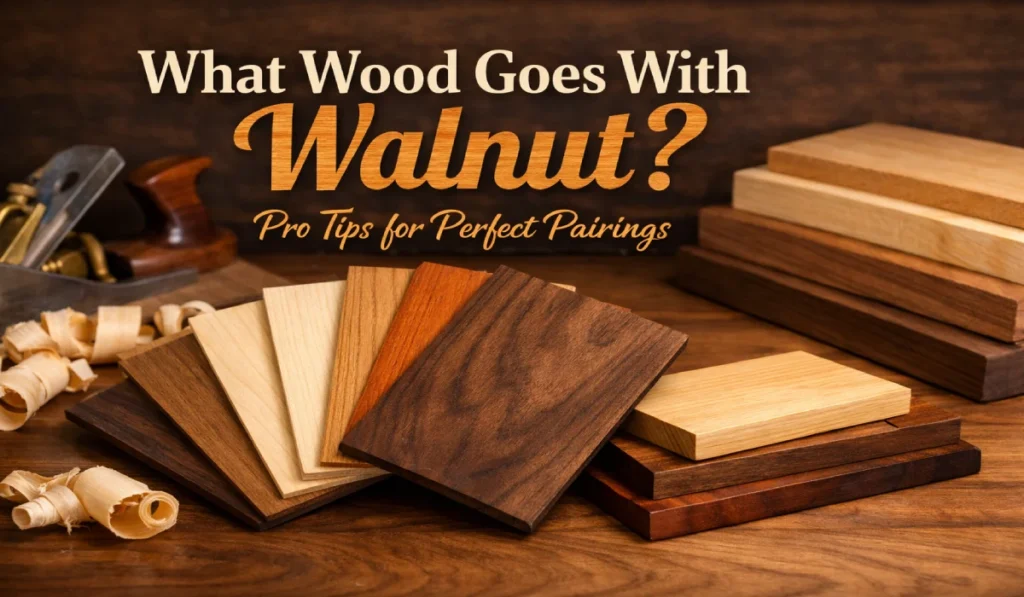
Walk into any high-end lumber yard or cabinet shop in America, and you’ll find Black Walnut (Juglans nigra) sitting on the top shelf-figuratively and literally. It is the aristocrat of domestic hardwoods. It works like butter, smells amazing when you cut it, and finishes to a deep, lustrous chocolate brown that screams quality.
But here’s the problem I’ve run into on plenty of jobs: Walnut can be overwhelming.
If you build an entire kitchen or a massive dining table out of nothing but walnut, it sucks the light out of the room. It can feel heavy and somber. That is where the art of contrasting woods comes in. Finding the right partner for walnut isn’t just about picking a lighter color; it’s about matching grain texture, workability, and accounting for how those woods will age over the next twenty years.
I’ve spent years experimenting with glue-ups, inlays, and joinery combinations. Below is my breakdown of what works, what doesn’t, and how to pair woods with walnut like a pro.
The Golden Rule: Contrast is King
Before we look at specific species, we need to talk about value contrast. In woodworking design, “value” refers to the lightness or darkness of the material.
Walnut is a low-value (dark) wood. If you pair it with something mid-tone, like a stained Red Oak or a dark Mahogany, the details get muddy. The joinery disappears. If you are cutting dovetails, you want people to see them from across the room. To make walnut sing, you generally want high contrast (very light woods) or complementary tones (warm, reddish woods).
1. The Classic Pair: Walnut and Hard Maple
If woodworking had a “Peanut Butter and Jelly,” it would be Walnut and Maple. This is the combination I use most frequently in the shop, especially for items like cutting boards, chess boards, and shaker-style furniture details.
Why it Works
- Visual Pop: Maple is creamy white, sometimes with a subtle yellow hue. Placed next to the dark cocoa of walnut, the boundary line is crisp and sharp.
- Hardness Match: If you use Hard Maple (Sugar Maple), the Janka hardness is 1450 lbf, compared to Walnut’s 1010 lbf. While Maple is harder, they are close enough that you can sand them flush without the walnut wearing away too fast (a phenomenon known as “dishing”).
- Grain: Both have relatively tight, closed grains (diffuse-porous). This means they finish similarly. You don’t have one wood soaking up finish like a sponge while the other sits on top.
The “Gotcha”
Be careful with the finish. Oil-based finishes (like boiled linseed oil or oil-based poly) will turn Maple yellow over time. If you want that Maple to stay bone-white for that high-contrast “tuxedo” look, use a water-based finish or a high-quality lacquer.
2. The Elegant Aging: Walnut and Cherry
This is my personal favorite combination for fine furniture. When fresh, American Cherry is a light pinkish-salmon color. It looks okay next to walnut, but not amazing.
However, give it six months.
Cherry is photosensitive. It darkens significantly with UV exposure, turning into a deep, rich russet red. Meanwhile, Walnut actually lightens slightly over the decades, turning more golden. As these two woods age, they move toward each other, creating a warm, harmonious blend rather than a stark contrast.
Best Uses
- Cabinetry: A walnut carcass with cherry drawer fronts.
- Tables: Walnut legs with a cherry top.
- Subtle Accents: Cherry dowels or splines in a walnut miter joint.
Pro Tip: Do not leave a fresh Cherry and Walnut piece in direct sunlight with tools sitting on it. The cherry will darken around the tool, leaving a permanent “shadow” in the wood color.
3. The Texture Play: Walnut and White Oak
For a long time, mixing Oak and Walnut was considered a bit of a taboo because the grain structures are so different. Walnut is smooth and semi-porous; Oak has deep, open pores.
But in modern and mid-century modern design, this pairing is on fire. specifically Quarter Sawn White Oak (QSWO).
Why it Works
White Oak has a neutral, wheat-colored tone that separates well from Walnut. But the real magic is the texture. The medullary rays (flecks) in quarter-sawn oak shimmer in the light, providing a complexity that stands up to the rich swirls of walnut crotch or burl.
Workability Note
Be aware of the “open grain” issue. If you are gluing up a panel with these two, and you spread glue across the joint, the open pores of the Oak can trap dark glue squeeze-out, which is a nightmare to clean up. I usually tape off my joint lines when working with Oak to keep that grain clean.
4. The Clean Modern Look: Walnut and Ash
If you want the look of Oak but with a cleaner, more Scandinavian vibe, go with Ash. Ash has a very similar grain pattern to Oak (cathedral grain) but is generally lighter, almost pale cream or straw-colored.
Ash is tough, flexible, and holds an edge beautifully. I love using Ash for the structural components (like legs and stretchers) and Walnut for the focal points (like the seat or tabletop). The grain of Ash is bold, so it holds its own against Walnut without competing for color.
5. The Exotic Accents
Sometimes you want to show off. Walnut is a great canvas for exotic woods because its dark brown is neutral enough to handle vivid colors.
- Padauk: This African wood is bright orange-red when freshly cut. A thin strip of Padauk laminated between two pieces of Walnut looks like a streak of fire. It eventually browns out, but it keeps a reddish hue.
- Purpleheart: As the name implies, it’s purple. It’s extremely hard and can burn your saw blades, but as a small inlay in a walnut box, it’s stunning.
- Zebrawood: This has distinct dark stripes on a light background. Because Walnut is dark, it picks up the dark stripes in the Zebrawood, tying the piece together visually.
Woods to Avoid (Or Use with Caution)
Not every wood plays nice with Walnut. Here are a few I generally avoid pairing with it:
1. Red Oak
Red Oak has a pinkish undertone that often clashes with the cool, green/purple undertones found in air-dried Walnut. It can make the piece look a bit cheap or mismatched. If you must use Oak, stick to White Oak.
2. Dark Mahogany / Sapele
While beautiful on their own, pairing dark Mahogany with Walnut often results in a “muddy” look. There isn’t enough contrast. From five feet away, it just looks like a dark blob. If you use them together, ensure the Walnut is steamed (dark uniform) and the Mahogany is ribbon-striped to differentiate them by grain, not just color.
3. Pine / Fir (Construction Lumber)
Just don’t do it. The hardness difference is too extreme. The Pine will dent if you look at it wrong, while the Walnut stays pristine. Plus, the yellow sap of pine rarely looks good against the chocolate of walnut. Keep the construction lumber for the framing; save the walnut for the finish work.
Technical Considerations for Mixing Species
As a pro, I can’t just talk about color. We have to talk about how the wood behaves.
Wood Movement
Every wood expands and contracts with humidity changes. Walnut is generally very stable. However, denser woods like White Oak or Hickory move differently.
- The Rule: When gluing cross-grain (like a breadboard end), never glue the entire width. The different rates of expansion will crack your piece.
- Grain Orientation: Always try to match the grain direction of your Walnut and your secondary wood. If you glue them perpendicular, you are asking for failure.
Sanding and Finishing
When you sand two different species side-by-side, the softer wood removes faster.
- Example: If you are sanding a Walnut table with a Maple inlay, the sander will dig into the Walnut (softer) slightly more than the Maple (harder) if you aren’t careful, leaving a raised ridge.
- Solution: Use a hard sanding block rather than a soft pad or just your hand. The block forces the sandpaper to stay flat across both species.
The “Bleed”
When applying a finish, especially oil, walnut dust can turn into a dark slurry. If you are sanding a finish into the wood (wet sanding), that dark walnut slurry will pack into the pores of lighter woods like Ash or Oak, turning them gray/dirty.
Pro Tip: Seal your lighter wood with a coat of dewaxed shellac before doing any heavy sanding or pore-filling on the adjacent walnut.
Practical Project Ideas for Walnut Pairings
If you are itching to try a combination, here are three beginner-friendly projects that utilize these pairings:
1. The “Tuxedo” Cutting Board
- Woods: Walnut and Hard Maple.
- Why: It’s the classic high-contrast look. Use the Walnut for the main body and thin strips of Maple for accents.
- Finish: Mineral Oil and Beeswax.
2. The Mid-Century Modern Coffee Table
- Woods: Walnut (Legs and apron) and Ash (Top).
- Why: The dark base grounds the piece, while the lighter Ash top keeps the room feeling airy and bright.
- Finish: Osmo Polyx-Oil or Rubio Monocoat (Pure).
3. The Heirloom Keepsake Box
- Woods: Walnut (Box sides) and Cherry (Lid panel).
- Why: The contrast is subtle and classy. Add a small handle made of darker Walnut on the Cherry lid to tie it together.
- Finish: Shellac (to keep the Cherry warm) and Paste Wax.
Final Thoughts
Walnut is expensive. At the time of writing this, FAS (First and Seconds) Black Walnut is trading high per board foot. Because of that cost, there is a temptation to use it sparingly.
Pairing Walnut with a domestic hardwood like Maple, Ash, or Cherry isn’t just an aesthetic choice—it stretches your budget. You can build the structural “guts” of a cabinet out of Maple (which is stronger and cheaper) and save the Walnut for the face frames and door panels where it really counts.
Trust your eye, but trust the Janka scale and wood movement charts, too. The best pairing is one that looks good today and stays together for the next hundred years. Now, get out in the shop and make some sawdust.
Frequently Asked Questions (FAQ)
Does Walnut wood lighten or darken with age?
Unlike Cherry, which darkens, Black Walnut lightens over time. UV exposure causes the dark chocolate tones to fade into a golden honey brown. You can slow this down by using finishes with UV inhibitors, but you cannot stop it completely.
Can I stain other woods to look like Walnut?
You can, but it’s rarely perfect. Poplar takes gel stain well and can mimic walnut’s color, but it lacks the grain texture. Staining Pine usually results in blotchiness. If you want the Walnut look but are on a budget, consider using Roasted (Torrified) Maple or Poplar, which is thermally modified to be dark brown all the way through.
Is Walnut harder than Oak?
No. White Oak (Janka 1360) and Red Oak (Janka 1290) are both harder than Black Walnut (Janka 1010). Walnut is durable enough for tables and floors, but it will dent easier than an Oak floor would.
What is the best finish for Walnut to keep it dark?
To maximize the depth and darkness, start with a coat of boiled linseed oil or pure tung oil to “pop” the grain. Follow that with a topcoat. Avoid water-based polyurethanes directly on bare walnut, as they can leave a cool, bluish cast that makes the wood look dead.