
When you’re walking through a furniture showroom or browsing lumber at a big-box store, you’ll often see pieces labeled as “Solid Hardwood” with a price tag that seems almost too good to be true. More often than not, that wood is Rubberwood.
But if you’re like most folks I talk to on the jobsite, you might be wondering: Is rubberwood actually a hardwood, or is it just some clever marketing name for a soft, spongy material?
After twenty years of running saws and finishing tables, I’ve worked with everything from domestic White Oak to exotic Ipe. Today, I’m going to break down exactly what rubberwood is, why it’s taken over the furniture industry, and whether it deserves a spot in your home.
The Short Answer: Yes, It’s a Hardwood
To clear up the biggest misconception right out of the gate: Yes, rubberwood is botanically classified as a hardwood.
In the world of woodworking, the “hardwood” vs. “softwood” distinction isn’t actually about how hard the wood feels when you hit it with a hammer. It’s about how the tree reproduces.
- Hardwoods (Angiosperms): These come from broad-leafed trees that produce seeds with a covering (like fruit or a nut).
- Softwoods (Gymnosperms): These come from conifers (evergreens) that drop needles and have “naked” seeds, usually in cones.
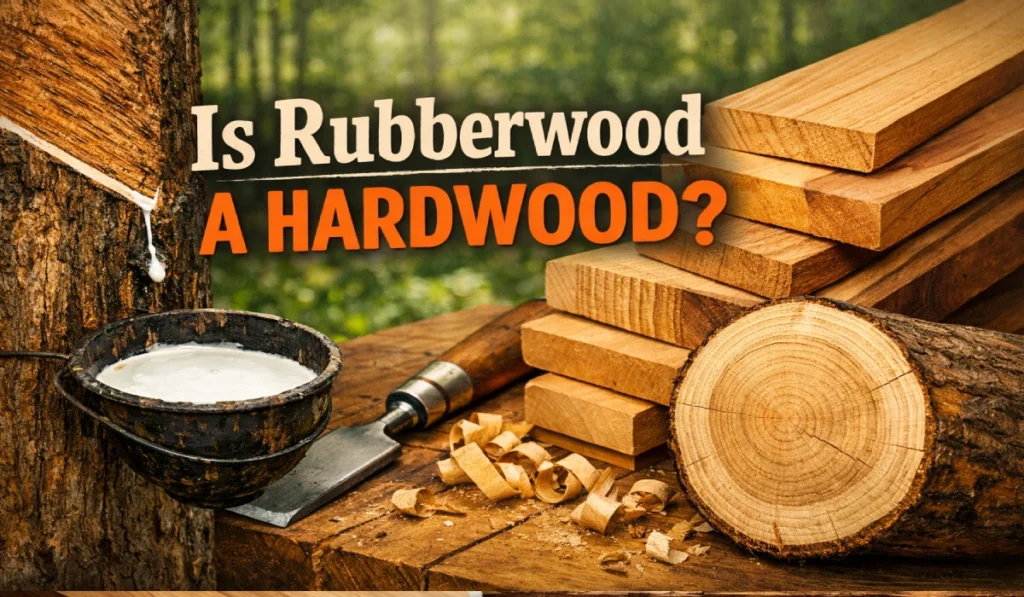
Rubberwood comes from the Hevea brasiliensis tree—the same tree used to produce natural latex. Since it’s a broad-leafed species, it’s a hardwood by definition. But as any carpenter will tell you, “hardwood” is a broad spectrum. To see where it really stands, we have to look at the Janka Hardness Scale.
Rubberwood on the Janka Scale
The Janka scale measures the force required to embed a small steel ball halfway into a piece of wood. It’s the industry standard for determining how well a wood species stands up to dents and wear.
| Wood Species | Janka Rating (lbf) |
| Northern White Pine | 380 (Softwood) |
| Rubberwood | 960 (Hardwood) |
| Black Walnut | 1,010 (Hardwood) |
| White Oak | 1,360 (Hardwood) |
| Hard Maple | 1,450 (Hardwood) |
As you can see, rubberwood sits right in the “sweet spot.” It’s significantly harder than common softwoods like Pine or Cedar, and it’s surprisingly close to the legendary Black Walnut. It’s plenty tough for dining tables, chairs, and coffee tables, but it won’t chew through your saw blades as fast as Hickory or Ipe.
Where Does Rubberwood Come From? (The Eco-Friendly Story)
One reason I’ve come to respect rubberwood over the years is its sustainability story. In an industry where we often worry about deforestation, rubberwood is one of the “greenest” choices you can make.
Rubber trees are grown in massive plantations across Southeast Asia (mostly Thailand, Malaysia, and Indonesia) for their sap. A tree produces latex for about 25 to 30 years. Once the latex yield drops, the tree is considered “spent.”
In the old days, these trees were simply cut down and burned to make room for new plantings. Now, we harvest that timber. We are essentially using a “byproduct” of the rubber industry. When you buy rubberwood, you aren’t contributing to the clearing of natural rainforests; you’re using wood that was already destined for the scrap heap.
Working With Rubberwood: A Pro’s Perspective
If you’re a DIYer or a fellow pro looking to build with rubberwood, here is the “dirt” on what it’s actually like to work with in the shop.
1. Grain and Texture
Rubberwood has a coarse, open grain—somewhat similar to Ash or Oak, but without the dramatic “cathedral” patterns. It has a very uniform light-blonde to straw color. This makes it a “blank canvas” for finishers.
2. Machining and Cutting
In my experience, rubberwood machines beautifully. It’s dense enough to hold crisp edges when you’re running a router bit, but it’s not so brittle that it chips out constantly.
Pro Tip: Because rubberwood has a high latex (sap) content even after kiln drying, it can occasionally gum up your saw blades. Keep a bottle of blade cleaner handy; a quick wipe-down every few hours of heavy cutting keeps your cuts burn-free.
3. Stability (The “Movement” Factor)
This is where you need to be careful. Rubberwood is known for having high shrinkage during the initial drying process. However, once it has been properly kiln-dried, it is remarkably stable. It doesn’t warp or twist as much as some domestic hardwoods when the humidity shifts. That said, it is not a wood for the outdoors. If you leave rubberwood in the rain, it will rot and warp faster than you can say “polyurethane.”
The Pros and Cons of Rubberwood Furniture
Is a rubberwood dining set right for your house? Let’s weigh it up.
The Pros
- Price Point: It is significantly more affordable than Cherry, Walnut, or Oak. If you’re on a budget but want “real wood” instead of particleboard or MDF, this is your best bet.
- Durability: It handles the “kids and pets” test well. It won’t ding if you drop a fork on it.
- Takes Paint Like a Dream: Because the grain is uniform and the wood is light-colored, it is one of the best hardwoods for a painted finish.
- Eco-Friendly: As mentioned, it’s one of the most sustainable timbers on the market.
The Cons
- Not for Outdoors: It is susceptible to fungal attacks and rot if exposed to moisture. Keep it in the dining room, not on the deck.
- “Blonde” Aesthetics: Some people find the natural color a bit boring or “cheap” looking if it isn’t stained well.
- Perception: Because it’s used in mass-produced furniture, it doesn’t carry the same “prestige” as a custom Walnut table.
How to Identify Rubberwood
If you’re out thrifting or furniture shopping, look for these tell-tale signs:
- Uniform Light Color: It’s usually a pale cream or light tan.
- Short Stave Construction: Because rubber trees aren’t massive, you’ll often see rubberwood tabletops made of many short pieces glued together (finger joints or butt joints).
- Visible Pores: Look closely at the surface; you’ll see small, pepper-like pores, similar to Mahogany but tighter.
Frequently Asked Questions (FAQ)
1. Is rubberwood as strong as Oak?
Not quite. While rubberwood is a true hardwood with a Janka rating of 960, White Oak sits around 1,360. Oak is significantly more scratch-resistant and rot-resistant. However, for indoor furniture like chairs and tables, rubberwood is plenty strong for everyday use.
2. Can you stain rubberwood to look like Walnut?
Yes! Rubberwood is very porous and takes stain quite well. However, because it can be a bit “blotchy,” I always recommend using a pre-stain wood conditioner. This helps the pigment soak in evenly so you don’t end up with dark streaks.
3. Why is rubberwood so cheap?
The low cost isn’t because the wood is low-quality; it’s because the supply chain is so efficient. Since the trees are already grown for latex, the timber is a secondary crop. This keeps the raw material costs down compared to a tree grown specifically for lumber over 80 years.
4. Does rubberwood smell like rubber?
When you’re cutting it in the shop, it has a slightly sweet, distinct odor—but it doesn’t smell like a car tire. Once the wood is dried and finished, it has no discernible scent at all.
5. Is rubberwood safe for people with latex allergies?
Generally, yes. The latex in a rubber tree is found in the bark and specialized vessels, not the heartwood itself. Furthermore, the kiln-drying and finishing process removes or seals any remaining proteins. However, if you have an extreme sensitivity, it’s always worth testing a small area or consulting a professional.
My Final Verdict as a Woodworker
I’ve built plenty of high-end custom pieces, but I’ve also assembled and repaired a fair share of rubberwood furniture.
Is it a “premium” hardwood? No. You won’t find it in the halls of museums or high-end galleries. Is it a “real” hardwood? Absolutely. It is a tough, reliable, and incredibly sustainable material that bridges the gap between flimsy “disposable” furniture and heirloom-quality antiques. If you’re looking for a solid wood table that can survive a decade of family dinners without breaking the bank, rubberwood is an excellent choice.