
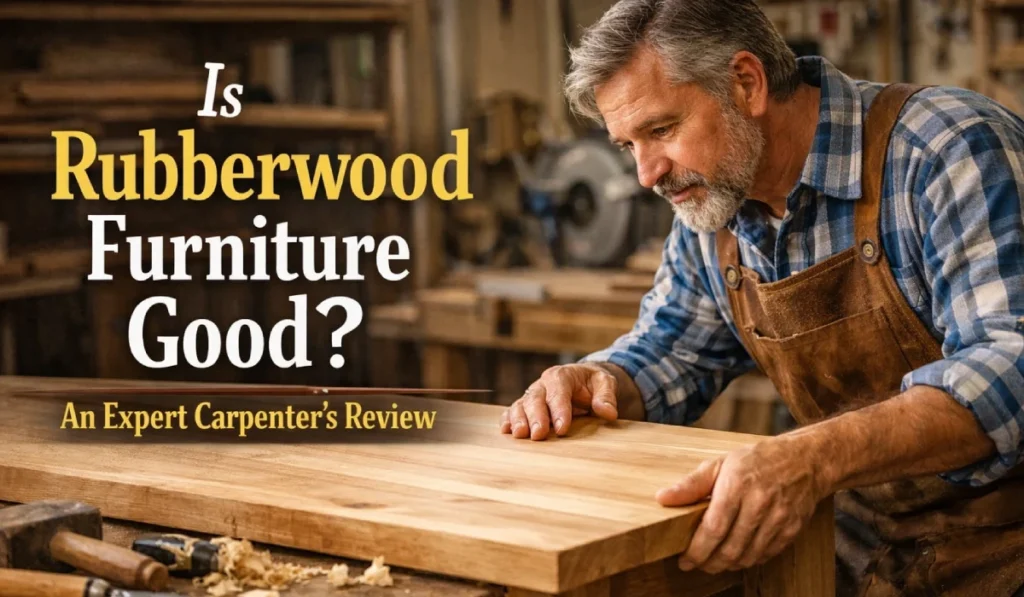
If you’ve spent any time browsing furniture stores or online catalogs lately, you’ve likely run into the term rubberwood. It’s everywhere-from mid-century modern coffee tables to heavy-duty dining sets. But if you’re like most folks I talk to on the jobsite, you might be wondering: “Is this stuff actually real wood, or is it some kind of glorified plastic?”
As someone who has spent decades covered in sawdust, swinging hammers, and putting power tools to the test, I’ve worked with everything from high-end Black Walnut to the cheapest construction-grade pine. I’ve seen rubberwood evolve from a “mystery import” to a staple of the American home.
So, is rubberwood furniture good or bad? Let’s strip off the finish and look at the grain.
What Exactly is Rubberwood?
First off, let’s clear up the name. Rubberwood does not feel like an eraser, and it isn’t flexible. It comes from the Hevea brasiliensis tree-the same tree used to produce natural latex.
In the woodworking world, we call it a “sustainable hardwood.” Here’s how the cycle works: These trees are planted on massive plantations for latex production. After about 25 to 30 years, the tree stops producing enough sap to be commercially viable. In the past, these “spent” trees were simply burned to make room for new ones. Today, we harvest that timber and turn it into furniture.
In my book, that’s a win. You’re getting a solid hardwood product without contributing to the deforestation of old-growth jungles.
The Workshop Test: Durability and Density
When a client asks me if a piece of furniture is “good,” they usually mean, “Will my kids break this in six months?”
To understand durability, we look at the Janka Hardness Scale. This measures how much force it takes to embed a small steel ball halfway into the wood.
- Rubberwood clocks in at about 960 lbf.
- For comparison, American Cherry is around 950 lbf, and White Birch is about 1,260 lbf.
What does this mean for you? Rubberwood is a true hardwood. It is significantly harder than softwoods like Pine or Cedar, meaning it resists dents and scratches much better than your average “big box store” budget furniture. It’s dense, it has a tight grain, and it has a weight to it that feels substantial when you try to slide a chair across the floor.
The Pros: Why Rubberwood is a Solid Choice
1. Exceptional Stability
One of the biggest headaches I face as a carpenter is “wood movement.” Wood is a living thing; it breathes, expands in the summer humidity, and shrinks in the winter chill. This causes joints to crack and drawers to stick.
Rubberwood is surprisingly stable. Because it is kiln-dried extensively to remove the latex sap, it undergoes very little shrinkage or warping compared to other hardwoods. This makes it an excellent choice for kitchen tables and chairs that see a lot of environmental changes.
2. Takes Paint and Stain Like a Pro
Rubberwood has a light, creamy blonde color with a grain pattern similar to Oak but much more subtle. Because the grain isn’t overly aggressive, it’s a “blank canvas” for finishes.
If you want a dark espresso look or a trendy “weathered grey” finish, rubberwood takes stain evenly without the blotchiness you often see in Maple or Pine. In the shop, I love it because I don’t have to fight the wood to get a consistent color.
3. Price Point vs. Value
Let’s be real: furniture is expensive. If I build you a custom dining table out of solid White Oak, it’s going to cost a premium. Rubberwood offers a middle ground. It provides the strength and feel of solid wood at a price point that is often closer to high-end veneer or MDF (medium-density fiberboard).
4. Eco-Friendly Credentials
As I mentioned earlier, this is “recycled” wood. Using rubberwood keeps “spent” trees out of the burn pile and reduces the demand for slow-growing hardwoods like Mahogany or Teak. If sustainability is a priority for your home, this is one of the best options on the market.
The Cons: What the Salesman Won’t Tell You
No material is perfect. If you’re considering rubberwood, there are a few things you need to watch out for.
1. Not for the Great Outdoors
I’ve seen people try to use rubberwood for patio furniture, and it’s a disaster. Rubberwood is highly susceptible to rot and fungal decay if it gets wet. It is strictly an indoor-only wood. Even in a high-humidity bathroom, you need to ensure it is sealed with a high-quality polyurethane to prevent moisture from seeping into the grain.
2. The “Perception” Problem
Because rubberwood is often used in mass-produced, “ready-to-assemble” furniture, it sometimes gets a reputation for being “cheap.” While the wood itself is strong, the hardware used to put it together (like cam locks and cheap screws) can sometimes fail. When you buy rubberwood, check the joinery. Look for mortise-and-tenon joints rather than just butt-joints held together by a prayer.
3. Susceptibility to Insects
In its raw, untreated state, rubberwood is like a buffet for certain types of beetles and borers. However, for the consumer, this isn’t usually a problem. Almost all commercial rubberwood is treated with protective chemicals during the drying process to ensure it’s bug-free by the time it reaches your living room.
How Rubberwood Compares to Other Popular Woods
In my years of remodeling and furniture building, I’ve found that most homeowners are choosing between three or four main types of wood. Here’s how rubberwood stacks up:
| Feature | Rubberwood | Oak | Pine | MDF/Veneer |
| Durability | High | Very High | Low | Moderate |
| Price | $$ | $$$ | $ | $ |
| Sustainability | Excellent | Moderate | High | Low |
| Finish Ease | Excellent | Moderate | Difficult | Easy |
Expert Tips for Maintaining Rubberwood Furniture
If you decide to pull the trigger on a rubberwood piece, you want it to last. Here is how I tell my clients to care for their wood:
- Avoid Harsh Chemicals: Rubberwood finishes can be sensitive. Skip the ammonia-based cleaners. A simple damp microfiber cloth followed by a dry one is all you need for daily cleaning.
- Watch the Heat: Just like any hardwood, a hot pizza box or a steaming coffee mug can “blush” the finish (create a white cloudy mark). Use coasters and heat pads.
- Tighten the Bolts: Since many rubberwood pieces are shipped flat-pack, the bolts can loosen over time as the house settles. Give them a quick turn with a wrench once a year to keep the piece “jobsite sturdy.”
Frequently Asked Questions (FAQ)
1. Is rubberwood furniture actually solid wood?
Yes. Unlike MDF or particleboard which are made of glued-together sawdust, rubberwood is solid timber cut from the Hevea brasiliensis tree. It has a natural grain and can be sanded and refinished.
2. Does rubberwood smell like rubber?
Not at all. Once the wood is kiln-dried and finished, it has no discernible odor. It smells like any other finished wood product you would bring into your home.
3. Is rubberwood safe for people with latex allergies?
Generally, yes. The latex in a rubber tree is found in the bark and a specific layer just beneath it, not in the heartwood itself. Furthermore, the intensive kiln-drying and finishing process removes or seals any remaining proteins. However, if you have an extremely severe allergy, it’s always worth consulting a professional.
4. Can I refinish rubberwood furniture?
You certainly can. Since it is solid wood, you can sand it down and apply a new stain or paint. Just be aware that most mass-produced rubberwood has a very tough factory finish, so you’ll need a good orbital sander and some patience to get down to the raw wood.
5. How long will rubberwood furniture last?
With proper care and indoor use, a well-constructed rubberwood piece can easily last 15 to 25 years or more. The key is ensuring the joinery is solid and keeping it away from excessive moisture.
The Verdict: Is it Good or Bad?
From a professional carpenter’s perspective, rubberwood is a “Good” choice for most households.
It is a durable, honest-to-goodness hardwood that outperforms softwoods and particleboard every day of the week. It’s not a “heritage” wood like Black Walnut that you’ll pass down for four generations, but for a busy family home, it offers the best bang for your buck.
It’s tough enough for the kids, stable enough for the kitchen, and easy enough on the wallet that you won’t have a heart attack if someone scratches it.