
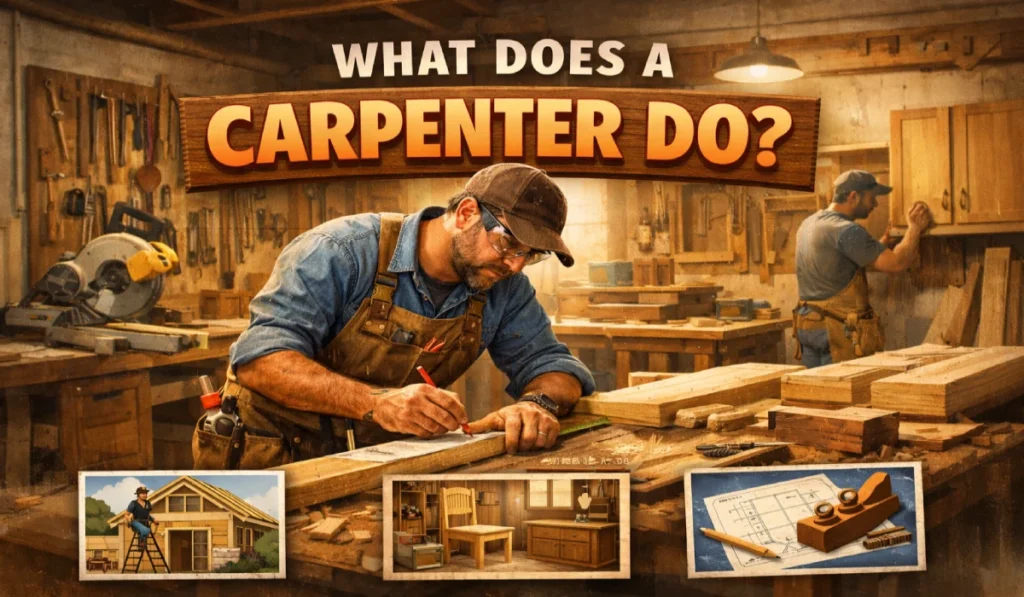
If you ask ten different people “what does a carpenter do,” you’re going to get ten different answers.
To the homeowner, we’re the guys fixing the squeaky deck or installing those new kitchen cabinets. But general contractors see us as the heartbeat of the jobsite—the first ones there to frame the walls and the last ones to hang the doors. From the sidewalk, a kid just knows us by our tool belts and loud saws.
But the reality? It’s a lot more than just cutting wood and banging nails.
I’ve spent years on jobsites across the U.S., from muddy foundations in the Pacific Northwest to high-end trim work in Manhattan high-rises. I can tell you firsthand that carpentry is one of the most versatile, physically demanding, and intellectually satisfying trades you can get into. It’s about geometry, physics, problem-solving, and grit.
In this guide, I’m going to pull back the curtain on the trade. We’ll look at the core duties, the different breeds of carpenters, the tools we live by, and what it really takes to make a living making sawdust.
The Core Definition: More Than Just Wood
At its simplest level, a carpenter constructs, repairs, and installs building frameworks and structures. While wood is our primary medium, modern carpenters also work with fiberglass, plastic, drywall, and lightweight steel.
But that textbook definition doesn’t capture the sweat of it. A carpenter is a builder of civilization. Look around the room you’re sitting in. The floor joists holding you up? Carpenter. The studs inside the drywall? Carpenter. The trim around the door? Carpenter. The formwork that held the concrete foundation while it cured? Carpenter.
Regardless of the specialty, every carpenter relies on a “Holy Trinity” of skills:
- Layout and Measuring: If you can’t measure, you can’t build. We live and die by the tape measure.
- Cutting and Shaping: Using power saws, chisels, and planes to force material into the right size.
- Joining: Fastening those pieces together so they don’t fall down when the wind blows.
The Daily Grind: Primary Duties and Responsibilities
So, what does a carpenter do on a Tuesday morning? It depends on the project, but here are the universal tasks that fill our days.
1. Blueprint Reading and Layout
Before a single board is cut, the job happens in the mind and on paper. We have to interpret blueprints, sketches, and building plans. We need to look at a 2D drawing and visualize the 3D structure. This involves serious math-geometry and trigonometry are used daily to calculate rafter angles, stair stringers, and wall layouts.
2. Sourcing and Selecting Materials
Not all wood is created equal. A good carpenter knows the difference between pressure-treated lumber for a deck and clear pine for a bookshelf. We calculate the footage needed (estimating), order the material, and check it for defects like bowing, cupping, or twisting when it arrives.
3. Cutting and Shaping
This is the loud part. We utilize a massive arsenal of tools-circular saws, miter saws, table saws, jigsaws-to cut materials to exact specifications. “Measure twice, cut once” isn’t just a saying; it’s an economic necessity. Lumber is expensive.
4. Installation and Assembly
This is where the physical labor kicks in. We are lifting heavy beams, nailing studs, screwing in cabinets, and leveling door frames. Everything has to be “plumb, level, and square.” If the framing isn’t square, the drywall won’t fit, the tile will look crooked, and the cabinets won’t close.
5. Code Compliance and Inspection
We don’t just build it to look good; we build it to be safe. Carpenters must know local building codes (like how far apart studs should be or what kind of fasteners to use for a hurricane tie). We constantly inspect our work to ensure it meets these legal and safety standards.
The Different Types of Carpenters
Here is where it gets interesting. “Carpenter” is an umbrella term. In the industry, we usually split into specific disciplines. Most of us can do a bit of everything, but pros usually specialize to get faster and make more money.
1. Rough Carpenters (The Framers)
These are the heavy lifters. Rough carpenters build the skeleton of the house or building. They work with structural lumber (2x4s, 2x6s, LVLs) and often work outdoors in all weather.
- What they do: Erect walls, floors, and roof systems.
- Key Skill: Speed and structural understanding. They need to frame a house fast so the other trades (electricians, plumbers) can get in.
- Vibe: High energy, heavy lifting, lots of framing hammers and nail guns.
2. Finish Carpenters (The Trimmers)
Once the drywall is up and painted, the finish carpenters come in. Their work is what you actually see.
- What they do: Install baseboards, crown molding, window casings, doors, and stairs.
- Key Skill: Precision and patience. A gap of 1/16th of an inch is a disaster in finish carpentry.
- Vibe: Clean clothes, precise tools, meticulous attention to detail.
3. Cabinetmakers (The Woodworkers)
These folks usually work in a shop rather than on a construction site. They build the furniture, cabinets, and shelving that get installed later.
- What they do: Cut, assemble, and finish fine cabinetry and furniture.
- Key Skill: Joinery (dovetails, mortise and tenon) and finishing (staining, lacquering).
- Vibe: Dusty shop, smell of varnish, high-end machinery.
4. Formwork Carpenters
These are specialized rough carpenters who build the molds (forms) for concrete.
- What they do: Build temporary structures out of wood and steel to hold wet concrete for foundations, bridges, and highways.
- Key Skill: Engineering knowledge. Wet concrete is incredibly heavy; if a form blows out, it can be deadly and cost thousands.
5. Shipwrights (Marine Carpenters)
Building on a boat is harder than building a house because nothing on a boat is straight.
- What they do: Repair and build structural and decorative elements on ships.
- Key Skill: Working with curves and water-resistant materials (teak, fiberglass).
6. Scenic Carpenters
These carpenters work in TV, film, and theater.
- What they do: Build sets that look like real buildings but are temporary and lightweight.
- Key Skill: Creativity and adaptability. You might have to build a saloon door one day and a spaceship console the next.
Tools of the Trade: What’s in the Bag?
You can’t do the job without the gear. While tools vary by specialty, every carpenter has a core set of equipment they wouldn’t be caught dead without.
The Essentials (Hand Tools)
- Tape Measure: The 25-foot tape is an extension of our arm. We also carry a “speed square” for quick 90 and 45-degree angles.
- Hammer: For a framer, it’s a heavy 22oz waffle-faced hammer. For a finish carpenter, it’s a smooth-faced 16oz hammer.
- Chisel: For cleaning out joints and installing hinges.
- Chalk Line: To snap long, straight layout lines on subfloors.
- Utility Knife: For sharpening pencils, cutting packaging, and scoring drywall.
- Cat’s Paw: A specialized nail puller for when you mess up (and you will mess up).
The Powerhouses (Power Tools)
- Circular Saw (The Skilsaw): The workhorse for cutting lumber.
- Miter Saw (Chop Saw): For making precise crosscuts and angles.
- Impact Driver/Drill: For driving screws. The impact driver has revolutionized the trade in the last 15 years-it has high torque and saves our wrists.
- Reciprocating Saw (Sawzall): Used mostly for demolition or cutting pipes and nails. It’s the “destroyer” tool.
- Laser Level: Modern layout relies on lasers to shoot level lines across a room instantly.
Skills You Can’t Buy at Home Depot
You can buy the best hammer in the world, but it won’t make you a carpenter. The real assets are intangible.
1. “The Eye”
A veteran carpenter can look at a wall and tell you if it’s out of plumb (leaning) without a level. We develop a visual acuity for straight lines and symmetry.
2. Jobsite Math
I’m not talking about calculus, but practical math. If I have a 12-foot wall and I need studs every 16 inches, how many studs do I need? If a roof rises 4 inches for every 12 inches of run, what is the length of the rafter? We do this math in our heads, on the fly, while standing on a ladder.
3. Physical Stamina
This is an athletic job. You are climbing ladders, carrying 80lb sheets of plywood, and kneeling on hard concrete all day. You need core strength, balance, and grip strength. It keeps you fit, but it wears on your joints over time.
4. Problem Solving
Construction never goes exactly to plan. The lumber might be warped, the foundation might be crooked, or the architect’s drawing might be physically impossible. A carpenter’s job is to figure out the workaround that is safe, sturdy, and looks good.
The Reality: Pros and Cons
I want to be real with you. Carpentry is romanticized, but it’s a hard gig. Here is the breakdown of the lifestyle.
The Pros
- Tangible Results: There is no feeling like driving past a house ten years later and telling your kid, “I built that roof.” You see the fruit of your labor every day.
- No Cubicle: If you hate sitting at a desk, this is the cure. You are moving, using your hands, and often working outside.
- High Demand: Good carpenters are scarce. If you show up on time, stay sober, and do good work, you will never be unemployed.
- Skill Independence: You can fix your own house. You save tens of thousands of dollars over a lifetime because you don’t need to hire people for repairs.
The Cons
- The Body Toll: Your back and knees will complain. Dust is bad for your lungs (wear a mask!). Vibration from tools can damage nerves. You have to take care of your body like an athlete does.
- The Weather: Framing in July heat is brutal. Framing in January snow is brutal. You work when the sun is up, regardless of the forecast.
- Tool Cost: Starting out can be expensive. A pro-grade set of bags and tools can run $500–$1,000, and you usually have to buy them yourself.
How to Become a Carpenter
If this sounds like the life for you, there are two main paths in the U.S.
Path 1: The Union Apprenticeship
This is often the “Gold Standard.” You join a rigorous program (like the United Brotherhood of Carpenters).
- How it works: You work during the day and get paid, then go to classes at night or on specific weeks.
- Benefit: You graduate with zero debt, a guaranteed wage scale, a pension, and high-level safety training.
Path 2: The Helper Route (Non-Union)
This is the “School of Hard Knocks.” You get hired by a local general contractor as a laborer or helper.
- How it works: You spend your first six months sweeping floors and moving lumber. If you show promise, they put a tape measure in your hand. You learn by watching and doing.
- Benefit: Faster entry. You can start tomorrow. You get a variety of residential experience that unions sometimes miss (like custom renovation work).
Trends in Carpentry: The Future of the Trade
You might think carpentry is “old school,” but it’s evolving fast. Here is what is happening in the industry right now:
- Sustainable Building: We are seeing a huge push for “Green Carpentry.” This means using sustainably harvested lumber, minimizing waste, and building super-insulated Passive House structures to reduce energy usage.
- Mass Timber: Steel and concrete are being replaced in some commercial buildings by Cross-Laminated Timber (CLT). We are building skyscrapers out of wood now. It’s lighter, captures carbon, and looks incredible.
- Prefab and Modular: More framing is being done in factories. Carpenters are assembling wall panels onsite rather than stick-framing one 2×4 at a time. It’s faster and reduces weather delays.
Conclusion
So, what does a carpenter do? We translate the abstract into the physical. We take a stack of raw, chaotic materials and impose order on them to create shelter, function, and beauty.
Whether you are a rough framer walking the top plates of a new development or a finish carpenter coping a delicate piece of crown molding, the pride is the same. It’s an honorable, essential trade that keeps the rain off our heads and the floors solid under our feet.
If you’re willing to learn, work hard, and invest in some good tools, carpentry isn’t just a job-it’s a craft that will serve you for a lifetime.
Frequently Asked Questions (FAQ)
1. Do I need to be good at math to be a carpenter?
You don’t need to be a mathematician, but you do need “construction math.” You need to be comfortable with fractions (adding 1/8 and 3/16 quickly), basic geometry (triangles/Pythagorean theorem), and reading a tape measure instantly. Most of this you learn on the job, but a solid foundation in high school math helps immensely.
2. What is the difference between a carpenter and a joiner?
In the U.S., the terms are often used interchangeably, but historically (and in the UK), there is a distinction. A joiner typically works in a workshop creating components (doors, windows, stairs) that are “joined” together. A carpenter typically works on-site installing those components and building the structural elements of the building.
3. Is carpentry a dangerous job?
It can be if you aren’t careful. According to OSHA, construction has higher injury rates than office jobs. The risks include falls, cuts from power saws, and hearing damage. However, modern safety standards are strict. If you follow safety protocols (PPE, fall protection, guard rails), you can have a long, injury-free career.
4. Can I make good money as a carpenter?
Yes. While entry-level helpers might start near minimum wage, skilled journeyman carpenters can make a very comfortable living, especially in unions or high-cost-of-living areas. Furthermore, many carpenters eventually become foremen, site superintendents, or start their own contracting businesses, where the income potential is significantly higher.
5. Do carpenters have to provide their own tools?
Generally, yes and no. Most employers expect you to have your own “hand tools” and “bags” (belt, hammer, tape, speed square, chalk line, screwdrivers). The employer usually provides the large power tools (table saws, chop saws, compressors) and consumables (blades, nails). However, as you advance, owning your own cordless drills and saws makes you more valuable and hireable.