
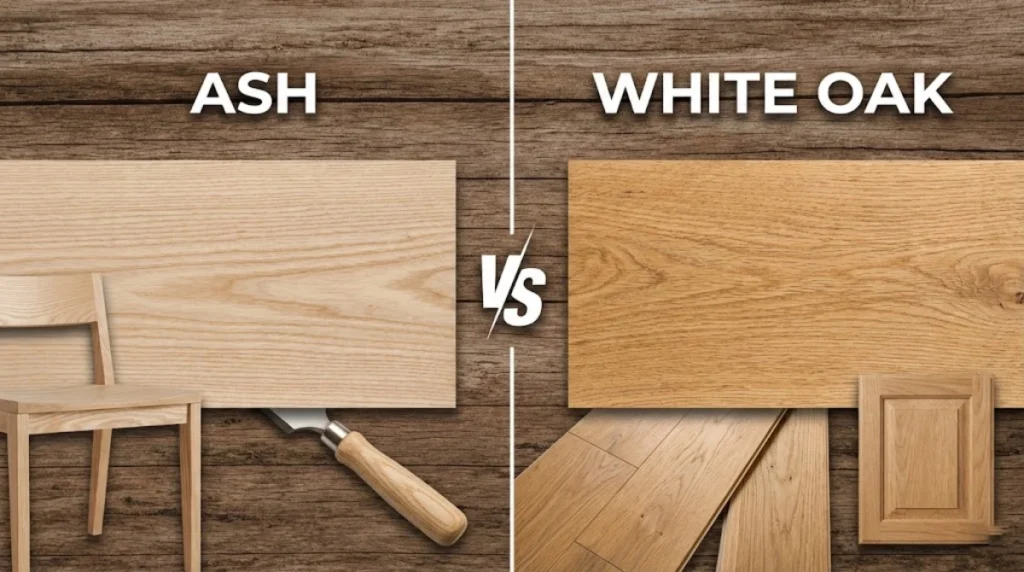
If you spend enough time around the lumber rack, you eventually run into the “Ash vs. White Oak” debate. To the untrained eye, a board of White Ash and a board of White Oak can look surprisingly similar-especially when they are rough sawn. They are both strong, light-colored domestic hardwoods that have been staples in American furniture making for centuries.
But once you get them on the workbench, run them through the planer, and start applying a finish, the differences become night and day.
I’ve built everything from dining tables to heirloom tool chests using both of these species. I’ve cursed at White Oak for dulling my blades and praised Ash for how effortlessly it bends. If you are trying to decide which species to load into your truck for your next project, you need to look past the price tag and understand how these woods behave in the real world.
In this guide, I’m going to break down the technical specs, the hands-on workability, and the aesthetic nuances of Ash versus White Oak so you can build with confidence.
The Tale of the Tape: Technical Specs
Before we start cutting joinery, let’s look at the raw numbers. As a woodworker, understanding the density and hardness of your material dictates everything from which saw blade to use to how the piece will hold up to a toddler with a toy hammer.
Janka Hardness
The Janka hardness test measures the resistance of a sample of wood to denting and wear. It measures the force required to embed an 11.28-millimeter (0.444 in) diameter steel ball halfway into a sample of wood.
- White Oak (Quercus alba): ~1,360 lbf
- White Ash (Fraxinus americana): ~1,320 lbf
The Takeaway: On paper, they are nearly identical in hardness. In the shop, however, White Oak feels significantly denser and heavier. While the numbers say they resist denting similarly, White Oak generally feels more solid underfoot if used for flooring, while Ash has a bit more “give” or elasticity.
Rot Resistance
This is where the two species diverge sharply.
- White Oak: Rated as very durable; frequently used in boatbuilding, tight cooperage (barrels), and outdoor furniture. The pores in the heartwood are plugged with organic matter called tyloses, which makes the wood nearly waterproof.
- White Ash: Rated as perishable to slightly durable. It is susceptible to bug attack and rot if left in the elements.
The Takeaway: If you are building an outdoor Adirondack chair or a front door that faces the rain, White Oak is the winner. Ash should remain strictly an indoor wood unless you plan on encasing it in a marine-grade epoxy.
Visual Appearance: Grain and Color
While technical stats matter, we usually pick wood because of how it looks. Both woods feature a ring-porous grain structure, meaning the growth rings are distinct and the texture is coarse. However, there are subtle cues that tell them apart.
White Oak: The King of Rays
White Oak typically ranges from a light tan to a pale yellow-brown. It is famous for its medullary rays—the ribbon-like cells that radiate from the center of the log.
When you quarter-saw White Oak, you reveal “flecks” or “tiger stripes.” This ray fleck is the hallmark of Arts and Crafts and Mission-style furniture. Even in flat-sawn boards, the grain of White Oak tends to look a bit “busier” and more organic because of these rays.
Ash: The Clean Contender
Ash is generally lighter than oak, ranging from a creamy white sapwood to a light grayish-brown heartwood. The grain pattern is usually straighter and less busy than oak. It lacks the visible medullary rays that oak possesses.
I often describe Ash as looking like Oak’s younger, modern cousin. It has that cathedral grain pattern (the arches you see on the face of a board), but it looks cleaner and more uniform.
Pro Tip: If you can’t tell a board apart, look at the end grain. If you see tiny lines (rays) longer than 3/4″ radiating from the center, it’s Oak. If you don’t see those rays, it’s likely Ash.
Workability: How They Behave in the Shop
This is the section that matters most to your tools. You can read charts all day, but how a board reacts to a chisel or a router bit is the real test.
Machining White Oak
White Oak is a joy to work with if your tools are sharp, but it can be punishing if they aren’t.
- Smell: It has a distinct, sweet smell when cut (some folks love it, some compare it to pickles or bourbon).
- Cutting: It cuts cleanly but is prone to burning if your feed rate is too slow, especially on the router table.
- Chipping: Because it is hard and brittle, you have to be careful about “blowout” or chipping when routing end grain. A backer board is mandatory.
- Gluing: It glues up well, but because it is so hard, it doesn’t compress much. Your joints need to be dead-on accurate.
Machining Ash
I personally love milling Ash. It machines incredibly well.
- Smell: It has a faint, sometimes slightly unpleasant scent when green, but is mostly odorless when dry.
- Cutting: It saws easily and doesn’t burn as quickly as Oak. It leaves a very crisp edge.
- Sanding: Ash sands quickly. You can get from 120 grit to 220 grit much faster on an Ash tabletop than a White Oak one.
- Splinters: Be warned—Ash splinters are nasty. They are needle-sharp and tend to dive deep. Always wear gloves when handling rough-sawn Ash.
Bending and Shock Resistance
Here is Ash’s superpower. Ash is arguably the best wood in North America for steam bending. It has long fibers that allow it to bend to extreme radii without snapping. This is why Ash is the standard for baseball bats, shovel handles, and curved chair parts (like the Windsor chair).
White Oak bends okay, but it is stiffer and more prone to snapping under sudden tension compared to the elasticity of Ash.
Finishing: Staining, Fuming, and Top Coats
The finishing room is where a project comes to life or dies a tragic death. These two woods react very differently to chemicals and pigments.
Staining
- Ash: This wood is a stain sponge in the best way possible. Because it is light-colored and has deep, open pores, it takes pigment very evenly. If you need to match a dark walnut or mahogany color using a cheaper domestic wood, Ash is your best candidate. It holds the color without getting “blotchy” like Maple or Pine.
- White Oak: It stains well, but the rays (those hard, shiny flakes) do not absorb stain. If you stain White Oak dark, the grain will darken, but the rays will remain light/golden. This creates a high-contrast look that highlights the grain structure. It’s beautiful, but it might not be the uniform look you want.
Ammonia Fuming
This is a technique unique to Oak. Because White Oak is high in tannins, you can expose it to ammonia fumes to naturally darken the wood to a rich, grayish-brown. This is how the classic Stickley furniture finishes were achieved.
Ash has very low tannin content. If you put Ash in a fuming tent, almost nothing will happen. If you want that gray, weathered look on Ash, you have to use a stain or a reactive graying agent.
The “Open Pore” Issue
Both woods are “open-pored.” If you want a glass-smooth dining table, you will need to fill the grain.
- You can use a grain filler (paste wood filler) before your topcoat.
- Alternatively, you can apply multiple coats of varnish or polyurethane, sanding back in between, until the pores are filled with the finish itself.
If you don’t fill the pores, you will feel the texture of the wood through the finish. For a rustic farmhouse table, this is desirable. For a formal writing desk, maybe not.
Cost and Availability: The Market Reality
Historically, Ash has always been the “Poor Man’s Oak.” It offered a similar look and durability for about 20-30% less money. However, the lumber market is shifting.
The Emerald Ash Borer (EAB)
We have to talk about the bug. The Emerald Ash Borer is an invasive beetle that is decimating Ash populations across North America. Because of this, millions of Ash trees are being harvested before they die.
- Short Term: There is currently a decent supply of Ash because so many trees are being cut down.
- Long Term: Ash prices are creeping up, and high-quality, wide boards are becoming harder to find. In some regions, Ash is now approaching the price of Red Oak.
White Oak Pricing
White Oak prices have skyrocketed in recent years. It is currently one of the most sought-after woods for flooring and cabinetry, creating a high demand that keeps prices high. Depending on where you live, White Oak can cost 2x more than Red Oak and significantly more than Ash.
Current Rough Estimates (Board Foot):
- 4/4 FAS White Ash: $4.00 – $7.00 / bd ft
- 4/4 FAS White Oak: $8.00 – $14.00 / bd ft
(Note: Prices vary wildly by region and milling, but White Oak is consistently the premium option.)
Best Uses: When to Choose Which
So, you’ve got the data, the visuals, and the price. Which one belongs in your project?
Choose White Oak If:
- You are building for the outdoors: Gates, outdoor benches, or front doors. The rot resistance is non-negotiable here.
- You want the “Heirloom” look: If you are building Arts and Crafts, Mission, or Stickley-style furniture, you need those ray flecks.
- You are doing flooring: White Oak is the gold standard for hardness and water resistance in flooring.
- You are coopering: Making a whiskey barrel? It has to be White Oak (to hold the liquid).
Choose Ash If:
- You are on a budget: You can get a very similar “oak-like” grain pattern for much less money.
- You are painting or staining dark: Since Ash lacks the distinct rays, it provides a great neutral canvas for paint or dark gel stains.
- You need shock resistance: Tool handles, baseball bats, or shop stools that will take a beating.
- You are bending wood: If your design calls for steam bending, Ash is the undisputed champion.
- You want a lighter, modern aesthetic: The creamy color of natural Ash with a clear water-based finish fits the “Scandi-modern” vibe perfectly.
Summary Comparison Table
| Feature | White Oak | White Ash |
| Scientific Name | Quercus alba | Fraxinus americana |
| Janka Hardness | 1,360 lbf | 1,320 lbf |
| Rot Resistance | Very High (Excellent for outdoors) | Low (Indoor use only) |
| Color | Light to medium brown, olive cast | Creamy white to light brown |
| Grain Pattern | Ray flecks present, “busier” look | Straight, cathedral grain, no rays |
| Workability | Hard, brittle, prone to chipping | Elastic, machines well, sands easily |
| Bending | Moderate | Excellent (Best in class) |
| Cost | High ($$$) | Moderate ($$) |
Frequently Asked Questions (FAQ)
Can I mix Ash and White Oak in the same project?
You can, but it’s tricky. If you leave them natural, the Ash will look much paler and creamier than the tan/brown Oak. If you stain them, the Ash will absorb more pigment than the Oak. It’s usually best to stick to one species per project unless you are going for a deliberate two-tone look.
Is Ash harder than Red Oak?
Yes, slightly. Ash (1320 Janka) is typically harder than Red Oak (1290 Janka), though they are very close. Ash is significantly harder than Walnut or Cherry.
Why is my Ash wood turning yellow?
Like many light woods (Maple, Pine), Ash will yellow over time when exposed to UV light. Using a water-based finish with UV inhibitors can slow this process down, whereas oil-based polyurethanes will add an amber hue immediately.
Which is better for a workbench top?
Both are excellent. White Oak adds mass, which is great for hand-tool woodworking (stops the bench from sliding). Ash is tough and resilient to pounding. I’d choose whichever is cheaper in your area, as a workbench top is a consumable surface.
Final Verdict From the Shop
I keep both of these species in my lumber rack, but I use them for very different things.
When I’m building a dining table that needs to survive a century of family dinners, or a front door that faces the elements, I bite the bullet and pay for the White Oak. The density, water resistance, and classic figure are worth the extra cost and the extra effort in machining.
However, for painted cabinetry, shop furniture, tool handles, or interior furniture where I plan to stain the piece a specific color, Ash is my go-to. It is easier on my saw blades, easier on my wallet, and once it’s finished, 99% of people will walk into the room and say, “Wow, nice Oak table!”
Ultimately, the wood doesn’t make the project; the craftsperson does. Both Ash and White Oak are premium hardwoods that, when treated with respect, yield beautiful results.